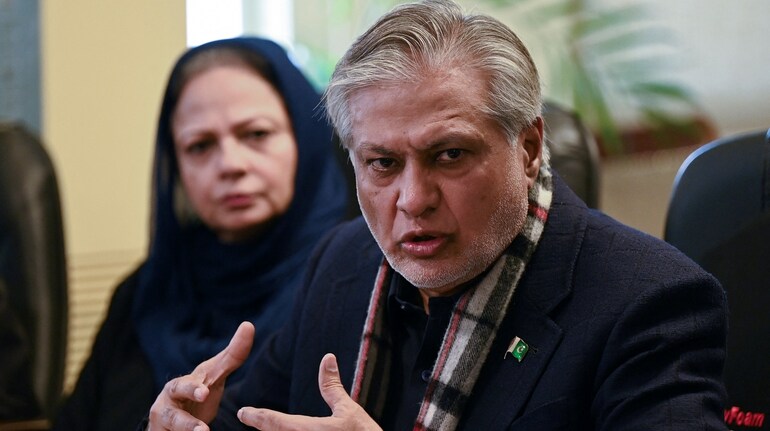
Just weeks after Pakistan Army Chief Field Marshal Asim Munir met with US President Donald Trump at the White House, the country’s foreign minister Ishaq Dar is set to meet US Secretary of State Marco Rubio, just days after Washington designated The Resistance Front – a Lashkar-e-Taiba proxy that claimed responsibility for Pahalgam terror attack - as a foreign terrorist organisation.
What makes this meeting particularly troubling is that Dar – far from being a technocrat simply seeking economic support – has openly defended TRF, even at the UN Security Council. Despite the US State Department designating TRF as a Foreign Terrorist Organisation (FTO) and a Specially Designated Global Terrorist (SDGT), Dar told the UN and Pakistan’s Parliament that Islamabad would not accept such condemnation. “I got calls from big capitals,” he said. “Pakistan will not accept.”
The meeting, occurring against this backdrop, exposes glaring contradictions in Washington’s anti-terror posture, and signals a potential thaw in US-Pakistan relations that could carry serious consequences for India.
Whitewashing of terror?
At a time when Pakistan should be facing global isolation for harbouring and defending terror groups, its top military and civilian leaders are instead on a charm offensive. Field Marshal Munir’s high-profile meeting with President Trump last month was a telling signal. Despite Pakistan’s deep-rooted support for anti-India terror outfits like Lashkar-e-Taiba and Jaish-e-Mohammed, the US appears to be warming up once again to Islamabad under the pretext of regional "stability."
The concern for India is that this renewed US-Pakistan proximity could dilute international pressure on Islamabad to dismantle its terror infrastructure. The timing could not be worse. After the Pahalgam attack, India had gained significant global sympathy and backing, with even the United Nations Security Council acknowledging the need to hold the perpetrators and sponsors accountable. Yet now, the very country that once bombed Osama bin Laden on Pakistani soil is entertaining meetings with those who refuse to denounce a group that slaughtered Indian civilians.
Who is Ishaq Dar and why his visit matters
Ishaq Dar is no ordinary foreign minister. A long-time Nawaz Sharif loyalist, Dar is seen as a key figure in facilitating Pakistan’s international lobbying. His repeated attempts to link Pakistan’s economic woes to “India’s aggression” and his statements legitimising the TRF make his Washington visit highly problematic.
Far from being a neutral technocrat seeking IMF deals, Dar represents the face of a regime that simultaneously pleads for economic aid while offering political and moral support to known terror groups.
Pakistan playing both US and China
Dar’s meeting with Rubio is not an isolated event. It is part of a larger diplomatic push by Pakistan to position itself as a balancing power between Washington and Beijing. While Dar is knocking on the doors of the US State Department, Pakistan’s Army Chief has simultaneously courted Chinese Foreign Minister Wang Yi. The twin-track diplomacy aims to maximise aid, arms, and legitimacy from both superpowers, without addressing the root issues of terrorism and internal radicalism.
By attempting to play both sides, Pakistan hopes to revive its old Cold War-era role of being “indispensable” to the West’s security calculus. This not only undermines India’s fight against cross-border terrorism but also threatens to legitimise Pakistan’s state-backed narrative on Kashmir -- one that continues to export terror under the guise of “freedom struggle.”
Why India must stay vigilant
India has rightly maintained its position of rejecting any third-party mediation on Kashmir. But given the sudden diplomatic activity between Pakistan and the US, New Delhi must prepare for renewed pressure to “de-escalate”, even as Pakistan continues to shield and support the very actors who orchestrated the Pahalgam carnage.
This is not just about Ishaq Dar’s visit or a photo-op with Munir. It’s a broader pattern of the US softening its approach to Pakistan at a time when clarity is needed the most. A country that cannot even condemn a terror group responsible for mass civilian deaths should not be rewarded with diplomatic legitimacy or financial bailouts.
India must use every platform -- bilateral, multilateral, and strategic -- to expose Pakistan’s duplicity and warn its allies in Washington: engaging Pakistan without accountability risks undermining the very principles of the global war on terror.
Discover the latest Business News, Sensex, and Nifty updates. Obtain Personal Finance insights, tax queries, and expert opinions on Moneycontrol or download the Moneycontrol App to stay updated!
Find the best of Al News in one place, specially curated for you every weekend.
Stay on top of the latest tech trends and biggest startup news.