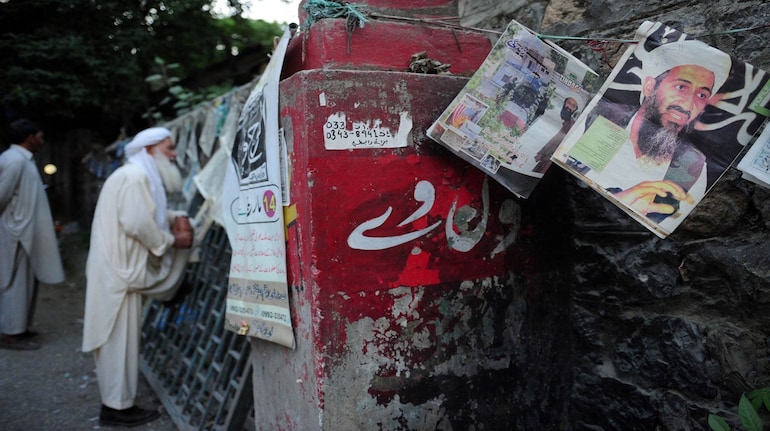
Fourteen years after US Navy SEALs killed Osama bin Laden in a late-night assault on his Abbottabad hideout, a new memoir has revisited how Pakistan’s leadership reacted with shock, confusion, and paralysis as the world discovered the Al-Qaeda chief had been living in the shadow of the country’s military.
On May 2, 2011, the 40-minute operation ended a decade-long manhunt.
Erstwhile US President Barack Obama, on May 2, had announced that US special forces had killed Osama bin Laden, the architect of the September 11, 2001 attacks and the world’s most wanted fugitive.
The operation ended nearly a decade-long hunt for the al-Qaeda leader, whose network had carried out the deadliest terrorist strike in American history. The assault took place not in the rugged tribal belt along the Afghan border, where many believed bin Laden had been hiding, but in Abbottabad, a garrison town just an hour’s drive from Pakistan’s capital, Islamabad.
For Islamabad, the raid triggered something deeper; it was like a complete shake-up, triggering an institutional crisis that exposed the political infighting, undermined its intelligence agencies, and left Pakistani leaders scrambling for a narrative.
In his book The Zardari Presidency: Now It Must Be Told, veteran politician and journalist Farhatullah Babar devotes nearly 50 pages to the fallout. Babar, who served as spokesperson to then-President Asif Ali Zardari, recounts an atmosphere of disbelief and embarrassment in the corridors of power.
Even as SEAL helicopters hovered over Abbottabad, Pakistan’s ruling coalition was busy wrangling over cabinet posts between the PPP and PML-Q, Babar mentions in his book.
Hours later, an emergency meeting at the presidency brought together Zardari, Foreign Minister Hina Rabbani Khar, Foreign Secretary Salman Bashir, and Babar.
Pressed for an honest assessment, Babar reportedly told Zardari bluntly -- the raid reflected either “complicity or sheer incompetence.” He urged immediate accountability at the highest levels of the Army and ISI.
Bin Laden was discovered in a sprawling walled compound, located only a few hundred meters from Pakistan’s military academy. The house stood out in the neighborhood -- it was nearly eight times the size of surrounding homes, had 18-foot-high walls topped with barbed wire, and conspicuously lacked phone lines or internet access.
Late on the night of May 2, a team of US Navy SEALs stormed the property. According to American officials, bin Laden “resisted the assault force” during an intense firefight and was shot dead inside the compound. Several others were also killed in the raid, which lasted about 40 minutes.
Following the operation, Pakistan’s leadership quickly found itself trapped in a limbo.
Admitting cooperation with Washington would mean confessing duplicity; admitting ignorance would mean acknowledging weakness. For 14 hours, officials remained silent before issuing a vague statement crediting “intelligence sharing” with the US, a claim Babar, however, calls hollow.
The journalist recalls pushing for an intelligence overhaul following the fallout.
Instead, Zardari rejected the idea of punishing individuals, insisting inquiry commissions were meant only to recommend reforms. He even confided that a “friendly country” had advised against taking action against the generals.
The result, Babar writes, was paralysis -- “No investigations, no accountability, no restructuring. Civilian leaders got cold feet, the military defended its pride, and foreign capitals preferred the status quo.”
Pakistan’s Foreign Office was left firefighting the diplomatic mess.
Within weeks, US officials, including Secretary of State Hillary Clinton and Senator John Kerry, landed in Islamabad. Pakistani leaders sought guarantees that Abbottabad would not set a precedent for unilateral strikes.
Washington gave none.
The memoir also points to the depth of US intelligence penetration inside Pakistan, from tracking the contractor who built bin Laden’s compound to maintaining safe houses across the country.
In fact, after Clinton’s visit, Babar notes, US officers were even allowed to interrogate bin Laden’s widows in Pakistani custody.
For Babar, the raid was Pakistan’s gravest humiliation since independence. Yet rather than seize the moment to reform its intelligence agencies, the civilian and military leadership alike chose face-saving over accountability.
“The web of lies had been laid bare,” he concludes. “But instead of confronting it, Pakistan’s rulers let the opportunity slip, leaving unanswered how the world’s most wanted man managed to hide for nearly a decade in the heart of a garrison town.”
Bin Laden’s death came almost 10 years after the September 11 attacks in 2001, when 19 al-Qaeda operatives hijacked four commercial airliners. Two were flown into New York’s World Trade Center towers, a third struck the Pentagon, and the fourth, United Airlines Flight 93, crashed in Pennsylvania after passengers attempted to overpower the hijackers. Nearly 3,000 people were killed that day.
Discover the latest Business News, Sensex, and Nifty updates. Obtain Personal Finance insights, tax queries, and expert opinions on Moneycontrol or download the Moneycontrol App to stay updated!
Find the best of Al News in one place, specially curated for you every weekend.
Stay on top of the latest tech trends and biggest startup news.