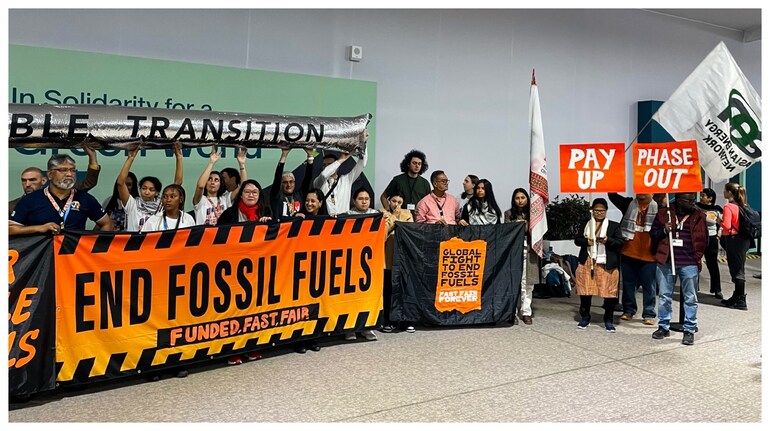
Ten years after world leaders signed the Paris Agreement in a moment of shared urgency, the hopes of turning a historic consensus into sustained climate action are facing a powerful headwind: a resurgence of climate denial fuelled by shifting politics, deep-pocketed lobbying and a tidal wave of online disinformation, the New York Times reported.
At the close of this year’s United Nations climate summit in Belém, Brazil, campaigners and researchers warned that the information battle over climate science has tilted sharply. While the scientific evidence has only grown stronger, the political resistance has become more organised, more visible and more effective at blunting momentum.
A decade of progress meets a revived opposition
The belief that climate denial had faded after 2015 now appears misplaced. Fossil-fuel industries continue to publicly question and privately lobby against policies that restrict oil, gas and coal use, often echoing arguments pushed by governments with large energy interests. Under the Trump administration, the United States has again aligned with Russia and Saudi Arabia in resisting references to fossil fuels in global negotiations.
That resistance was evident in the summit’s final declaration, which avoided using the term “fossil fuels” altogether—an omission that enraged environmental groups and surprised several delegations. Despite Brazil’s early rhetoric calling out misinformation and “algorithm-driven polarisation,” the talks struggled to reach even voluntary consensus on the need for an eventual phaseout of fossil fuels.
Disinformation becomes central to climate politics
With rising global temperatures and record-breaking disasters, the movement to curb emissions expected broader public clarity. Instead, disinformation has expanded across social media, podcasts and alternative news networks. Climate scepticism—once confined to fringe corners—now travels through mainstream channels, amplified by influencers with massive followings and politicians who frame climate action as elitist, threatening and economically destabilising.
Researchers say this shift has been building for years. Sophisticated campaigns by lobby groups have crafted messaging designed to undermine trust in climate science while portraying activists and scientists as irrational or alarmist. The effect is clear: public debates now feature narratives that dismiss clean energy as a “scam,” exaggerate the drawbacks of renewables or suggest that global warming itself is exaggerated or fabricated.
This year’s summit marked the first time climate disinformation was formally put on the agenda. Twenty-one countries signed a new declaration urging governments to address false information and protect scientists and journalists who face harassment. Yet beyond this symbolic step, there is little agreement on how countries can counter coordinated efforts that operate across borders and platforms.
Oil interests reshape the conversation
The presence of fossil-fuel representatives at UN summits has grown dramatically. In Belém, an estimated 1,600 delegates were linked directly to oil, gas or coal interests—significantly outnumbering delegations from several vulnerable countries. Critics argue that this influence has translated into watered-down language, stalled deadlines and declarations that speak vaguely about transition without committing to timelines.
Meanwhile, oil-producing countries continue to push for expanded exploration. Even Brazil, the host country, recently granted licences for offshore drilling near the mouth of the Amazon River, a decision that undercut its own calls for climate responsibility.
Social media platforms retreat from fact-checking
Climate denial is also benefiting from the retreat of social platforms from earlier fact-checking efforts. Facebook has relaxed restrictions on political content. YouTube’s enforcement of monetisation bans related to climate misinformation is inconsistent. As a result, misleading claims move faster and travel farther than scientific corrections, often becoming part of political messaging before platforms can intervene.
Even isolated incidents, such as a short-circuit fire at the summit venue, quickly morph into fuel for misinformation cycles. Within hours, climate-sceptic blogs falsely linked the fire to clean-tech batteries—a claim widely shared before officials clarified the actual cause.
A movement battling for narrative control
For climate advocates, the challenge is not only policy but persuasion. Many now argue that they underestimated the scale and sophistication of climate denial, assuming the science would speak for itself. Instead, a persistent barrage of misinformation has shaped perceptions, influenced elections and created hesitation among governments expected to lead the transition.
The Paris Agreement promised a decade of accelerating ambition. Instead, its tenth anniversary is marked by rising emissions, rising scepticism and rising uncertainty over whether the world can still agree on the basic facts required to act. The science remains clear, but the narrative around it is increasingly contested—leaving the climate movement fighting not just for policy, but for public trust itself.
Discover the latest Business News, Sensex, and Nifty updates. Obtain Personal Finance insights, tax queries, and expert opinions on Moneycontrol or download the Moneycontrol App to stay updated!
Find the best of Al News in one place, specially curated for you every weekend.
Stay on top of the latest tech trends and biggest startup news.