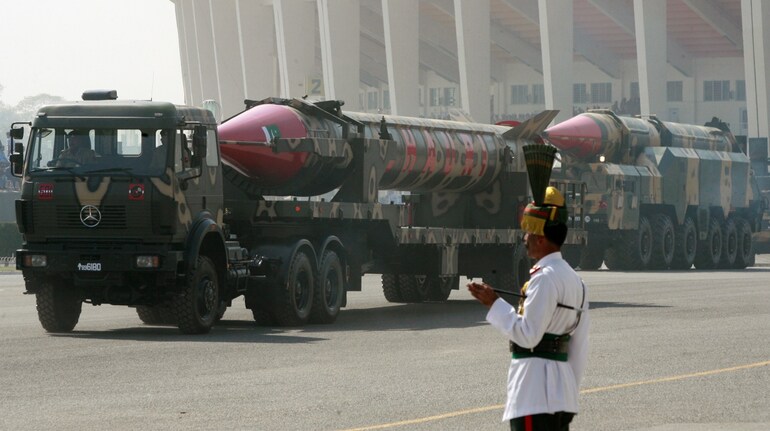
The Ministry of External Affairs (MEA) on Friday responded to US President Donald Trump’s recent remarks that Pakistan has restarted nuclear testing, stating that such actions align with Islamabad’s long record of covert and unlawful proliferation.
“Clandestine and illegal nuclear activities are in keeping with Pakistan’s history, that is centered around decades of smuggling, export control violations, secret partnerships, AQ Khan network and further proliferation," MEA spokesperson Randhir Jaiswal said during the weekly press briefing.
“India has always drawn the attention of the international community to these aspects of Pakistan’s record. In this backdrop, we have taken note of President Trump’s comment about Pakistan’s nuclear testing," he added.
Trump’s latest remarks on Pakistan’s alleged nuclear testing have reignited concerns about global security and the potential return of a Cold War-style arms race. His comments came shortly after he ordered the Department of War to resume US nuclear testing, a move that has not been seen in decades and has raised fears of escalating nuclear competition with Russia and China.
Trump justified his decision by claiming that countries such as Pakistan and North Korea were also advancing their nuclear testing programmes. In his interview on CBS’s 60 Minutes, the President said, “Russia’s testing and China’s testing, but they don’t talk about it… Certainly North Korea’s been testing. Pakistan’s been testing.” He also repeated his earlier assertion that both India and Pakistan had been “on the verge of a nuclear war” earlier this year, which he claimed to have averted.
In response, a senior Pakistani official told CBS News that the country “will not be the first to resume nuclear tests,” adding, “Pakistan was not the first to carry out nuclear tests and will not be the first to resume nuclear tests.”
Pakistan first entered the nuclear club in May 1998, conducting a series of underground tests at Chagai Hills in Balochistan, code-named Chagai-I. The tests were built on the expertise of Dr Abdul Qadeer Khan, a metallurgist who infamously stole nuclear technology from Europe and later ran an international proliferation network supplying nuclear know-how to countries like Iran and North Korea.
According to the Stockholm International Peace Research Institute’s (SIPRI) Yearbook 2025, Pakistan now possesses an estimated 170 nuclear warheads. The report also notes that the country continues to develop new missile delivery systems and produce fissile material, highlighting an ongoing expansion of its arsenal without transparency or credible oversight mechanisms.
India, in contrast, has adhered to a far more responsible and transparent nuclear policy. After conducting its first test in 1974 and the Pokhran-II series in 1998, India has maintained a doctrine of “credible minimum deterrence” and a declared no-first-use policy. Unlike Pakistan, India has voluntarily refrained from further nuclear testing, reinforcing its commitment to strategic restraint and regional stability.
Both India and Pakistan remain outside the Comprehensive Nuclear-Test-Ban Treaty (CTBT), but the contrast between New Delhi’s restraint and Islamabad’s secretive expansion underscores the fundamental difference in their nuclear postures -- one rooted in deterrence, the other in duplicity.
Discover the latest Business News, Sensex, and Nifty updates. Obtain Personal Finance insights, tax queries, and expert opinions on Moneycontrol or download the Moneycontrol App to stay updated!
Find the best of Al News in one place, specially curated for you every weekend.
Stay on top of the latest tech trends and biggest startup news.