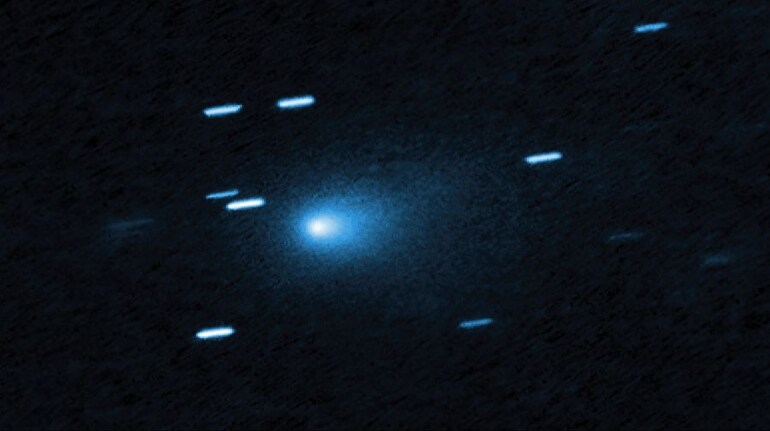
A new set of images from China’s Tianwen-1 spacecraft has become the latest twist in the growing fascination with 3I/ATLAS, the interstellar object that has puzzled scientists since its discovery. The orbiter, circling Mars since 2021, managed to photograph the faint, fast-moving comet even as NASA has held back its own high-resolution image, prompting fresh debate about transparency and scientific access, according to an article in the New York Post.
How Tianwen-1 captured a nearly invisible target
The China National Space Administration said the probe’s high-resolution camera pulled off a difficult feat: imaging a target 10,000 to 100,000 times dimmer than the Martian surface it was designed to photograph. Engineers had to re-plan the camera’s pointing, exposure cycles and tracking strategy to lock onto the comet during a narrow observation window from October 1 to 4. The result was an animated GIF showing ATLAS streaking past Mars, along with a clearer still image taken on October 3.
Why ATLAS is drawing global attention
3I/ATLAS is only the third confirmed interstellar object to enter our solar system, following ‘Oumuamua and comet Borisov. Its unusual behaviour, shifting colours and non-gravitational acceleration have led some researchers, notably Harvard astrophysicist Avi Loeb, to question whether it behaves like a standard comet at all. NASA last week recorded an unexpected acceleration, and earlier observations noted that its glow appeared “bluer than the sun,” fuelling theories that range from exotic chemistry to speculative claims of artificial propulsion.
Pressure grows on NASA to release its image
NASA’s Mars Reconnaissance Orbiter reportedly captured a HiRISE camera photo of ATLAS on October 2, but the agency has not released it. Representative Anna Paulina Luna publicly urged NASA’s acting administrator to share the unreleased data, arguing that the information could help scientists worldwide understand an object unlike any previously observed. Loeb praised Luna’s push, saying withholding data slows scientific progress on a once-in-a-generation event.
A space-race to document an interstellar visitor
As ATLAS moved behind the sun in September and disappeared from Earth-based telescopes, the task of capturing it fell to deep-space probes. Europe’s Mars Express and the ExoMars Trace Gas Orbiter have both photographed the object in recent weeks, each adding clues to its trajectory and composition. With Tianwen-1’s new images now public, researchers have fresh material to analyse the comet’s coma, nucleus and highly unusual motion.
What scientists hope to learn next
CNSA says teams are now conducting deeper analysis using Tianwen-1’s data to refine estimates of the comet’s size, behaviour and origin. As ATLAS becomes visible from Earth again later this month, astronomers anticipate a new wave of observations—and renewed pressure on NASA to release what it knows. For now, it’s China’s probe, not America’s, that has given the world its clearest look at an object that may hold answers far beyond our solar system.
Discover the latest Business News, Sensex, and Nifty updates. Obtain Personal Finance insights, tax queries, and expert opinions on Moneycontrol or download the Moneycontrol App to stay updated!
Find the best of Al News in one place, specially curated for you every weekend.
Stay on top of the latest tech trends and biggest startup news.