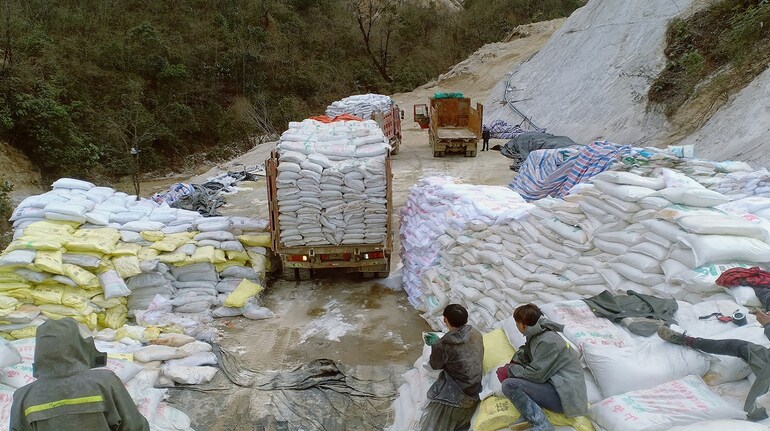
Rebel-controlled areas in Myanmar’s Kachin state have emerged as hubs for unregulated rare earth mining, fuelling global supply chains for electric vehicles and wind turbines, while giving Beijing leverage in trade diplomacy, The Economic Times reported.
A March study conducted by the Institute for Strategy and Policy (ISP) in Myanmar, based at Chiang Mai University in Thailand, revealed that over 240 rare earth sites, two-thirds of the country’s total, were established within just four years following the 2021 military coup.
During this time, China imported approximately 170,000 tons of rare earths from Myanmar, which is equivalent to the weight of 23 Eiffel Towers.
Beijing’s dominance in rare earth magnets through Myanmar’s mines and its own refining capacity came under strain in October 2023, when the Kachin Independence Organisation (KIO) seized control of several mining hubs from pro-China militias. The standoff ended in April 2024 after Chinese firms reportedly agreed to pay a levy of 35,000 yuan ($4,900) per ton to the KIO, according to Reuters. A KIO spokesperson, however, denied knowledge of such payments.
The Kachin Independence Army (KIA), the KIO’s armed wing, is known for its battlefield presence but remains dependent on Chinese supplies for fuel, food and medicines, Swedish author Bertil Lintner told ET. “The KIA doesn’t like to deal with the Chinese, but has no choice,” he said, adding that despite pressure from Beijing, the group has occasionally acted independently.
Lintner also dismissed speculation that India or the US could source minerals directly from the Kachin mines. “The mines are located on the Chinese border… transporting minerals to India would be extremely difficult, and the Chinese would do everything they can to prevent that,” he said.
On September 10, Reuters reported that India’s Ministry of Mines instructed both state-owned and private firms to collect rare earth samples from areas controlled by KIA, with the insurgent group agreeing to assess the feasibility of bulk exports.
Meanwhile, China continues to engage not only with Myanmar’s military junta but also with non-state armed actors that control large tracts of territory, including rare earth concessions.
A research paper by Patrick Meehan and Mandy Sadan from the UK, along with Dan Seng Lawn of the Kachinland Research Centre, said that Chinese companies frequently establish secret agreements with militant groups in exchange for mining rights.
UK-based non-profit Global Witness has warned that China’s outsourcing of rare earth extraction to Myanmar has come at a “terrible cost to the environment and local communities.”
Its 2022 investigation, followed up in 2024, described mining practices that have “ravaged landscapes and poisoned waterways,” underscoring the social and ecological toll of the global green energy transition.
Discover the latest Business News, Sensex, and Nifty updates. Obtain Personal Finance insights, tax queries, and expert opinions on Moneycontrol or download the Moneycontrol App to stay updated!





Find the best of Al News in one place, specially curated for you every weekend.
Stay on top of the latest tech trends and biggest startup news.