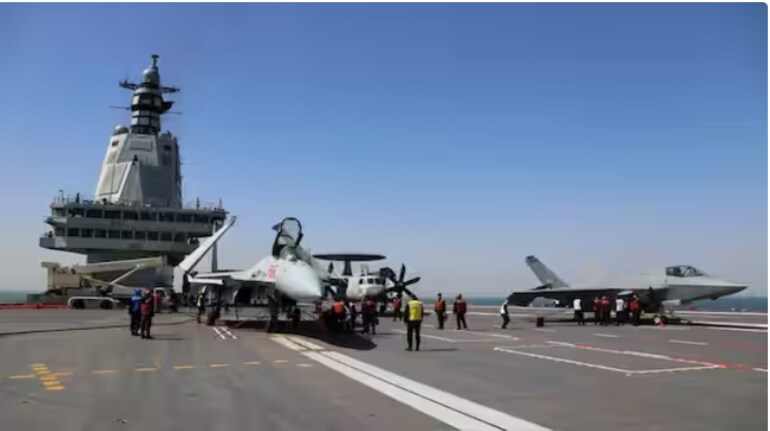
China has commissioned the Fujian, its third aircraft carrier and the first to be both developed and built domestically. Overseen by Xi Jinping in Hainan, the ship uses three electromagnetic catapults—akin to the US Gerald R. Ford class—replacing the ski-jump ramps on China’s first two carriers. Unlike the Ford, however, Fujian uses conventional propulsion, a choice that could limit its range, the Financial Times reported.
A fleet that signals long-range ambition
Beijing is already building a fourth carrier and, according to PLA-linked textbooks and academic writings, plans more. The party’s aim is a cutting-edge military that rivals US forces, asserting dominance in its “near abroad” while projecting power to protect expanding global economic interests. Xi has set milestones to fully modernise the PLA by 2035 and make it a “world-class” force by 2049.
The regional disputes driving the build-up
China claims sovereignty over self-ruled Taiwan and vows to bring it under its control, by force if necessary. It also claims the South China Sea in its entirety—clashing with south-east Asian claimants and international law—and disputes a group of islets with Japan. Because the US keeps deliberate ambiguity over defending Taiwan, PLA training for a Taiwan conflict includes preparing to counter US forces in the Pacific.
Carriers are vulnerable—but still central to China’s message
Modern systems—drone swarms and ship-killing missiles—have made carriers more vulnerable and eroded their once-central role in US power projection. Beijing nonetheless sees carriers as symbols of comprehensive national strength and as tools to deny uncontested US dominance in the western Pacific’s waters and airspace.
A fast-learning navy
China’s carrier programme has accelerated. The Liaoning, purchased as an unfinished Soviet hull in 1998, was commissioned in 2012. The Shandong, a domestic build based on Liaoning’s design, entered service in late 2019. In July, the PLA operated two carriers simultaneously outside the first island chain from Japan through Taiwan to the Philippines, and, for the first time, sailed a carrier beyond the second island chain toward the Northern Marianas, Guam and Palau—bringing Chinese air wings closer to key US bases in Guam and Hawaii.
Still behind the US, but closing gaps in operations
The PLA remains far behind the US Navy in carrier operations. Even so, the pace of fighter takeoffs from Chinese carriers has increased quickly in recent years, reflecting improving shipbuilding, flight operations and blue-water experience. Fujian’s commissioning marks the next step in a campaign designed to expand reach, complicate US planning and signal that China intends to contest influence across the Indo-Pacific.
Discover the latest Business News, Sensex, and Nifty updates. Obtain Personal Finance insights, tax queries, and expert opinions on Moneycontrol or download the Moneycontrol App to stay updated!





Find the best of Al News in one place, specially curated for you every weekend.
Stay on top of the latest tech trends and biggest startup news.