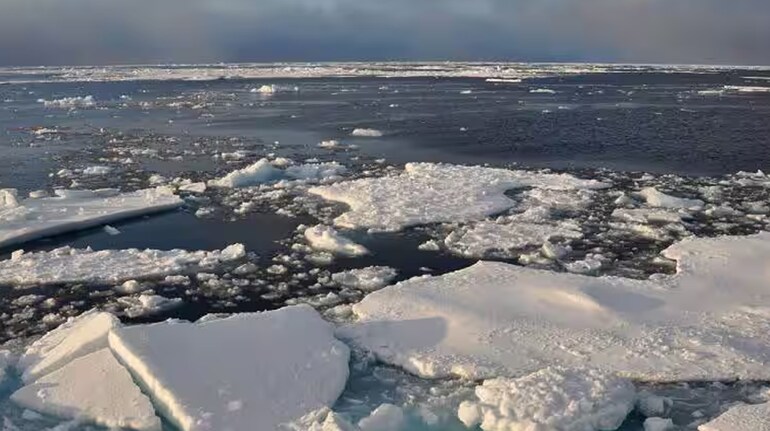
In late September, a Chinese shipping container called the Istanbul Bridge departed from Ningbo-Zhoushan port carrying run-of-the-mill freight from batteries to blouses. Instead of taking the conventional southern path to the Suez Canal, it headed north into the icy waters of the Arctic Ocean. It's sailing on the Northern Sea Route, a treacherous shipping route that follows Russia's northern shore and opens into Europe. The trip, billed as the launch of the inaugural China-Europe Arctic Express route, is all part of Beijing's plans to build a "Polar Silk Road." It also illustrates how climate change isn't just reshaping ecosystems but is actually redrawing global trade maps, CNN reported.
The Arctic is warming at a rate close to four times higher than the rest of the world. Large stretches of sea ice that long ago froze ships solid year-round now break and thaw in summer and early autumn, permitting brief windows of navigability. China, peering into the decades ahead with dreams of an ice-free Arctic, has already begun testing commercial sailings that once were the prerogative of icebreakers and scientific missions.
The enticement of velocity and protection
The Northern Sea Route has one undeniable advantage: speed. By shortening nearly by half the Suez Canal journey, the Arctic route minimizes travel time from China to northern Europe by a mere 18 days. To those businesses that rely on rapid delivery, especially during high shipping season like Christmas, this shortening matters.
Beyond speed, the Arctic route also provides a way of circumventing traditional choke points. Commercial ship attacks by Houthi rebels in the Red Sea have disrupted shipping to Suez since 2023. The Panama Canal, another vital artery, has struggled with low water levels due to severe drought. The Arctic, however, is an open road—at least on paper.
Chinese officials have also claimed that the shorter distance reduces greenhouse gas emissions by nearly 50 percent. For a shipping industry under increasing scrutiny to decarbonize, that figure is attractive. Yet environmental experts argue that the supposed climate benefit is misleading, given the high ecological risks involved.
The dangers of Arctic shipping
All its promise aside, the Arctic is nonetheless a very risky destination. Far from the image of unlimited open blue water, melting ice can make navigation unreliable. Ice floes shift spontaneously, fog obscures vision, and extended Arctic nights subject ships to darkness for months. Any spill in such a remote location is difficult to contain. Oil spill response infrastructure is non-existent, and cold waters ensure the pollutant persists longer.
If ships employ heavy fuel oil—a ubiquitous, less expensive option—the implications of a spill would be specifically devastating. Tar-like and heavy, the oil emulsifies and spreads over ice and coastlines, resisting cleanup efforts. Heavy fuel oil also releases black carbon when burned, a pollution particle that settles on ice, darkens its surface, and accelerates melting. While regulations banning heavy fuel oil in the Arctic have been tabled, loopholes and transition exemptions guarantee its use continues.
Marine environments are also facing other threats. Noise from shipping disturbs whales and other Arctic species, and ship strikes on whales increase as traffic does. Conservationists state that what seems like a modest growth in shipping today could be an environmental tipping point if the route is extended.
Geopolitical stakes and Chinese ambitions
China's interest in the Northern Sea Route is not solely commercial. Possessing a secure Arctic route increases Beijing's influence on global commerce and re-establishes it as a polar power. Western shipping giants like Mediterranean Shipping Company have thus far refrained from using the route due to the risk of environmental damage and safety hazards. That opens a window of opportunity for China to build experience and take the lead as rivals hesitate.
The partnership with Russia is central to this project. Russian icebreakers are escorting vessels, and Moscow has long promoted the Northern Sea Route as a flagship element of its economic policy. The partnership offers China both practical backing and geopolitical heft in an otherwise Western-dominated region.
Nevertheless, the future of the route is in doubt. Last year, only around 90 vessels navigated the Northern Sea Route compared with over 13,000 via the Suez Canal. A single catastrophic accident—be it oil spill, human life, or wrecked ship—can halt progress overnight. On the other hand, extended volatility in the Red Sea or South China Sea would shift calculations in favour of the Arctic.
The road less travelled
The Northern Sea Route contains within it promise and peril. It offers, on the one hand, lower shipping time, protection from global chokepoints, and a prized geopolitical asset for China. But it also contains enormous risks to the fragile Arctic ecosystem and to the safety of crews operating in one of the most hostile environments on earth.
As global warming speeds up, what was previously written off as impossible is now technologically possible. The question is whether the planet is prepared to pay the environmental cost of quicker commerce. For China, the wager is one of strategic aspiration as well as the willingness to be in places others still view as off-limits. Whether this Arctic gamble pays dividends—or results in catastrophe—has yet to be determined.
Discover the latest Business News, Sensex, and Nifty updates. Obtain Personal Finance insights, tax queries, and expert opinions on Moneycontrol or download the Moneycontrol App to stay updated!
Find the best of Al News in one place, specially curated for you every weekend.
Stay on top of the latest tech trends and biggest startup news.