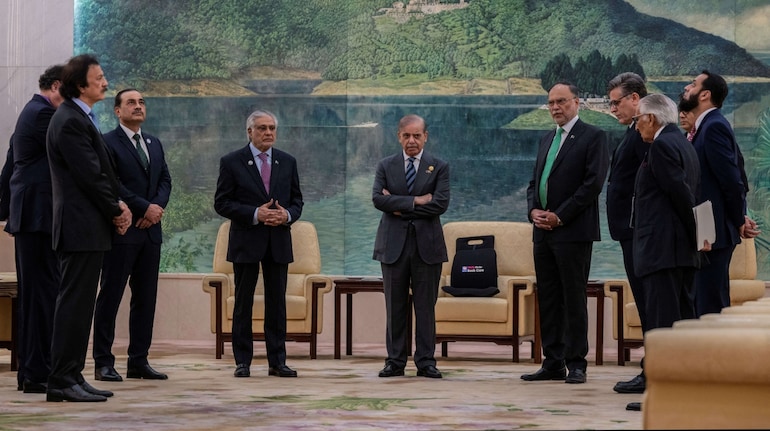
China has set tough new conditions for Pakistan before moving ahead with the next phase of the China-Pakistan Economic Corridor (CPEC), CNN-News18 has learned from top military sources.
According to the sources, Beijing has made it clear during high-level meetings in the Chinese capital from September 2 to 4 that Phase-2 of CPEC will only proceed if Pakistan guarantees credible security for Chinese citizens and assets. Repeated terror attacks on CPEC-linked projects have raised major concerns, and China is now pushing Islamabad to show how it plans to protect workers, investments, and infrastructure.
“Chinese authorities have reservations over the rising US influence and interests in Pakistan, and they want clarity before committing deeper into CPEC expansion,” sources told CNN-News18. The warning reflects Beijing’s unease about Washington’s growing diplomatic and economic presence in Pakistan, which risks undercutting Chinese influence.
At the same time, China is pushing for control over Pakistan’s rare earth mineral reserves. Sources told CNN-News18 that talks are underway on mining rights and revenue-sharing, with Beijing determined to secure a long-term grip on the sector. “From rare earth minerals to the new security roadmap, Beijing has laid down conditions for Islamabad,” top military sources stressed.
Notably, in July, Washington and Islamabad announced a trade agreement that Pakistan said would lower tariffs and attract fresh investment. The US is eyeing Pakistan’s mineral wealth, centred in Balochistan, such as copper, gold, lithium and uranium.
China is also pressing Pakistan to open a pathway for CPEC projects into Afghanistan. Beijing views the expansion into Afghan territory as essential for its regional connectivity goals, but again it is demanding a clear security plan from Islamabad before making commitments.
Pakistan’s delegation is being led by Prime Minister Shehbaz Sharif and Chief of Army Staff Field Marshal Asim Munir, who are scheduled to meet President Xi Jinping, Premier Li Qiang, Foreign Minister Wang Yi, and senior Chinese military officials.
According to sources, the outcome of these meetings will decide the future of CPEC and the wider China-Pakistan partnership. For Pakistan, already struggling with economic collapse and security failures, Beijing’s fresh demands underline how little trust remains between the two supposed “iron brothers.”
Another example reflecting China's growing frustration with Pakistan is the $7 billion Mainline-I (ML-I) railway project between Peshawar and Karachi, which has stalled after Beijing declined to release promised funds.
The ML-I railway line was declared the single most “strategically important” venture under the China-Pakistan Economic Corridor (CPEC). Pakistan expected Beijing to cover 85 percent of the nearly $10 billion cost through a concessional loan. But China balked at the terms, insisting Pakistan scale down costs to around $6.7 billion. Even then, Beijing refused to extend loans at softer rates, forcing Islamabad to look elsewhere.
In desperation, Pakistan turned to the ADB and the Asian Infrastructure Investment Bank (AIIB). Reports suggest the ADB is considering financing only a portion of the project, beginning with the Karachi-Rohri section. Islamabad has asked for complete financing, but the lenders have agreed to cover just 60 percent of the first stretch, roughly $1.2 billion. The ADB has also demanded revised design documents and has linked funding to the outcomes of a Project Readiness Facility, which will review feasibility, detailed design, and actual cost estimates.
Discover the latest Business News, Sensex, and Nifty updates. Obtain Personal Finance insights, tax queries, and expert opinions on Moneycontrol or download the Moneycontrol App to stay updated!
Find the best of Al News in one place, specially curated for you every weekend.
Stay on top of the latest tech trends and biggest startup news.