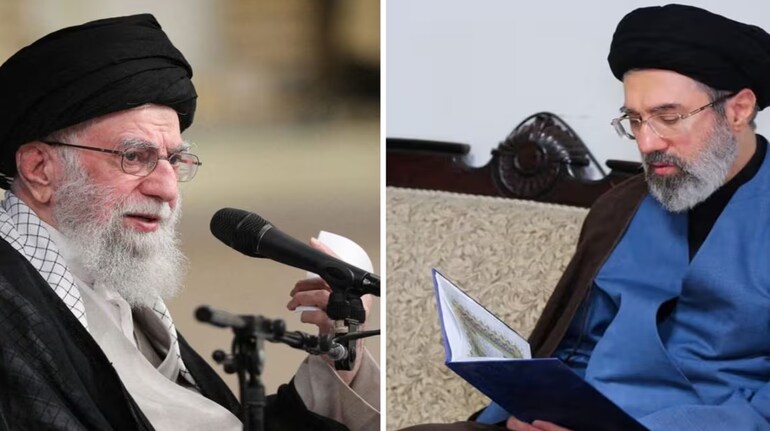
While Ayatollah Ali Khamenei exercised absolute authority as Iran’s Supreme Leader, analysts and media reports suggest his rule was never simply a “one-man show.” Instead, it operated as a delicate balancing act between institutions, factions and military power centres that supported — and sometimes checked — his authority.
Khamenei was assassinated on February 28 in joint U.S.–Israeli airstrikes on Tehran. In the aftermath, reports indicate that Iran’s Assembly of Experts has elected Mojtaba Khamenei, the son of the late Supreme Leader, as the country’s new top leader. According to those reports, the decision came under pressure from the Islamic Revolutionary Guard Corps (IRGC) amid ongoing U.S.–Israel strikes.
Will Mojtaba Khamenei inherit the same sweeping authority as his father? And what exactly were the powers that defined Ayatollah Ali Khamenei’s decades-long rule?
Commander-in-Chief of all armed forces
Under Iran’s political system, the Supreme Leader serves as the Commander-in-Chief of all armed forces. Khamenei historically exercised authority over the IRGC, the Artesh and the Basij.
Artesh (Regular army):
The professional military responsible for defending Iran’s territory, airspace and waters. It includes ground, air and naval forces. Compared to the IRGC, it is generally seen as more conventional and less involved in internal politics.
IRGC (Islamic Revolutionary Guard Corps):
An ideological force tasked with protecting the Islamic system and the regime itself. It is often considered more powerful than the regular army, controlling Iran’s ballistic missile programme and operating its own land, air and naval units. It also oversees the Quds Force, which conducts operations outside Iran.
Basij (Volunteer Militia):
A paramilitary network operating under the IRGC. In peacetime, it functions as a social enforcement body and is often described as acting as “morality police.” During unrest, it becomes a key instrument to suppress protests and maintain internal control — widely recognised for its crowd-control tactics.
Collective governance?
Iran’s political structure includes several institutions that project the appearance of shared governance but ultimately operate under the Supreme Leader’s influence.
The Assembly of Experts is formally responsible for electing and supervising the Supreme Leader. Advisory councils and close aides also play roles in day-to-day administration. Some experts argue that during his later years of declining health, a more collective form of decision-making may already have been in place.
Khamenei’s final authority
Khamenei held the “final say” on major state decisions, including foreign policy, the nuclear programme and judicial matters. He frequently sidelined dissent and maintained control over Iran’s most powerful institutions.
His authority was closely intertwined with the IRGC. Rather than governing alone, he acted as a “brutal balancer” between competing hardline factions. Analysts say the Guard provided the military strength and economic leverage that sustained his rule. Without his stabilising presence, observers believe the IRGC could emerge as the decisive power broker — potentially reducing any successor to a figurehead.
Will Mojtaba Khamenei enjoy the same powers?
Whether Mojtaba Khamenei can exercise the same dominance as his father remains the biggest question in Tehran today. Although he has reportedly inherited the title, experts point to several major challenges.
First, the 1979 Revolution was built on rejecting hereditary monarchy. A succession from father to son risks appearing like a return to a “Shiite Monarchy,” something many senior clerics oppose. Unlike his father, Mojtaba is not a “Grand Ayatollah” (Marja). Many religious scholars in Qom reportedly see him more as a political appointee than a theological authority, weakening his spiritual legitimacy.
Second, while Ali Khamenei maintained control over the IRGC, Mojtaba is widely perceived as having been elevated with its backing. If tensions arise between him and senior military commanders — particularly hardliners engaged in the ongoing conflict with the U.S. and Israel — he may lack the personal stature to overrule them as his father once did.
Third, he assumes leadership while the country faces heavy bombardment and military pressure. In times of crisis, authority often shifts toward those controlling force. With Iran’s “police state” infrastructure reportedly being targeted amid attempts to spark unrest, Mojtaba must demonstrate he can maintain order — or risk seeing his legitimacy erode quickly.
Fourth, the Artesh has historically been more cautious toward the Khamenei family than the IRGC. If the Revolutionary Guard is weakened by external strikes, the regular army could attempt to assert greater independence, potentially fragmenting the power structure further.
Mojtaba Khamenei may hold the constitutional title, but he appears to lack the decades of accumulated authority and political capital that defined his father’s rule. His leadership, analysts suggest, could prove far more fragile — and heavily dependent on the military balance inside Iran.
(With inputs from agencies)
Discover the latest Business News, Sensex, and Nifty updates. Obtain Personal Finance insights, tax queries, and expert opinions on Moneycontrol or download the Moneycontrol App to stay updated!
Find the best of Al News in one place, specially curated for you every weekend.
Stay on top of the latest tech trends and biggest startup news.