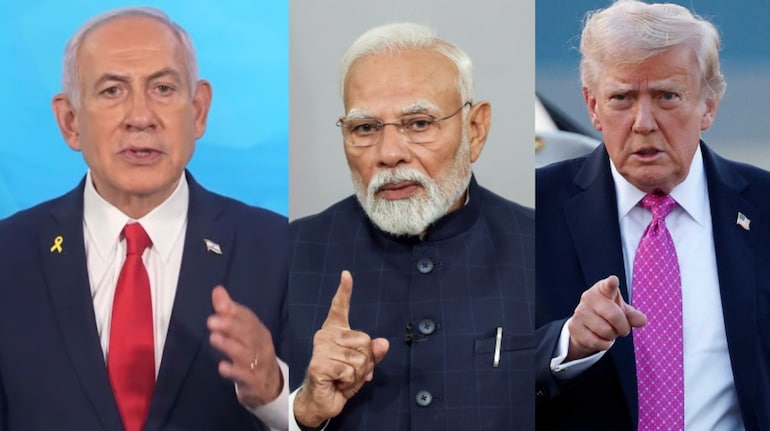

As the US-Israel-Iran conflict enters its third week with no clear resolution, a growing number of voices in global strategic circles are pointing to India as a potential mediator. While New Delhi has not formally offered to step in, the idea has gained traction among diplomats and analysts who believe India has the rare ability to engage all sides.
The latest endorsement came from Finland’s President Alexander Stubb, who told Bloomberg, “We need a ceasefire. I'm wondering if India can actually get involved. We saw Foreign Minister S Jaishankar call for a ceasefire to calm things down.”
His remarks add to a series of calls from influential figures who see India as uniquely positioned to help de-escalate tensions.
A rare ability to talk to all sides
One of the biggest reasons behind this perception is India’s ability to maintain working relationships with all three key players in the conflict.
New Delhi has deepened defence and technology ties with Israel in recent years. At the same time, it has preserved long-standing civilisational and economic links with Iran. Its partnership with the United States has also grown steadily, particularly in areas such as trade, defence and strategic cooperation.
This balance has allowed India to remain engaged with all sides even after the conflict began.
Colonel Douglas MacGregor, speaking to Tucker Carlson, argued that India’s neutrality gives it an edge. “To stop the US-Israel-Iran war, we need an intermediary, and preferably, the Prime Minister of India, Narendra Modi,” he said. He added, “PM Modi has good relations with Iran and Israel. India is not involved in this war in any way. India is a neutral state and the only neutral state that is growing in stature, power, and influence.”
Similarly, former UAE envoy to India Hussain Hassan Mirza told India Today TV, “India is a great country. The profile of India, the mere fact that one telephone call from Mr Modi to both Israel and Iran to stop, it will stop. One phone call.”
Economic rise strengthens diplomatic weight
India’s growing economic strength is another key factor behind its rising global influence.
Despite global disruptions, India remains one of the fastest-growing major economies. According to the International Monetary Fund’s World Economic Outlook 2026, the country is expected to contribute around 17 percent of global real GDP growth this year.
This economic momentum has translated into greater diplomatic leverage. India has expanded trade ties and signed multiple free trade agreements in recent years, strengthening its position as a major economic partner across regions.
The Economist noted the resilience of India’s economy, stating, “South Asia’s largest economy is surprisingly stable. This year the country has been both a victim of President Donald Trump's trade war, singled out for especially punitive tariffs owing to its purchases of Russian oil, and a participant in a shooting war with nuclear-armed Pakistan. Its economy has barely noticed.”
Such stability enhances India’s credibility as a country capable of engaging in high-stakes diplomatic efforts.
Strategic autonomy and credibility
India’s foreign policy has long been shaped by the principle of strategic autonomy. This approach allows New Delhi to maintain independent decision-making without aligning fully with any global power bloc.
The roots of this approach lie in the Non-Aligned Movement, where India played a founding role during the Cold War. While the movement itself has faded in relevance, its core idea continues to guide India’s diplomacy.
This has enabled India to maintain relations with countries that are often on opposing sides. For example, India remains part of the Quad grouping with the United States, Japan and Australia, while also sustaining strong trade ties with China and defence ties with Russia.
In the context of the Iran war, this flexibility allows India to engage both Washington and Tehran without appearing biased.
Why others face limitations
Other potential mediators face significant constraints.
China, despite offering to mediate, is widely seen as lacking neutrality due to its extensive energy ties with Iran and its role in supplying dual-use components. Gulf countries that have traditionally acted as intermediaries are themselves affected by the conflict. European nations are closely aligned with the United States, limiting their ability to act as neutral brokers.
This leaves India in a relatively unique position.
A growing global expectation
Even though New Delhi has not indicated any move to mediate so far, the increasing number of calls for its involvement reflects a shift in how India is perceived globally.
Senior advocate Mahesh Jethmalani summed up this evolving role in a post on X. “India is no longer seen as a passive observer at the margins of global conflict. It is increasingly seen as one of the very few powers that can speak to all sides, protect its own interests, and still retain the credibility to calm a crisis. That shift did not happen by accident. It came from years of steady leadership, strategic autonomy, and a foreign policy that refused to become anyone’s camp follower.”
Whether India ultimately steps in or not, the fact that it is being viewed as a credible peace broker highlights its growing influence in a rapidly changing global order.
Discover the latest Business News, Sensex, and Nifty updates. Obtain Personal Finance insights, tax queries, and expert opinions on Moneycontrol or download the Moneycontrol App to stay updated!
Find the best of Al News in one place, specially curated for you every weekend.
Stay on top of the latest tech trends and biggest startup news.