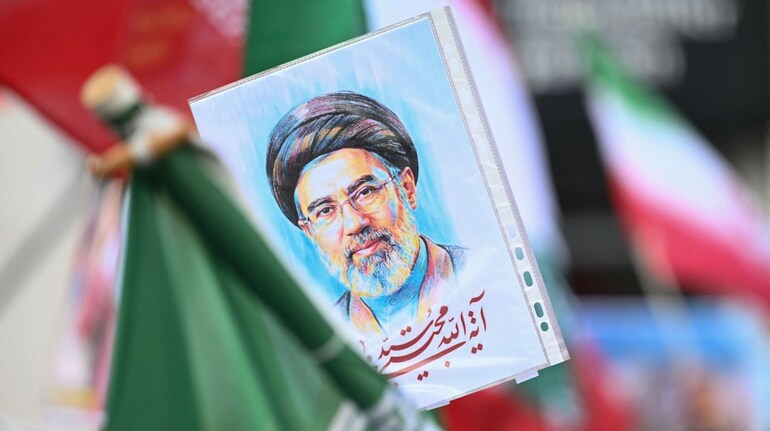

The rise of Mojtaba Khamenei as Iran’s new Supreme Leader may appear inevitable given his lineage as the son of the late Ayatollah Ali Khamenei. But according to a detailed account by The New York Times, the process was anything but smooth.
Instead, his elevation followed an intense power struggle inside Iran’s clerical and military establishment, unfolding amid a war with the United States and Israel.
The selection process resembled a high-stakes political battle within the Islamic Republic. Rival factions pushed their preferred candidates, powerful generals intervened, and clerics debated the ideological future of the regime. In the end, Mojtaba Khamenei secured the position after a contentious vote that exposed deep divisions within Iran’s ruling elite.
Leadership vacuum after Ayatollah Khamenei’s death
The succession battle began after Ayatollah Ali Khamenei was killed in Israeli airstrikes on February 28, on the first day of the war with Israel and the United States.
Under Iran’s constitution, the responsibility for selecting a new Supreme Leader lies with the Assembly of Experts, a body of 88 senior clerics.
According to The New York Times, the assembly convened a secret virtual meeting on March 3 to begin deliberations on the country’s next leader. The meeting itself took place under extraordinary circumstances. Earlier that day, Israeli strikes had targeted the assembly’s headquarters in Qum, killing several administrative staff members.
The choice before the clerics carried enormous significance. Iran’s Supreme Leader not only serves as the country’s highest religious authority but also holds ultimate control over the military and the political system.
Even in normal times, selecting a successor to a leader who had ruled since 1989 would have been difficult. Doing so during a war raised the stakes dramatically.
Rival factions push competing visions
According to interviews cited by The New York Times, Iran’s political elite quickly split into two camps.
Hardliners wanted continuity. They supported maintaining Ayatollah Khamenei’s confrontational policies toward the West and preserving the ideological direction of the Islamic Republic.
Moderates argued that Iran needed a new face and a more conciliatory approach toward the United States to stabilise the country.
Several influential figures backed Mojtaba Khamenei. These included powerful commanders from the Islamic Revolutionary Guards Corps, such as commander in chief Gen. Ahmad Vahidi, strategist Gen. Mohammad Ali Aziz Jaffari, and parliament speaker Gen. Mohammad Bagher Ghalibaf, who previously served as a Guards commander.
Hossein Taeb, the former intelligence chief of the Guards known for overseeing cross border assassination operations, also supported Mojtaba Khamenei’s candidacy.
Moderates rallied behind alternative candidates. These included former president Hassan Rouhani, who negotiated the 2015 nuclear deal, and Hassan Khomeini, the grandson of the Islamic Republic’s founder Ayatollah Ruhollah Khomeini. Another proposed compromise candidate was cleric and scholar Alireza Aarafi.
Ali Larijani, the head of Iran’s National Security Council and widely seen as a key political power broker, reportedly opposed Mojtaba Khamenei.
He argued that Iran required a unifying leader rather than a polarizing figure.
President Masoud Pezeshkian and several other officials also expressed reservations.
Wartime anger strengthens hardliners
As the debate unfolded, emotions fueled by the war began to shape the outcome.
According to officials quoted by The New York Times, anger toward US President Donald Trump and Israeli Prime Minister Benjamin Netanyahu hardened attitudes among clerics.
Rather than seeking a leader who could reform the system, many assembly members appeared to prefer someone who would continue the policies of the late ayatollah and avenge his death.
“We were looking at seven criteria for picking a candidate,” Ayatollah Mahmoud Rajabi, a member of the assembly’s board of directors, said in an interview with state television.
“Some had very strong social and political vision, another one had more religious credentials, another had strong management, one in wisdom.”
Rajabi added that the assembly attempted several times to meet in person but security concerns prevented it.
Mojtaba Khamenei wins the first vote
In the first round of voting on March 3, Mojtaba Khamenei secured the required two-thirds majority.
The vote signaled that the Revolutionary Guards and their allies had gained the upper hand.
The Assembly of Experts notified government officials and state media prepared to announce the decision at dawn on March 4.
However, the announcement was abruptly halted.
Moderates attempt to block the succession
Ali Larijani intervened and postponed the public announcement.
He warned that declaring Mojtaba Khamenei as Supreme Leader could make him a target, as both President Trump and Israeli Defense Minister Israel Katz had threatened to eliminate any successor.
Days later, on March 6, Israel launched bunker busting strikes on the Supreme Leader’s compound in Tehran. Mojtaba Khamenei was not present at the site.
The delay gave moderates an opportunity to challenge the vote.
Larijani argued that the March 3 decision was unconstitutional because the vote had taken place virtually rather than in person.
Another argument soon emerged. Two senior aides to the late Ayatollah Khamenei reportedly presented evidence that the former leader opposed hereditary succession.
They testified that he had explicitly told them he did not want any member of his family to replace him. They also produced a written will carrying the same message.
The aides warned that appointing Mojtaba Khamenei would contradict the ideals of the 1979 revolution that had overthrown Iran’s monarchy.
A counteroffensive by the Revolutionary Guards
The challenge alarmed the powerful Revolutionary Guards commanders who supported Mojtaba Khamenei.
One assembly member, Ayatollah Ali Moalemi, publicly criticized the effort to reverse the decision.
“There were efforts to change the minds of the assembly members and drag us in another direction,” Moalemi said.
“There were hands from outside the assembly with the intention to infiltrate and influence us.”
Behind the scenes, Guards leaders intensified their lobbying.
Hossein Taeb personally contacted all 88 members of the Assembly of Experts and urged them to support Mojtaba Khamenei.
According to officials cited by The New York Times, he framed the vote as a religious and ideological duty.
Final vote confirms Mojtaba Khamenei
The Assembly of Experts convened again on March 8 for a final vote.
Although the meeting remained virtual due to wartime security concerns, members agreed that emergency conditions made such procedures legitimate.
Each cleric wrote their chosen candidate’s name on paper, sealed the ballot in an envelope, and sent it via couriers to be counted.
Mojtaba Khamenei won 59 out of 88 votes, securing the required two thirds majority.
Shortly before midnight, Iranian state media announced that Iran had a new Supreme Leader.
Messages of loyalty and congratulations quickly followed, including from some figures who had previously opposed his candidacy.
A fragile unity after a bitter contest
Despite the fierce internal struggle, Iran’s political establishment quickly presented a united front after the announcement.
Mojtaba Khamenei has not yet appeared publicly since the decision.
According to The New York Times, the dramatic succession battle revealed both the deep divisions within Iran’s ruling elite and the growing influence of the Revolutionary Guards in shaping the country’s future leadership.
The episode also highlighted how wartime pressures accelerated the rise of a leader who might not otherwise have been considered for the role.
Discover the latest Business News, Sensex, and Nifty updates. Obtain Personal Finance insights, tax queries, and expert opinions on Moneycontrol or download the Moneycontrol App to stay updated!
Find the best of Al News in one place, specially curated for you every weekend.
Stay on top of the latest tech trends and biggest startup news.