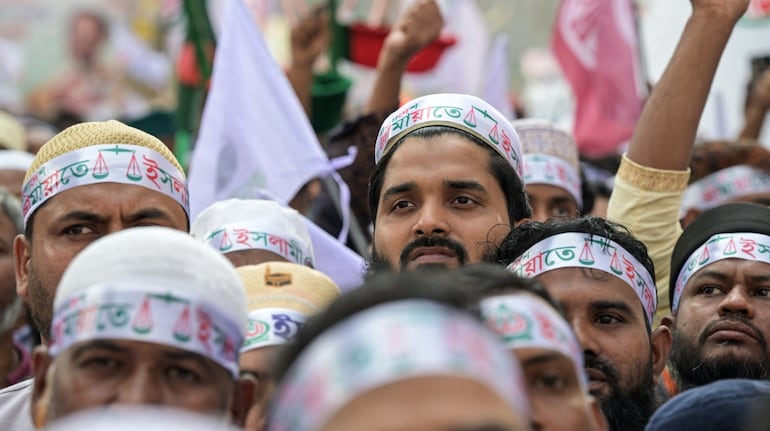

Bangladesh’s 2026 parliamentary election is fast turning into one of the most polarised and unsettling contests the country has seen in years. With the ruling Awami League opting out of the race and several smaller parties stepping aside, the political field has narrowed sharply, raising serious concerns about democratic legitimacy and stability.
According to sources cited by CNN-News18, the withdrawal of the Awami League has not opened up a competitive multi-party contest. Instead, it has cleared the way for what is effectively a two-cornered fight dominated by the Bangladesh Nationalist Party-led opposition alliance and an Islamist bloc anchored by Jamaat-e-Islami.
A contest narrowing to BNP vs Jamaat
The BNP-led alliance has fielded candidates in 272 constituencies, reserving 28 seats for smaller partners under seat-sharing arrangements. Jamaat-e-Islami, meanwhile, is contesting in 226 constituencies and has distributed 74 seats among seven allied Islamist parties. After failed negotiations with Islami Andolan Bangladesh, Jamaat was initially forced to prepare for contests in as many as 268 seats before regrouping.
A key development has been Jamaat’s ability to pull the Jatiya Party into its orbit. While the Jatiya Party has filed nominations in roughly 200 seats, sources say sustained legal pressure and local intimidation have severely curtailed its ability to campaign independently. Its role is therefore expected to be auxiliary rather than decisive.
Political observers say these developments have reduced the election to a de facto BNP versus Jamaat contest, with the latter attempting to maximise gains through tactical alliances and indirect support.
Jamaat’s dominance within the Islamist bloc
Among Islamist forces, Jamaat-e-Islami remains the only group with a nationwide organisational network, disciplined cadres and access to steady funding. It is setting campaign strategy, selecting candidates and directing resources, while allied groups play supporting roles.
Smaller partners such as the National Citizen Party are viewed as largely cosmetic additions, helping Jamaat project a broader front. Groups like Bangladesh Khelafat Majlis and Islami Oikya Jote offer mobilisation support through mosque and madrasa networks, particularly on polling day. Analysts note that these outfits are unlikely to swing results on their own, but they can assist with booth-level management and vote consolidation.
Although not formally aligned, Islami Andolan Bangladesh continues to matter. Its street strength in southern Bangladesh and potential tacit coordination with Jatiya Party networks could quietly improve Jamaat’s seat conversion rate in close contests.
With the Awami League absent and smaller secular parties marginalised, analysts warn that the election risks becoming a polarised showdown between a weakened BNP alliance and an emboldened Islamist camp.
Why India should watch closely
For India, the stakes extend well beyond Bangladesh’s internal politics. The BNP’s top leadership has a long record of adversarial rhetoric toward New Delhi, and recent signals from Tarique Rahman, son of former prime minister Khaleda Zia, have renewed concerns in Indian strategic circles.
Indian officials have taken note of Rahman’s increasingly sharp tone on India and reports suggesting outreach to anti-India elements ahead of the election. New Delhi has also closely tracked Islamist consolidation around Jamaat-e-Islami, given the party’s historical links to radical networks and its openly ideological agenda.
With Bangladesh at risk of sliding into a deeply polarised and Islamist-influenced political order, Indian policymakers see the 2026 election as a potential inflection point. A weakened BNP dependent on Islamist allies, or a Jamaat-boosted opposition victory, could complicate security cooperation, border management and regional stability at a time when South Asia is already under strain.
Discover the latest Business News, Sensex, and Nifty updates. Obtain Personal Finance insights, tax queries, and expert opinions on Moneycontrol or download the Moneycontrol App to stay updated!





Find the best of Al News in one place, specially curated for you every weekend.
Stay on top of the latest tech trends and biggest startup news.