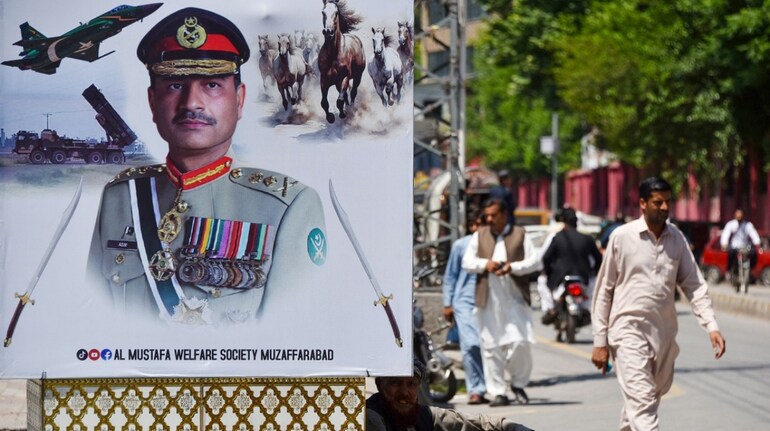
Fresh off his Washington visit, Pakistan Army chief Field Marshal Asim Munir may have expected a warm welcome in Beijing. Instead, he was firmly rebuked by Chinese Foreign Minister Wang Yi, who expressed deep dissatisfaction over Islamabad’s failure to protect Chinese nationals and projects. Despite public claims of an "iron-clad" friendship, China’s patience with Pakistan is wearing thin, and its frustration is now spilling into official meetings.
On Thursday, Wang made Beijing’s displeasure abundantly clear during talks with Munir, urging the Pakistani military to step up its efforts in providing security for Chinese nationals and projects in Pakistan.
“It is hoped that the Pakistani military will continue to make all-out efforts to ensure the safety of Chinese personnel, projects and institutions in Pakistan,” Wang said, as quoted by China’s state-owned Xinhua news agency.
While the official Chinese readout, as expected, stuck to usual diplomatic niceties, references to the “iron-clad friendship” and “all-weather strategic cooperation,” the underlying frustration could hardly be concealed. Over the past several years, a wave of targeted attacks by Pakistan-based militant groups, especially the Baloch Liberation Army (BLA), has rattled China’s confidence in Pakistan’s ability to safeguard its massive investments.
A relationship strained by bloodshed and broken promises
The focal point of Chinese investments in Pakistan, the $60 billion China-Pakistan Economic Corridor (CPEC), has been under relentless siege from domestic insurgent groups who view it as exploitative and neo-colonial. Chinese nationals working on key projects -- from energy plants to port infrastructure -- have been kidnapped, shot at, and killed, often with little consequence or effective response from the Pakistani state.
Beijing has long pressed Islamabad to do more. But for all of Pakistan’s military posturing and promises, attacks continue unabated — a fact that no amount of rhetorical reaffirmation of friendship can hide. From the bombing of a Chinese bus in Dasu in 2021, which killed nine Chinese engineers, to repeated ambushes in Gwadar, Pakistan has not only failed to protect Chinese personnel but also has proven incapable of safeguarding its own military and civilians from similar threats.
The Gwadar disappointment
Perhaps nothing underscores China’s mounting frustration more than the stagnation of the Gwadar port, which was once touted as the “crown jewel” of CPEC and a linchpin in Xi Jinping’s Belt and Road Initiative (BRI). Despite billions of dollars being poured in over the past decade, the port remains a ghost town, mired in local resistance, insecurity, and administrative incompetence.
Far from transforming Pakistan into a trade and logistics hub, Gwadar has become a symbol of broken promises and unfulfilled potential. Fishermen and local Baloch communities, displaced by port construction and denied access to basic services, have staged repeated protests. Militant groups have capitalised on this disenchantment, portraying CPEC as a tool of Chinese imperialism, and targeting Chinese presence accordingly.
Diplomatic optics vs strategic reality
General Munir’s visit to China -- coming so soon after his high-profile engagements in the United States -- was supposed to reinforce Pakistan’s geopolitical balancing act. Yet Beijing’s blunt messaging shows that the old strategy of playing major powers against each other may no longer be working. China expects concrete results, not just reassurances.
Wang Yi’s message was a calibrated warning: the Communist Party’s patience is wearing thin. Pakistan cannot continue to rely on fraternal slogans when it fails on the most basic of responsibilities, securing the lives of foreign nationals who are driving its largest infrastructure projects.
Pakistan scrambles to protect Chinese
In a clear reflection of its growing dependence on Beijing, Pakistan’s Prime Minister Shehbaz Sharif has unveiled a new security overhaul aimed at safeguarding Chinese nationals working in the country, especially those involved in the China-Pakistan Economic Corridor (CPEC).
On Tuesday, Sharif chaired a meeting regarding security arrangements for Chinese citizens in Pakistan and announced that Pakistan’s police force will undergo military-grade training specifically to protect them.
But Pakistan's “care” seems reactionary, not preemptive. Over the past few years, multiple high-profile attacks, including suicide bombings and shootings, have targeted Chinese engineers, teachers, and workers. According to data from Pakistan’s National Counter Terrorism Authority (NACTA), 14 terrorist attacks since 2021 have claimed the lives of at least 20 Chinese nationals, leaving 34 others injured.
For China, the dilemma is growing. Pakistan is a strategic ally, but increasingly a security liability. With CPEC faltering and Xinjiang-related concerns about cross-border militancy simmering, Beijing may find it harder to justify continued indulgence of Islamabad’s chronic instability.
Discover the latest Business News, Sensex, and Nifty updates. Obtain Personal Finance insights, tax queries, and expert opinions on Moneycontrol or download the Moneycontrol App to stay updated!
Find the best of Al News in one place, specially curated for you every weekend.
Stay on top of the latest tech trends and biggest startup news.