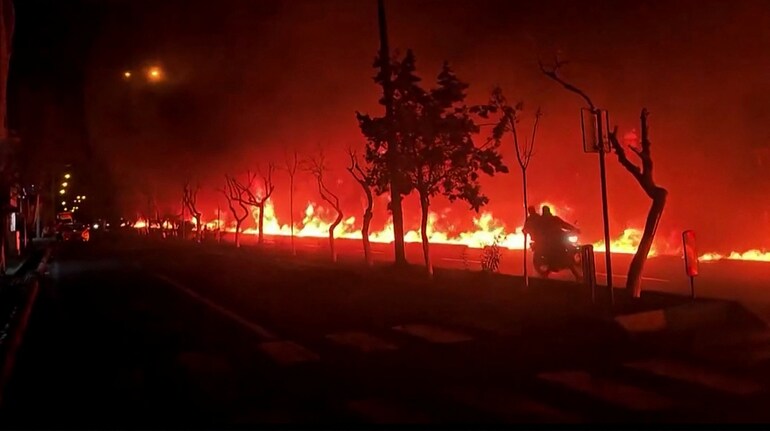

Iran is witnessing a new environmental concern amid the ongoing war involving the United States and Israel. After weeks of airstrikes targeting key energy infrastructure, parts of northern Iran have reported polluted rainfall commonly referred to as "black rain."
The phenomenon has been linked to major fires at oil storage facilities that were struck during the conflict. Officials and environmental experts say the burning oil infrastructure released large volumes of pollutants into the atmosphere. When rainfall arrived over the weekend, these pollutants mixed with rain clouds and fell back to the ground as contaminated precipitation.
Residents in several areas have already reported health symptoms and unusual dark residue following the rainfall.
What is ‘black rain’
Black rain is a type of rainfall contaminated with pollutants such as soot, ash, oil particles and industrial chemicals.
These particles accumulate in the atmosphere when large fires or industrial accidents release heavy pollution into the air. As raindrops fall through this polluted atmosphere, they collect the particles and carry them down to the ground. The result is rainfall that appears dark, oily or dirty.
Such events can occur after oil facility fires, refinery explosions, massive wildfires, volcanic eruptions or nuclear fallout.
Environmental experts say that black rain is usually associated with extremely high levels of airborne pollution.
Charles Driscoll, a professor of environmental engineering at Syracuse University, told ABC News that for black rain to form, the concentration of pollutants in the atmosphere must be very high.
“For black rain to be produced, the concentrations of pollutants must be extremely high,” he said.
Oil facility fires triggered the pollution
The rainfall followed Israeli strikes on major Iranian oil facilities on March 7. Several oil depots and refineries were targeted during the attacks.
Facilities reportedly hit include oil storage sites in Karaj, Shehran and Aghdasiyeh, along with a refinery in Tehran. The refinery in the capital alone has the capacity to process around 225,000 barrels of crude oil per day.
The strikes triggered fires that continued burning for several days. The smoke released from these fires carried hydrocarbons, sulphur compounds and other pollutants high into the atmosphere.
Tehran, a city with nearly 10 million residents, was covered by thick smoke from the burning facilities.
When storm systems moved into the region, rainfall carried these pollutants back to the ground. Iranian officials said the contaminated precipitation in some areas resembled black rain.
Videos and photographs circulating on social media appear to show thick smoke over Tehran as well as dark residue on surfaces.
Some residents have reported that cars, rooftops and streets were coated with a sticky or oily film following the rainfall.
The UK-based environmental monitoring organisation CEOBS described the situation as a "major environmental incident."
Health concerns grow
Health experts say polluted rainfall could have immediate as well as long-term effects on public health.
The World Health Organization has warned that exposure to oil-contaminated rainfall could pose risks to the population.
“The black rain and the acidic rain coming with it are indeed a danger for the population, respiratory mainly,” WHO spokesperson Christian Lindmeier said during a briefing.
Residents in affected areas have already reported symptoms including headaches and difficulty breathing.
Medical experts say short-term exposure to polluted rain and airborne particles can trigger respiratory irritation, especially in people with asthma or existing lung conditions.
Longer-term exposure could be more serious. Ultrafine particles known as PM2.5 can enter the bloodstream when inhaled.
Researchers have linked these particles to a range of health problems including cardiovascular disease, neurological disorders and certain cancers.
Contact with contaminated rainwater may also lead to skin irritation, eye irritation and other health complications.
War toll continues to rise
The environmental fallout comes as the conflict continues to claim lives on both sides.
According to available figures, more than 1,300 people have been killed in Iran since the fighting began. Israel has reported 13 deaths during the same period.
As the war continues and fires burn at damaged energy facilities, concerns are growing that pollution and environmental damage could become another long lasting consequence of the conflict.
Discover the latest Business News, Sensex, and Nifty updates. Obtain Personal Finance insights, tax queries, and expert opinions on Moneycontrol or download the Moneycontrol App to stay updated!
Find the best of Al News in one place, specially curated for you every weekend.
Stay on top of the latest tech trends and biggest startup news.