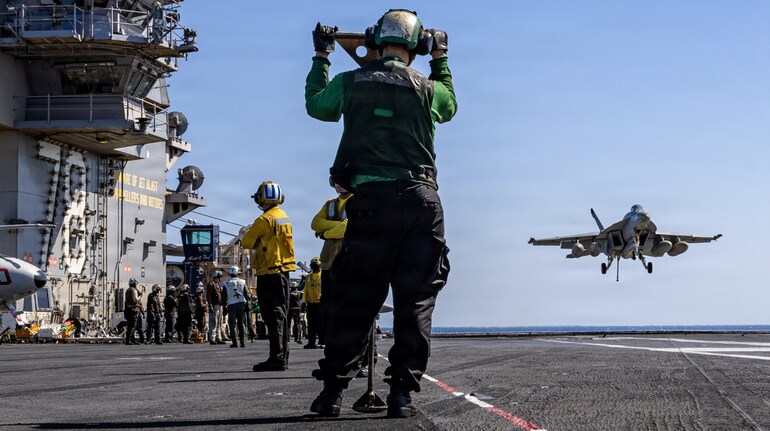

One of the United States’ most powerful warships, the USS Gerald R Ford, has been forced to pull back from active deployment in the Iran war after a fire broke out onboard and longstanding technical issues worsened. But what has raised eyebrows is not just the damage to the ship, but the possibility that some of it may have been caused by the crew itself.
With reports of clogged sewage systems, a major fire in a laundry unit, and growing frustration among sailors after extended deployment, questions are now being asked. Did exhausted crew members deliberately damage parts of the ship to get out of a prolonged war mission?
A supercarrier under strain
The USS Gerald R Ford is the US Navy’s most advanced aircraft carrier and a key pillar of its global power projection. Commissioned in 2017, the nuclear-powered vessel carries more than 4,500 personnel and up to 90 aircraft, making it one of the most expensive and complex warships ever built.
Since February 28, the carrier has played a central role in US operations linked to the Iran war. But its current condition tells a different story.
The ship is now headed to Souda Bay in Crete for repairs after a fire damaged parts of its interior, including crew living quarters. According to Reuters, nearly 200 sailors were treated for smoke-related injuries, and the blaze affected around 100 sleeping berths.
Deployment pushed beyond limits
Part of the problem lies in how long the ship has been at sea.
The Ford has been deployed for nearly 10 months, far exceeding the US Navy’s recommended deployment period of six to eight months under its Optimised Fleet Response Plan.
Experts say such extended deployments take a toll not just on machines but also on the people operating them.
“Ships get tired too, and they get beat up over the course of long deployments. You can’t run a ship that long and that hard and expect her and her crew to perform at peak capacity,” retired Rear Admiral John F Kirby told The New York Times.
For many sailors, the situation has been worsened by broken promises. According to NPR, crew members were told they would return home in early March, only for their deployment to be extended until May.
Toilets clogged, systems failing
Alongside the fire, the ship has been dealing with persistent issues in its sewage system.
The Ford’s Vacuum Collection, Holding and Transfer system, which operates like an aircraft toilet system but on a much larger scale, has long been prone to breakdowns.
This time, however, the problem appears to have been aggravated by the crew.
According to Bloomberg, US Navy officials confirmed that sailors were responsible for clogging the system by flushing inappropriate items.
“In most instances, clogs are the result of items being flushed that should not be introduced into the system,” the Navy said, citing the ship’s commanding officer.
Reports suggest that items as unusual as T-shirts were flushed down the toilets, worsening already fragile systems and creating unsanitary conditions onboard.
Fire and suspicions of arson
The most serious incident, however, was the fire that broke out in the ship’s laundry area.
The blaze spread quickly, damaging living spaces and forcing the ship to retreat from active operations for repairs. While the exact cause of the fire remains under investigation, some reports have raised the possibility of deliberate action.
Greek newspaper Kathimerini, citing unnamed sources, reported that “one scenario being examined is that the blaze may have been deliberately caused by crew members to terminate their extended mission.”
The US Navy has not confirmed whether arson is being investigated, but the speculation has drawn attention to the growing stress levels among the crew.
Mounting pressure on sailors
Conditions aboard the Ford appear to have deteriorated significantly in recent months.
Frequent sewage breakdowns, extended deployment and uncertainty over return timelines have created a difficult environment for sailors.
Democratic Senator Mark Warner highlighted the strain, saying, “It kind of adds insult to injury if you are deployed now for months beyond what you expected, and the sewage system doesn't work. What kind of stress are we putting on these sailors?”
Such conditions can erode morale and discipline, especially on a vessel operating continuously in high tension zones.
Not without precedent
The idea of sabotage by crew members is not without precedent in the US Navy.
In 2020, a fire destroyed the USS Bonhomme Richard while it was docked in San Diego. Investigators accused a sailor, Ryan Sawyer Mays, of deliberately starting the fire, allegedly out of frustration after being reassigned.
That incident showed how stress, resentment and fatigue can lead to extreme actions even within disciplined military environments.
What we know and what remains unclear
There is confirmed evidence that crew members contributed to the clogging of the ship’s sewage system. Whether the fire was an accident or an act of sabotage remains unclear.
What is evident, however, is a combination of factors that have put immense pressure on the crew. Extended deployment, technical failures and declining living conditions have all contributed to a situation that raises serious questions.
The USS Gerald R Ford may be one of the most advanced warships in the world, but its current troubles highlight a simple reality. Even the most powerful military machines depend on human endurance. And when that endurance is stretched too far, the consequences can be unpredictable.
Discover the latest Business News, Sensex, and Nifty updates. Obtain Personal Finance insights, tax queries, and expert opinions on Moneycontrol or download the Moneycontrol App to stay updated!
Find the best of Al News in one place, specially curated for you every weekend.
Stay on top of the latest tech trends and biggest startup news.