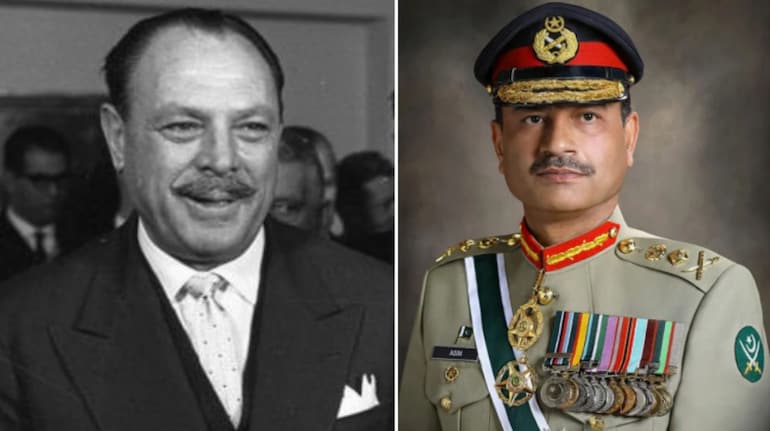
The Pakistani Army doesn’t reward victories; it promotes paranoia. When its military lies are exposed, its terror infrastructure decimated, and its global reputation in tatters, the generals in Rawalpindi don’t resign; they rise. General Asim Munir’s sudden elevation to field marshal, Pakistan’s highest military rank is a reflection of this fact, as it comes not in a moment of triumph but in the shadow of defeat.
India’s Operation Sindoor not only caught Pakistan’s defence establishment off guard but also exposed the brittle myth of its military invincibility. Islamabad's response is straight from its old playbook: glorify the army, silence dissent, and double down on its India obsession.
Munir’s promotion draws eerie parallels with the rise of General Ayub Khan, Pakistan’s first field marshal and military dictator, who ruled the country after overthrowing civilian leadership. Both men are products of an establishment that thrives on India-centric paranoia, sees civilian democracy as dispensable, and considers peace an existential threat to their military-industrial relevance.
Asim Munir’s promotion - An eerie similarity
General Asim Munir's promotion to field marshal was approved by Pakistan's federal cabinet, led by Prime Minister Shehbaz Sharif. This decision followed India’s retaliatory strikes on the intervening night of May 10 and 11, which caused severe damage to Pakistan’s key airbases and defence sites. A shattered Pakistan reached out to India through its DGMO, urging a ceasefire.
Instead of reflection or course correction, the Pakistani deep state has chosen defiance - rewarding failure and consolidating militaristic supremacy.
This isn’t unprecedented. In fact, it’s almost a ritual. In 1965, after India repelled Pakistan’s invasion and decisively won the war, then-General Ayub Khan not only clung to power but also promoted himself to field marshal. That war, launched under the false belief that Indian Muslims in Kashmir would rise up in support of Pakistan, ended in disaster. But it made Ayub a national "hero" in Pakistan’s twisted military mythology.
The shared ideological contempt for India and Hindus
What binds Ayub Khan and Asim Munir across generations is more than just their ranks. It is a shared ideological contempt for India, and especially Hindus.
During his reign (1958–1969), Ayub Khan institutionalised a brand of nationalism rooted in Islamic identity, marginalizing non-Muslim communities, particularly Hindus. While Ayub positioned himself as a modernizer and secularist abroad, his domestic policies told a different story.
His regime witnessed one of the largest exoduses of Hindus from East Pakistan (now Bangladesh), triggered by targeted land reforms and discriminatory laws. The 1962 Constitution under Ayub’s leadership reduced safeguards for minorities and emphasised Pakistan’s Islamic character. Ayub also laid the ideological groundwork for equating Indian identity with Hindu identity, a narrative that continues to resonate in Pakistan’s civil-military discourse. During Ayub’s rule, Pakistani school textbooks began explicitly painting Hindus as scheming, untrustworthy enemies. The trend persists to this day. He publicly referred to India as a Hindu state and used religion as a justification for military hostility.
Ayub’s blunders eventually led to Pakistan’s defeat in 1971 as well, yet his image remains glorified in Pakistani military lore.
General Asim Munir reflects an evolved but similarly hardline posture. Unlike Ayub, Munir’s approach is less about legislative tools and more rooted in information warfare, state-sponsored propaganda, and religious mobilisation. Under Munir’s watch, the Pakistan Army has increasingly framed India as a Hindu nationalist aggressor, weaponising this narrative to stoke public emotions and justify strategic hostility. His rhetoric, often couched in pan-Islamic terms, has included direct attacks on India’s ruling BJP and RSS, casting them as existential threats to Islam.
Reports also suggest that Munir has given tacit support to radical clerics and pro-jihadist groups who amplify anti-Hindu sentiments under the guise of “defending Kashmir.” The attempted revival of the “two-nation theory” as a justification for domestic policies under Munir echoes the communal tone Ayub once used to consolidate power.
Why promotions follow defeats in Pakistan
In Pakistan, elected governments are puppets. The military has ruled directly for nearly half the country's existence and indirectly for the rest. Field marshal titles are symbols of power, not performance.
Elevating Munir is an attempt to rewrite the narrative after the embarrassment of Operation Sindoor. It’s a page out of Ayub Khan’s old playbook - pretend you’ve won, promote the general, and sell it to the public as national resilience.
The elevation of Asim Munir to field marshal is not an honour, it’s a warning. A warning that Pakistan’s military has learned nothing from history, that it still believes anti-Hindu rhetoric and covert jihad can mask internal failures.
Discover the latest Business News, Sensex, and Nifty updates. Obtain Personal Finance insights, tax queries, and expert opinions on Moneycontrol or download the Moneycontrol App to stay updated!
Find the best of Al News in one place, specially curated for you every weekend.
Stay on top of the latest tech trends and biggest startup news.