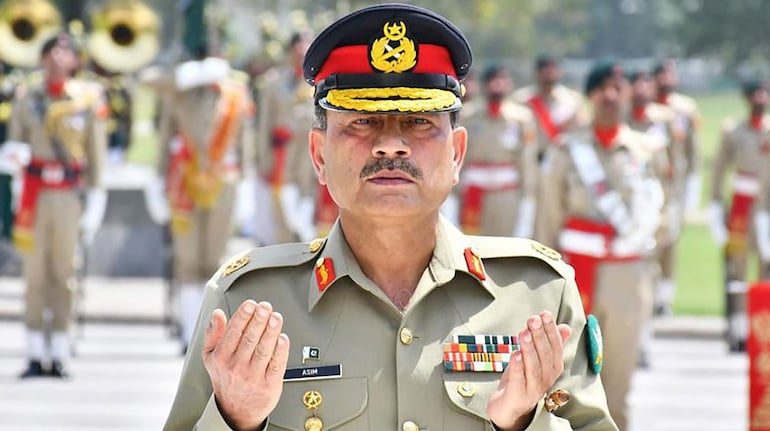
Pakistan Army Chief and newly designated Field Marshal Asim Munir’s sudden change in travel plans has raised eyebrows across South Asia. Munir was scheduled to visit Sri Lanka and Indonesia, but instead, he made an urgent trip to Beijing to meet Chinese Foreign Minister Wang Yi and top military officials. The visit is more than a mere scheduling adjustment; it reflects Pakistan’s growing desperation to maintain strategic relevance and manage its two most crucial external relationships: China and the United States.
Munir’s Beijing visit came amid mounting Chinese concerns about the security of its citizens and investments in Pakistan, particularly those linked to the China-Pakistan Economic Corridor (CPEC). Recent attacks on Chinese engineers and workers have alarmed Beijing, which sees Pakistan as central to its Belt and Road Initiative in South Asia.
During his meeting with Wang Yi, Munir was reportedly pressed on guarantees for the safety of Chinese nationals, projects, and institutions. Beijing’s message was clear: Pakistan’s internal instability, from terror attacks to political chaos, is threatening Chinese strategic interests. By rushing to Beijing, Munir signaled Islamabad’s continued dependence on Chinese money, weapons, and diplomatic backing, even at the cost of sidelining traditional regional outreach to countries like Sri Lanka and Indonesia.
Desperate balancing act between China and US
Munir’s sudden pivot also coincided with Pakistan’s renewed lobbying efforts in Washington, where its leaders are trying to reclaim relevance amid India’s rising global stature. In the last two months, Pakistan has staged a charm offensive aimed at convincing the US that Islamabad remains a critical partner -- a tough sell given its history of harbouring terror groups and its deep entanglement with China.
Munir himself lunched with President Donald Trump, a meeting that Trump used to shower praise on the Pakistani general, calling him “a great man” — hollow flattery that means little in real policy terms. Meanwhile, Pakistan’s finance minister Aurangzeb visited Washington to engage with US officials, and now Foreign Minister Ishaq Dar met Secretary of State Marco Rubio.
This diplomatic two-timing underscores Pakistan’s strategy: cling to China for economic survival while trying to woo the US for military aid and political legitimacy. But Washington is no longer blind to Pakistan’s duplicity, especially after Trump’s farcical claims in May 2025 about “mediating a ceasefire” between India and Pakistan -- claims India dismissed outright as baseless.
The India factor: Why Pakistan is playing both sides
Underlying all these moves is Pakistan’s obsession with countering India. With India consolidating partnerships with the US, Japan, and other Indo-Pacific powers, Pakistan fears being sidelined entirely in South Asia. By showcasing ties with China while courting Washington, Islamabad hopes to project that it remains geopolitically significant. However, this balancing act reeks of desperation: China sees Pakistan as a client state, while the US increasingly views it as a liability.
India has taken note. On Thursday, MoS Kirti Vardhan Singh reaffirmed that India “closely monitors all military and security-related developments in its neighbourhood” and raises its concerns with partners at the appropriate level.
“The Government of India is aware of a China-Pakistan-Afghanistan meeting held in Beijing, China, on May 21, 2025. The government’s position on CPEC is clear and consistent. Government has consistently protested to parties concerned over the inclusion of the so-called China-Pakistan Economic Corridor (CPEC), which passes through parts of the Indian Union Territories of Ladakh and Jammu & Kashmir under illegal occupation of Pakistan, as a flagship project of OBOR/BRI and asked them to cease these activities,” he said.
“Any proposed participation of third countries or expansion or expansion of the so-called CPEC projects to third countries is unacceptable. Government has consistently conveyed this position to relevant parties,” the MoS added.
Why this move reflects Pakistan’s strategic weakness
Skipping Sri Lanka and Indonesia -- two nations that could have offered symbolic solidarity -- in favour of an emergency dash to Beijing sends a blunt message: Islamabad’s foreign policy today revolves entirely around appeasing China and pleading with Washington. Neither strategy guarantees success. China will keep tightening its grip on Pakistan through debt and security dependence, while the US remains sceptical about Pakistan’s double game on terror.
For Pakistan, the optics are grim: instead of shaping regional strategy, it is scrambling for relevance, swinging between two powers even as its domestic economy collapses and its political system flounders. For India and the region, this is yet another sign that Pakistan’s strategic autonomy is an illusion, and its desperation is on full display.
India’s strategic advantage amid Pakistan’s balancing failure
Pakistan’s frantic oscillation between Washington and Beijing only highlights India’s growing diplomatic leverage. Unlike Islamabad, which is trapped in a zero-sum game of appeasing two competing powers, New Delhi has strengthened ties with both the US and key Indo-Pacific partners without compromising its autonomy. India’s rising economic clout, defence partnerships, and strategic role in global supply chains give it a level of credibility Pakistan cannot match.
While Islamabad begs for relevance, India is shaping the regional agenda, from leading critical technology partnerships with the US to expanding trade ties with Southeast Asia. Pakistan’s failure to maintain independent foreign policy reinforces India’s image as the region’s reliable, stable power, further isolating Islamabad diplomatically.
Discover the latest Business News, Sensex, and Nifty updates. Obtain Personal Finance insights, tax queries, and expert opinions on Moneycontrol or download the Moneycontrol App to stay updated!
Find the best of Al News in one place, specially curated for you every weekend.
Stay on top of the latest tech trends and biggest startup news.