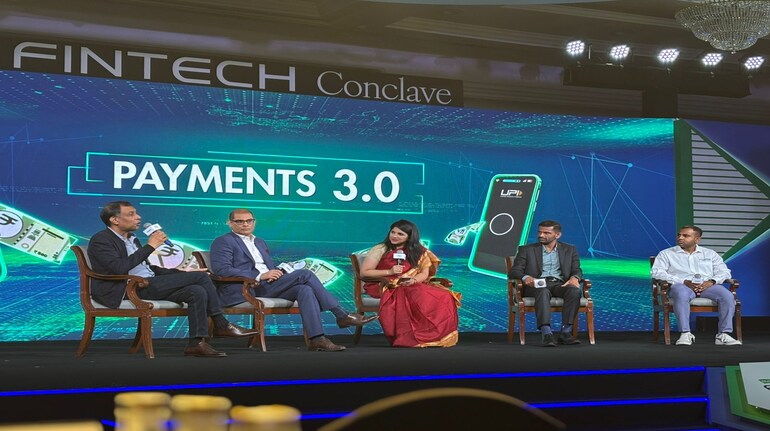
As the National Payments Corporation of India (NPCI) deadline to impose a market cap on UPI players approaches, Sharath Bulusu, Director of Product Management, Google Pay, said that he is expecting clarity from NPCI on the matter.
“We are expecting clarity from NPCI. As long as there is clarity, we will work through it. We have worked through a lot of change as an ecosystem, generally,” Bulusu said during a panel discussion at Moneycontrol's India Fintech Conclave (IFC) 2024 in Mumbai on December 18.
In December 2022, the NPCI extended the deadline for third-party UPI players to meet its 30 percent volume cap in digital payment transactions by two years to end December 2024.
In an earlier interaction with Moneycontrol, NPCI MD and CEO Dilip Asbe hinted at a possible extension of this deadline as market shares continue to balance out.
According to the latest data from NPCI, PhonePe currently leads the market with a share of around 48 percent by volume, followed by Google Pay’s 37 per cent share. With recent entrants like Super.money and Navi launching their own UPI services, this ‘balancing’ of market share is expected to take a few more years.
During the panel discussion, speaking about the growing competition in the UPI space, MN Srinivasu, co-founder of Billdesk, said that it is challenging to disrupt incumbents who have a first-mover and scale advantage, unless there is intervention.
“Disruption is when private players do it, intervention is when policy makers do it. Policy makers do not disrupt, they intervene,” he said.
Srinivasu added that users do not use UPI apps for functionality alone. “All apps have reached a level of quality where the distinction between their performance is indistinguishable for the regular consumer… In the long term, the eventual market share of players matters, rather than the total number of players,” he said.
Meanwhile, Google Pay’s Bulusu said he is not perturbed, and increasing competition in the sector is a “fun new phase.”
“The game is still early, the worry is not someone taking away what (share) you have, but expanding the existing market…We have over 350 million users who are actively using UPI every month. For a country our size, it ought to be twice that. If that growth continues to happen, there is ample room for many more players to grow and innovate,” he said.
Speaking about the next phase of growth for UPI, Reeju Datta, co-founder, Cashfree Payments, pointed towards international expansion by looking at UPI as a global payment network. “This can unlock a large share of growth in terms of cross-border payments,” he said.
The NPCI is currently working with countries such as Peru, Namibia, and Trinidad and Tobago to help them create their own soverign payment ecosystems. It is also working with the UAE and Mauritius to help them create card schemes like Rupay, said Ritesh Shukla, CEO, NPCI International Payments Limited.
UPI, as a service, is available in seven countries, including Nepal, Bhutan, Mauritius, Sri Lanka, UAE, and Singapore.
“In times to come, we will go live in many other corridors that are relevant to Indian tourists like Qatar, Thailand, and other Southeast Asian markets. We are hopeful of going live in at least three or four more countries (in 2025), and if projects complete on time, maybe six countries,” Shukla said.


Discover the latest Business News, Sensex, and Nifty updates. Obtain Personal Finance insights, tax queries, and expert opinions on Moneycontrol or download the Moneycontrol App to stay updated!

Find the best of Al News in one place, specially curated for you every weekend.
Stay on top of the latest tech trends and biggest startup news.