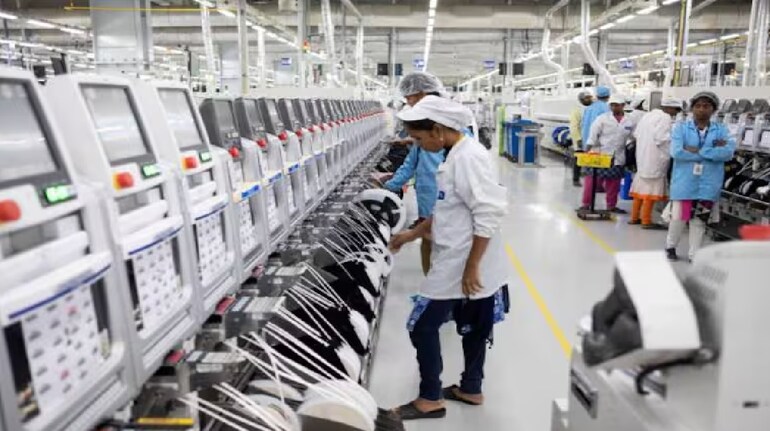
India’s electronics industry views US President Trump’s reciprocal tariff rate of 27% on the industry, set to kick in from April 9, as relatively advantageous in comparison to rival exporter nations China, Vietnam, and Thailand. Vietnam has levied a 46% tariff, China has a 34% tariff, and Thailand, which also makes some electronic components, has a 36% tariff.
The India Cellular and Electronics Association (ICEA) said India has fared well in the initial round of tariff adjustments, emerging favourably, especially when compared to key electronics export competitors such as China, Vietnam, Thailand, and Indonesia, owing to the relentless efforts of our negotiators and leaders.
While countries like Brazil and Egypt enjoy marginally better tariff outcomes, India’s positioning, particularly with China and Vietnam facing combined tariffs of up to 54-79% (China) and Vietnam at 46%, offers a valuable near-term window of export competitiveness.
“…the true long-term inflection point for India's electronics trade with the US will rest on the successful conclusion of a Bilateral Trade Agreement (BTA),” said ICEA Chairman Pankaj Mohindroo.
The India Cellular and Electronics Association of India (ICEA) represents leading mobile manufacturers in India, including Apple, Dixon, Motorola, Xiaomi, and Lava, as well as Foxconn, Flex, Dixon, and others.
Mohindroo said the BTA must now become the cornerstone of our trade strategy, to help unlock stable market access, tariff predictability, and a framework for scaling high-value electronics exports.
“As we await possible retaliatory moves from other major economies, our deepest focus must remain on converting this strategic opening into sustained export growth and supply chain integration,” Mohindroo said.
Dixon Technologies managing director Atul Lall told Moneycontrol that India has a competitive advantage over China and Vietnam following the US’s rollout of reciprocal tariffs.
“I was very skeptical about how Vietnam, Thailand and others would be treated, but in comparison, we, as a country, are in a better position. It looks positive for us...we've only been in deep discussion with Motorola in the last few months and have been trying to map out a scenario. They have a global footprint, and we are the largest one,” Lall added.
Dixon is a key beneficiary of the production-linked incentive scheme, exporting smartphones worth Rs 1,700-1,800 crore to the US, primarily for its customer, Motorola. Lall said the company expects Rs 4,500-5,000 crore in revenue from exports to the US this fiscal, primarily through its order book from Motorola. It expects a higher growth rate than the 35 percent it saw last year.
Tarun Pathak, the Research Director at Counterpoint, said the tariffs will likely create 'significant uncertainty' and negatively impact the United States. "By overlooking crucial factors like labour, skills, and supply chain complexities to bolster domestic manufacturing and attract investment, the tariffs have been met with negative market reactions and criticism from key nations."
In the case of smartphones, Pathak said supply chains are so seamlessly integrated and Asia-dominated that it will be impractical for them to set up shop in the US overnight unless it is super advanced high-value chip manufacturing, such as seen with TSMC, with capex and subsidies from the government, but that has also been tough.
"The end chips will be costlier than the ones manufactured in Asia. The biggest losers in this entire episode will be the American consumers because the costs of their products will go up significantly, and the US will not bring local manufacturing anytime soon," Pathak said.
Pathak said the situation presents a mixed picture for India, with relatively lower tariffs, but also offers further negotiation opportunities.
Prabhu Ram, Head of the Industry Intelligence Group at CMR, said Trump’s tariffs could trigger global supply chain realignments, presenting India’s electronics sector with a strategic opportunity to reinforce its global standing. "To sustain its competitiveness and maximize this shift, India must implement targeted policy measures that enhance its appeal and further accelerate integration into global value chains," he said.
Bad news for Apple's Make-in-India plans?
Abhilash Kumar, an industry analyst at TechInsights, said that the reciprocal tariffs enforced on India exports to the US would be a setback for Apple iPhones being assembled in India for sales in the US.
As one of India’s largest electronics exporters, Apple ships iPhones to international markets, with a large share headed to the US. Currently, Apple benefits from zero-duty access for Indian-made iPhones entering the US market, making local production highly profitable.
Apple is projected to shift nearly 15% of its iPhone production from China to India by FY25, surpassing its earlier target of 10% by FY26.
"It would either result in increased prices of iPhones to encapsulate the tariffs, or Apple might have to compromise on their margins, or both. China, India and Brazil are the key countries where iPhones are assembled, and it would be tedious for Apple to expand beyond them soon. Diversifying and assembling more in Brazil might be an option as the tariffs are around 10% there," Kumar said, adding the upcoming iPhone 17 series could get a price hike as assembling depends greatly on India and China.
Apple’s iPhones contributed nearly 70% of the export revenue in January 2025. One of Apple’s major contract manufacturers, Foxconn, accounted for 33% of the total exports for the month, equivalent to $960 million.
Industry's zero-duty pitch for the US
The electronics industry has already told the government to extend zero-duty benefits in the potential agreement for smartphones, hearables and wearables, colour televisions, consumer electronics, appliances, lighting, and other products. Such arrangements can boost India’s electronics exports to the US, from the current $10 billion to $80 billion by 2030, an 800 percent growth, ICEA said in its recommendations to Commerce Secretary Sunil Barthwal on March 1.
India currently imposes a 16.5% basic customs duty (BCD) and surcharge on imports of smartphones and electronics from the US. A 16.5% reciprocal duty would make manufacturing in India less competitive, erasing its cost advantage.
The electronics industry also urged the government to eliminate tariffs on smartphones, wearables, and consumer electronics imported from the US, which would not immediately create manufacturing competition in these segments.
The US had the largest electronics market, worth $520 billion in CY23, which included smartphones worth $60 billion, switching and routing apparatus worth $51.3 billion, laptops and tablets worth $46.3 billion, desktops and servers worth $37.1 billion, Air Conditioners worth $14 billion, wearables and audio worth $12.4 billion, and colour televisions worth $12 billion, as per ICEA.
Ashok Chandak, President of the India Electronics and Semiconductor Association (IESA), said tariffs may impact India’s on-the-upswing exports, but India could still stay competitive as China, Vietnam, Taiwan, and Thailand face even higher tariffs.
“India’s low electronics imports from the US provide room for tariff adjustments to maintain trade balance…as the geopolitical and economic landscape evolves, India must strategize swiftly, leveraging trade diplomacy, domestic policy shifts, and industrial resilience to mitigate risks and maintain its competitive edge in global trade,” Chandak added.



Discover the latest Business News, Sensex, and Nifty updates. Obtain Personal Finance insights, tax queries, and expert opinions on Moneycontrol or download the Moneycontrol App to stay updated!
Find the best of Al News in one place, specially curated for you every weekend.
Stay on top of the latest tech trends and biggest startup news.