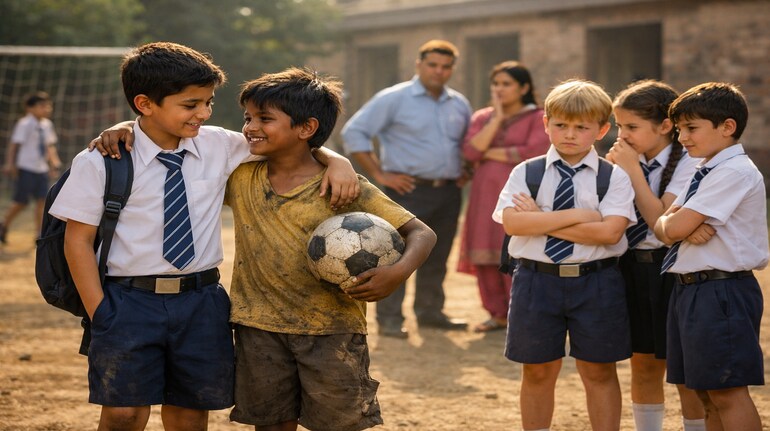
A Jaipur resident’s account of his son being socially ostracised for playing football with a neighbour’s child has triggered a wider conversation on how class prejudice quietly seeps into childhood.
The episode came to light after Gaurav Kherterpal took to X to describe how children in his lane stopped including his son in their games. The reason, he said, was not a quarrel or rivalry, but the fact that both father and son had begun playing daily with a Nepali boy whose father works as a domestic help in the neighbourhood.
My son has been boycotted by kids in our lane. The reason - we (yes, both of us) started playing football everyday with a Nepali kid whose father is a servant in one of the neighbouring houses.For context, in my lane - almost everyone (barring yours truly) has a business, net… — Gaurav Kheterpal (@gauravkheterpal) January 17, 2026
In his post, Kherterpal painted a sharp contrast between material wealth and moral values. He noted that most families in the lane are affluent, own luxury cars, employ multiple household staff and host lavish social gatherings. Yet, despite this outward display of success and modernity, allowing children to play with a “servant’s kid” was apparently seen as crossing an invisible social line. “This is not about money. This is not about success,” he wrote, calling it “classism dressed up as culture and values”.
Kherterpal argued that while urban India prides itself on good schools, global exposure and polished English, it often passes on a far uglier legacy to the next generation, the belief that a person’s dignity is tied to their surname, income or the job their parents do. Questioning whether society has truly progressed, he added that while caste hierarchies may have weakened in some spaces, economic status and symbols of wealth continue to shape social behaviour.
The post quickly went viral, drawing strong reactions from users who said such discrimination is widespread but rarely acknowledged. Many praised Kherterpal for the values he is instilling in his child, calling the incident a stark reminder of how casually exclusion is normalised.
One user shared a similar experience, recalling how employers insist their drivers eat at the same restaurant but at separate tables, a practice so common, they said, that it often goes unquestioned. Another pointed out that even “educated” families frequently discourage their children from interacting with kids from poorer households, citing instances where domestic workers’ children were ignored or isolated in housing society parks.
Discover the latest Business News, Sensex, and Nifty updates. Obtain Personal Finance insights, tax queries, and expert opinions on Moneycontrol or download the Moneycontrol App to stay updated!
Find the best of Al News in one place, specially curated for you every weekend.
Stay on top of the latest tech trends and biggest startup news.