An IIT Bombay graduate recently voiced concern about the rising cost of living across India, warning that even smaller cities were no longer shielded from the mounting financial pressures. Monali Dambre, who is currently based in Bengaluru, took to X to highlight how significantly daily expenses—particularly for essential groceries—had increased in recent times. Her observations sparked a wider debate on inflation, affordability, and economic sustainability for the lower and middle-income population.
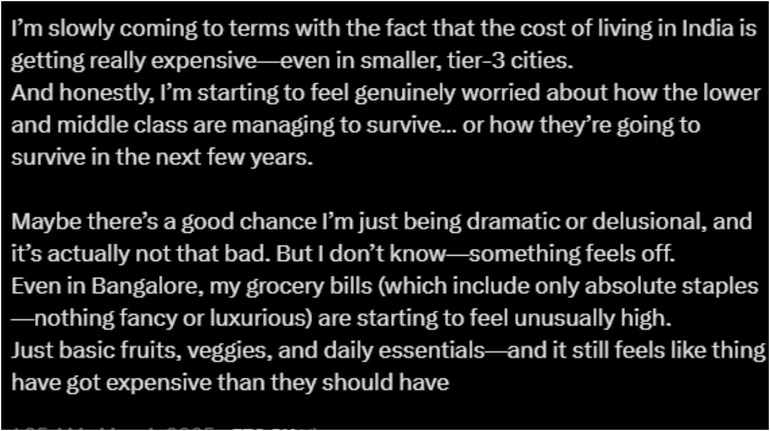
“I’m slowly coming to terms with the fact that the cost of living in India is getting really expensive—even in smaller, tier-3 cities. And honestly, I’m starting to feel genuinely worried about how the lower and middle class are managing to survive… or how they’re going to survive in the next few years,” Dambre wrote in her widely shared post.
Expressing a sense of unease over rising expenses, she continued, “Maybe there’s a good chance I’m just being dramatic or delusional, and it’s not that bad. But I don’t know—something feels off. Even in Bangalore, my grocery bills (which include only absolute staples—nothing fancy or luxurious) are starting to feel unusually high. Just basic fruits, veggies, and daily essentials—and it still feels like things have got expensive than they should have.”
Im slowly coming to terms with the fact that the cost of living in India is getting really expensiveeven in smaller, tier-3 cities.And honestly, Im starting to feel genuinely worried about how the lower and middle class are managing to survive or how theyre going toMonali (@monali_dambre) May 3, 2025
The post quickly gained traction, with many users weighing in on the issue. Some debated whether the method of shopping had a role to play. While a few suggested that online quick-commerce apps were driving up bills, others countered that even local markets and physical grocery stores were offering little to no relief from inflation.
“I have one anecdote to take from it what you will—I went grocery shopping in the local market near my house in Indiranagar once. The veggies were the same price as Zepto, the dals etc were more expensive,” one user wrote in response.
Others highlighted broader economic issues affecting costs across sectors. “Real estate is the biggest culprit,” a user argued. “People end up paying very high rents and EMIs. Also, all businesses need to keep prices high just to cover the exorbitant rents of their premises. Sad thing is government will not do anything, because all politicians' black money is hoarded in real estate. Any country that can fix its real estate can keep the costs low for everyone.”
Another user noted, “Yes, the inflation on food and groceries is way too high. In general, the cost of living has increased far above the usual 5–6% annual year-on-year limit.”
A fourth person echoed the sentiment: “It’s true, the cost of living is too high today, especially for lower and middle-income people. One often finds themselves working non-stop each day and spends no time in socialising, travelling, or stepping out for entertainment. After demonetisation and GST, the expenses started rising. During COVID it rose further and now heavy taxation has made life miserable for many.”
Discover the latest Business News, Sensex, and Nifty updates. Obtain Personal Finance insights, tax queries, and expert opinions on Moneycontrol or download the Moneycontrol App to stay updated!
Find the best of Al News in one place, specially curated for you every weekend.
Stay on top of the latest tech trends and biggest startup news.