Note to readers: Hello world is a program developers run to check if a newly installed programming language is working alright. Startups and tech companies are continuously launching new software to run the real world. This column will attempt to be the "Hello World" for the real world.
In 2008, I had joined the local news desk of a prominent newspaper in Bengaluru, which was soon to become India’s Silicon Valley. Among other things in the mid-noughties, I had half a page in the paper to feature new gadgets every week. Nokia, Blackberry, Samsung, and a few other companies were regulars on the page. Around 2012, I moved to a business daily to write on technology services companies.
Soon I got bored with tracking quarterly results and rehearsed statements. India’s startup ecosystem was in its infancy and I quit the paper to join a start-up blog. It was something new, and their excitement was infectious.
As start-ups became the buzzword, I went back to the pink paper to write about them. I was able to upgrade my life a little. I moved into a middle-class apartment with my family. I got some furniture and so on. After selling the Nokia phone, I had to upgrade my phone. After much research, I zeroed in on a Micromax handset.
Experiences With Indian Products
Micromax, a Gurgaon-based company that began making handsets in 2008, had some smartphones that were affordable on a young journalist’s salary. Going from a phone that ran on Symbian (Nokia’s proprietary operating system) to an Android-based phone was like suddenly being able to breathe after being underwater for a while.
There were tens of thousands of apps to play with and an operating system that worked really well. But I soon realized that I was running out of memory faster than I could delete apps, music, and photos. The phone began to slow down, and I was starting to get that same sinking feeling I had the evening I sold the Nokia phone.
Around the same time, I had the opportunity to visit the office of e-commerce firm Flipkart for a story about how it scaled its back-end systems to meet the unprecedented demand for a new phone from an unknown brand called Xiaomi.
Everybody was surprised it sold out so quickly. In fact, they even thought their website had a glitch when buyers complained that they were getting ‘out of stock’ messages.
But it turned out that, just like me, there were millions of Indians waiting for a credible (and affordable) alternative to the models then available. The phone was priced unbelievably low for the features it offered, and that was its main draw.
This was the sweet spot Xiaomi hit. As the years went by, I watched Xiaomi’s phenomenal growth in India. It became India’s largest smartphone company and rivaled Samsung.
Close Encounter With Xiaomi
In the winter of 2018, I went to Beijing on a reporting assignment. I hung out at Xiaomi’s first store in Beijing, near its headquarters in Haidian. I also took a stroll in Haidian Park, where I saw real-world applications of artificial intelligence (AI)—such as a running track that could identify runners and keep score of their mileage, a virtual Shifu who taught tai chi to visitors, and an almost autonomous bus. It was a stunning display of China’s technological progress.
My previous visit to Beijing was in 2011, and the difference was evident. China’s Silicon Valley was evolving rapidly. And in it, companies like Xiaomi were hatching world-domination plans. I was awestruck and a little sad. My admiration was tainted with melancholy because I had seen Bengaluru, India’s Silicon Valley, evolve into an urban mess just like most Indian cities that once held promise.
At the same time, China seemed to have pulled ahead to become a global superpower. I had begun to track Chinese technology companies and their growth back in India closely. I wondered often, what made these Chinese companies so successful? Is there something we can learn from them? The seeds of a book were sown in my head then.
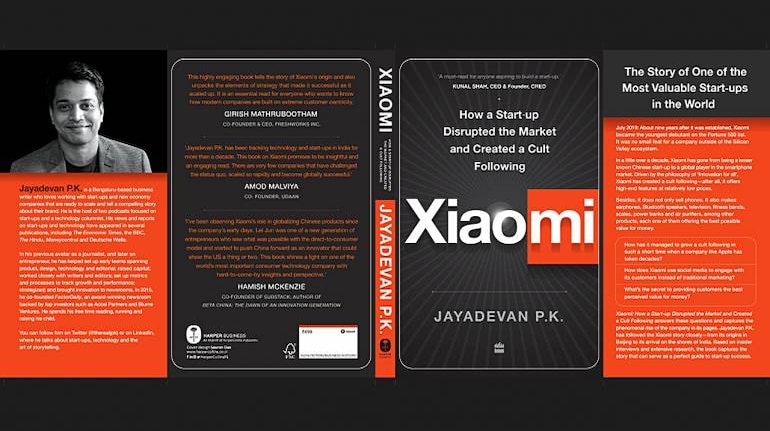
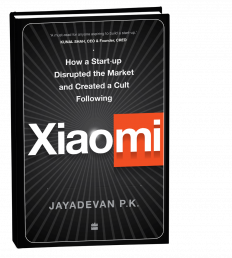
Earlier this month, my book titled ‘Xiaomi: How a Startup Disrupted the Market and Created a Cult Following,” was released for preorders. Xiaomi’s rise and global success is an amazing story of many factors that came together. It is as if someone has masterfully knit together a future-proof strategy, carefully picking elements from many different industries and backed it with heads-down execution.
 I have tried to capture Xiaomi’s journey from a little-known software company in Beijing to one of the youngest companies to enter the hallowed Fortune 500 list. I’ve also interspersed the book with elements of strategy that may be useful for other start-ups to understand. The book attempts to throw light on the company’s strategy to become an internet company and how user-centricity is core to it. It also talks about the factors that made China fertile grounds for several billion-dollar companies.
As a growing startup ecosystem and a nation of techno-optimists, India has much to gain from tracking the journey of China and companies like Xiaomi. Micromax and the previous generation of phone makers may have lost the battle but the opportunity for us to create economic growth is still ahead of us and the key to it will be collaboration, not confrontation, as is evident from the way Xiaomi has embraced the Make in India program, creating a win-win for both the company and India’s fledgling electronics manufacturing sector. India has many things going for it, especially in sectors like enterprise software and internet products, minus the negative sentiments that Chinese companies often have had to face.



Discover the latest Business News, Sensex, and Nifty updates. Obtain Personal Finance insights, tax queries, and expert opinions on Moneycontrol or download the Moneycontrol App to stay updated!
Find the best of Al News in one place, specially curated for you every weekend.
Stay on top of the latest tech trends and biggest startup news.