-
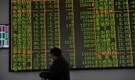
Japan's Nikkei falls 3% amid profit booking, worries over spike in interest rates
Japan's revised official data showed that its GDP expanded 0.4 percent in the October-December period last year, paving the way for Bank of Japan to raise interest rates.
-

Japan leapfrogs China to become world’s second-biggest stock market
China overtook Japan in 2014 but its gauge has lost value since the turn of this year
-
Asian stocks ease, cautious ahead of central bank announcements
Japan's benchmark Nikkei average opened down 0.52 percent while the broader Topix edged 0.41 percent lower. Stocks in South Korea and Australia fell.
-
Indian benchmark indices may open up tracking global cues
Indian benchmark indices are likely to open up tracking positive global cues. SGX Nifty at the time of writing this story was up 13 points at 8204.00.
-
Asia markets open mixed; Nikkei down, Kospi and ASX trade flat
In Japan, the Nikkei 225 opened down 0.41 percent, while the Topix fell 0.34 percent.
-
Asia higher; ASX up 0.9%, Nikkei up 0.3%, China, Taiwan closed
Japan's Nikkei 225 gained 0.25 percent, while the Topix index was up 0.34 percent with major banking stocks gaining more than 1 percent each.
-
Indian indices may open lower; 2 central bank policy meet loom
Indian indices may take cues from the global data and open lower today. SGX Nifty closed down 30 points at 8739.50.
-
EMs gaining from asset switch, but expensive now: Morgan Stanley
Jonathan Garner of Morgan Stanley sees India as a fast growing market and expects the growth to accelerate further in the coming days. He says it is among the bright spots in the post-Brexit world. He is bullish on consumption, industrial and cyclical plays
-
Nikkei leads Asia market losses; Hang Seng, ASX 200 down
ASX 200 fell 0.36 percent, with a 2.17 percent drop in the energy sector. In Hong Kong, the Hang Seng index was down 0.32 percent in early trade, while Chinese mainland shares were flat.
-
Asia markets mostly higher, but Japan falls behind
The Japanese benchmark Nikkei 225 was down 0.31 percent in morning trade, while the broader Topix slipped 0.74 percent. Across the Korean Strait, the Kospi was up 0.25 percent, while Hong Kong's Hang Seng index was up 0.38 percent in early trade
-
Asia markets mostly higher despite Wall Street selloff
"2016 should end much better than it has started off for investors, ultimately providing okay investment returns, but expect a continued volatile ride," Shane Oliver, head of investment strategy at AMP Capital, said in a note Thursday.
-
Nikkei leads declines in Asia after Fed stands pat
Asian shares declined early Friday after the Federal Reserve cited concerns about global economic growth in its decision to hold off on its first rate hike in nearly a decade.
-
Shanghai Comp skids 7.6% to end at 8-month low
Earlier in the session, the Tokyo bourse had staged a comeback, alongside most of the other regional stock indices, on the back of bargain hunting in beaten-down stocks and as the Dow Jones Industrial Average futures opened up more than 100 points Monday evening in the US.
-
Nikkei tops 20,000 for 1st time in 15 yrs; up 2.4% on week
The rally has been driven by many factors, including hopes of higher shareholder returns, a rise in corporate earnings, a recovery in domestic consumption and more share buying, both real and imagined, by Japanese public investors.
-
Nikkei closes at highest level in 7.5 years
The Nikkei benchmark gained 1.9 percent to 17,979.72, the highest closing level since July 2007.
-
Nikkei edges up on US jobs data, China worries limit gains
The Nikkei ended up 0.4 percent at 17,711.93, but off an intraday high of 17,799.49, the highest since Jan. 30.
-
Nikkei rises to fresh 5-week high; US jobs data eyed
Japan's Nikkei share average rose to a fresh five-week high on Friday as a weak yen lifted risk appetites following better-than-expected US jobless claims and the European Central Bank's decision to keep its rates unchanged.
-
Nikkei jumps to 5-week high as GPIF shows risk appetite
As GPIF allocation hopes buoy risk appetite, Japan's Nikkei share soared to a five-week high.
-
Nikkei rises to 3-week high on US manufacturing; G20 eyed
The Nikkei ended 416.49 points higher at 14,865.67, the highest closing level since January 31. For the week, the index gained 3.9 percent, the biggest weekly rise since mid-November and snapping a 6-week losing streak.
-
Nikkei jumps 2.2%, biggest gain in a week, ahead of US data
The Nikkei ended at 14,462.41, recovering from a four-month trough of 13,995.86 set on Wednesday. It was the biggest daily percentage rise since January 29.
-
Nikkei tumbles to one-month low on strong yen
The Nikkei ended 489.66 points lower at 15,422.40 after hitting as low as 15,383.69, its lowest level since December 18. It was the biggest daily percentage drop since August 7.
-
Nikkei suffers worst weekly loss since October
The benchmark Nikkei was down 2.3 percent this week, marking its biggest weekly decline since the period ended October 25. It surged 57 percent last year to log its best annual rise since 1972, driven by Japan's massive fiscal and monetary stimulus campaign.
-
Nikkei climbs above 16000 on US trade data
The Nikkei ended 1.9 percent higher at 16,121.45, nearing a six-year high of 16,320.22 reached on December 30.
-
Nikkei retreats from 6-year high
The Nikkei shed 0.6 percent to 16,083.30 in mid-morning trade after earlier hitting a six-year high of 16,232.69. The index was on track to end a seventh straight day of gains, its longest such run since October.
-
Nikkei bounces to hit six-year closing high
Nikkei has been underpinned by a soft yen after the US Federal Reserve this week finally announced it would start dialing back its massive stimulus, sending the dollar broadly higher.