

co-presented by
ASSOCIATE SPONSORS
co-presented by

ASSOCIATE SPONSORS


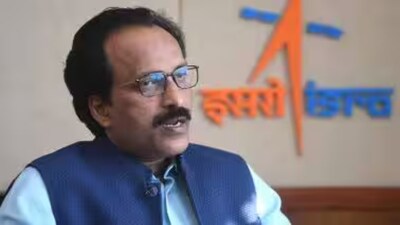
The rocket is getting ready and scientists at the Bengaluru-headquartered space agency are expecting a launch later this month, he said.

Speaking at a session on space technology and defence during the Bengaluru Tech Summit, which also saw the launch of the Draft Karnataka Space Tech Policy, Somanath emphasised the importance of cost-effective production
He also praised tech mogul Elon Musk for his innovative work in the space sector, noting that Musk's achievements have inspired global efforts, including those within ISRO

India, with its own ambitions of establishing a lunar base by 2050, sees this collaboration as a potential opportunity to accelerate its space goals.
Somanath further stated that the only options available are from Russia or the US. He said the US has the Crew Dragon spacecraft, and Russia has the Soyuz, and either of these could potentially handle the rescue.

ISRO Chairman S Somanath emphasized the importance of making this data widely available. "This data is not going to be confined with those scientists who have created those instruments, but it will be made available to all the researchers of the country and the world for furthering the outcome of this," Somanath stated during the National Space Day celebrations in New Delhi.

The testing phase of the Pushpak RLV achieved a significant milestone as it was airlifted by an IAF helicopter to an altitude of nearly 4.5 km. Following the completion of predefined criteria for operational readiness, the RLV was subsequently released to start its testing procedures.

Speaking of the moon mission, he said that ISRO must have continuous access to the moon and that this mission would not just happen by an accident but would require a continuous exercise of missions to the moon and then expanding knowledge on the moon in a substantial manner.
Somanath was speaking to reporters on the sidelines of the convocation of the Jawaharlal Nehru Technological University (JNTU) here.
The Bengaluru headquartered space agency earlier in the day had successfully placed its first X-Ray Polarimeter satellite in PSLV C58 mission.
Speaking at `Techfest', an annual science and technology event organised by the Indian Institute of Technology Bombay, he said it is important to improve the ability of satellites to detect changes, to bring in more of AI-related and data-driven approach to analyse data, reduce data downloads and get only the necessary information.
Somanath also said there is a good opportunity to launch a mission to explore planet Venus by 2028.

The Navigation with Indian Constellation (NaVIC) uses seven satellites to provide real-time positioning and timing services in India and an area extending upto 1,500 km from the country's borders.

The space agency has also lined up the first test flight of the 'abort mission' for Gaganyaan, the country's first human spaceflight, early next year.
Addressing a day-long meeting on Venusian science, Indian Space Research Organisation (ISRO) Chairman S Somnath said the Venus mission has been conceived, a project report made and "money identified”.


