




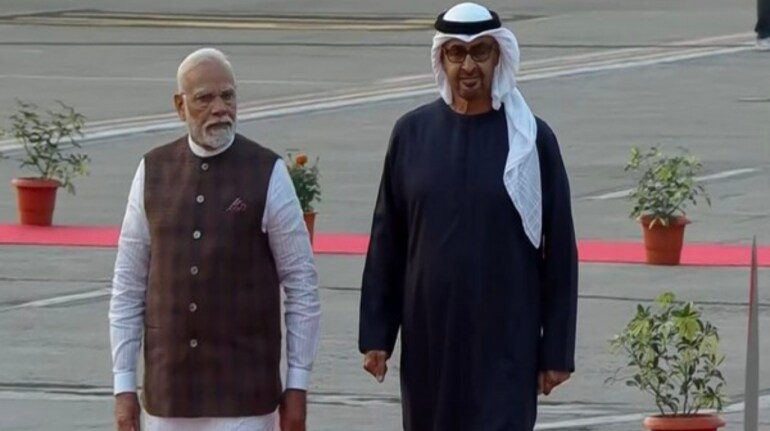
Indian Prime Minister Narendra Modi is scheduled to visit the United Arab Emirates (UAE) on February 13-14. During his two-day official visit, he will inaugurate the BAPS Mandir. The BAPS Shri Swaminarayan Mandir is the first traditional Hindu temple in Abu Dhabi and is built on 27 acres of land donated by the UAE leadership, symbolising the long-standing cultural, social, and economic ties between India and the Gulf region. Additionally, the Prime Minister will address the Indian community in the UAE at an event in Zayed Sports city in Abu Dhabi.
Several economic deals are also expected to be signed during the Prime Minister’s visit. This comes after the President of the United Arab Emirates, Mohammed bin Zayed Al Nahyan, made a rare speech at the Vibrant Gujarat Summit.
India-UAE political relationsThe bilateral relationship between India and the UAE is strong, and trade ties between the two nations run deep. Dating all the way back to 3,000 BC, India and the UAE were a part of the trade trio - Meluha (most scholars identified as the Indus Valley Civilization, present-day Indian subcontinent), Magan (Oman and parts of the UAE), and Dilmun (Bahrain and parts of Saudi Arabia), according to historical records.
The discovery of valuable goods and spices in Roman settlements along Egypt's Red Sea coast provides evidence of this ancient trade, but since H H Sheikh Zayed Bin Sultan Al Nahyan became the ruler of Abu Dhabi in 1966 and the UAE Federation was established in 1971, the relationship between the UAE and India has developed further.
Also read: PM Modi to visit UAE today; check full schedule and key detailsThe New EraWith PM Modi's 2015 visit, a 34-year hiatus of an Indian PM to the UAE ended, and a new chapter in their relationship began. The relationship has since developed quickly, leading to the conclusion of three major agreements: a comprehensive strategic cooperation agreement in 2017, the Comprehensive Economic Cooperation Agreement (CEPA) in 2022, and the more recent Bilateral Investment Treaty (BIT) on February 1, 2024.
According to a press statement released by the Ministry of Commerce & Industry on May 1, 2023, the UAE and Saudi Arabia are India’s third and fourth largest trading partners. In fact, UAE is the first country where PM Modi has visited six times. PM Modi’s upcoming visit to the UAE will be his seventh.
Also Read | Abu Dhabi weighs investment pledges worth $50 billion for India
India-UAE relations gaining strength: Significance of the visit, MoUs, bilateral talksThe UAE’s Ministry of Investment has recently signed three Memorandums of Understanding (MoUs) with India. These agreements aim to expand bilateral investment cooperation in the renewable energy, food processing, and healthcare sectors. The relevant Indian ministries signed the MoUs, highlighting the UAE's commitment to supporting India's economy, which is expected to grow by 7.3 percent this fiscal year. A Ministry of Commerce and Industry press statement said that the trade volume between India and the UAE has increased by 16 percent to reach $ 85 million in FY 2022-23. The UAE is now the fourth-largest source of FDI for India, with a $ 3.5 billion investment.
MoUs were signed to establish a Local Currency Settlement System and enhance financial collaboration. This agreement was established on July 15, 2023, and aims to promote cross-border transactions.
Also Read | India-UAE Currency Deal: Internationalising the rupee, one step at a time
This cooperation will involve the reciprocal acceptance of domestic payment systems by linking national payment networks.
Also Read | Cabinet approves bilateral investment treaty with UAE
In November 2023, the Education Ministers of both countries signed an MOU to enhance educational collaboration by promoting the mobility of students, faculty members and other initiatives.
The landmark Bilateral Investment Treaty (BIT)The most recent Bilateral Investment Treaty (BIT) between India and the UAE aims to promote economic cooperation between the two nations. By encouraging bilateral investments and providing a secure and stable environment for investors, the BIT supports the Atmanirbhar Bharat initiative.
Moreover, the BIT is not only an isolated agreement but also a part of India's broader economic partnerships and initiatives. By establishing strong economic ties with the UAE, a major trade partner and a significant source of Foreign Direct Investment (FDI), India enhances its position in the global economic landscape.
The ‘energised’ India-UAE bondThe agreements also have significant implications for India's energy security, as it helps to diversify its sources of crude oil and natural gas.
Also Read | India, UAE ink pact for possible energy grid connectivity between two countries
Indian Oil Corporation Limited (IOCL) and Abu Dhabi National Oil Company (ADNOC) have signed an agreement for the purchase of 1.2 million metric tonnes of LNG over a period of 14 years, starting from 2026-2039. Additionally, in January 2024, ADNOC Gas signed a 10-year deal to supply 0.5 million metric tonnes per annum of LNG to GAIL India. Both countries have also agreed to promote cooperation and investments in Green Hydrogen through a Memorandum of Understanding signed in January 2023.
India's collaboration with the UAE to purchase crude oil and natural gas highlights the strategic importance of energy cooperation between the two nations. The bilateral agreements facilitate the procurement of essential energy resources, contributing to India's energy security and strengthening economic relations between the two countries.
Boosting businesses and promoting wealth fundsIndian MSMEs, or micro, small, and medium-sized enterprises, now have a dedicated venue to market and exchange their goods thanks to the opening of Bharat Mart in Dubai. By boosting commercial ties between the two countries, this programme not only elevates Indian companies internationally but also fortifies economic collaboration.
The UAE sovereign wealth funds, such as Abu Dhabi Investment Authority (ADIA) and Mubadala Investment Fund, have significant opportunities for investments in India. UAE entities, including ADIA and Mubadala, made investments during this period, with ADIA investing $500 million in Lenkstart and Mubadala investing $300 million in Cube Highways. The Middle-East Economic Corridor project is strategically important in enhancing economic ties between India and the UAE. The corridor connects Mundra Port in Gujarat to Fujairah Port in the UAE via sea routes, and extends further to Saudi Arabia and Jordan via rail connections. The project aims to establish an alternative trade route, challenging existing global initiatives.
Also Read | UAE wealth fund plans $4-5 billion in investments via India's new finance hub
The meeting in Dubai with Sheikh Rashid A Maktoum emphasises the value of interpersonal and diplomatic ties as it is anticipated that this one-on-one conversation will increase understanding between the parties and look into ways to further cooperation in areas of shared interest.
India-Gulf relations over the yearsSince 2014, the relationship between India and West Asia, particularly the GCC, has deepened into a strategic partnership, with India's West Asian policy being a game-changer. This includes sub-regional and regional approaches, special attention to certain relationships, and support for major Gulf powers in the BRICS and the SCO.
India's security and stability in West Asia and GCC are linked to its critical interests such as energy security, economy, and nine million expatriates. The Indian Navy deployed 10 naval ships in the region to provide security and relief to commercial ships.
UAE President, Sheikh Zayed, visited India as Chief Guest on Republic Day in 2017, for the G20 Summit, and recently for the Vibrant Gujarat Summit. India signed the first Comprehensive Economic Partnership Agreement (CEPA) with the UAE which could become a template for India-GCC FTA. India and Oman are also discussing a Free Trade Agreement (FTA). Saudi Crown Prince Mohammed bin Salman paid a highly important visit in September last year and was on a State visit to India after the G20 Summit.
Special purpose vehicles have been created for trade and investments, energy, climate, space, cyber security, nuclear energy, ICT (Information and communication technologies) and AI. High-level councils steer the progress and projects. India is focusing on sub-regional and regional initiatives. It welcomed normalisation of ties between Israel and the Gulf and WANA countries and appreciated the lifting of the Qatar blockade. Initiatives like I2U2 (Group of India, Israel, the United Arab Emirates, and the United States) and IUSU (Group of (India, USA, Saudi Arabia and UAE)) are already underway. India, UAE, Saudi Arabia, USA, and European leaders signed the IMEEC (India-Middle East-Europe Economic Corridor) connectivity agreement at the G20 Summit. The project could be a game changer, but it's currently under a cloud due to the Israel-Hamas conflict.

Discover the latest Business News, Sensex, and Nifty updates. Obtain Personal Finance insights, tax queries, and expert opinions on Moneycontrol or download the Moneycontrol App to stay updated!
Find the best of Al News in one place, specially curated for you every weekend.
Stay on top of the latest tech trends and biggest startup news.




