






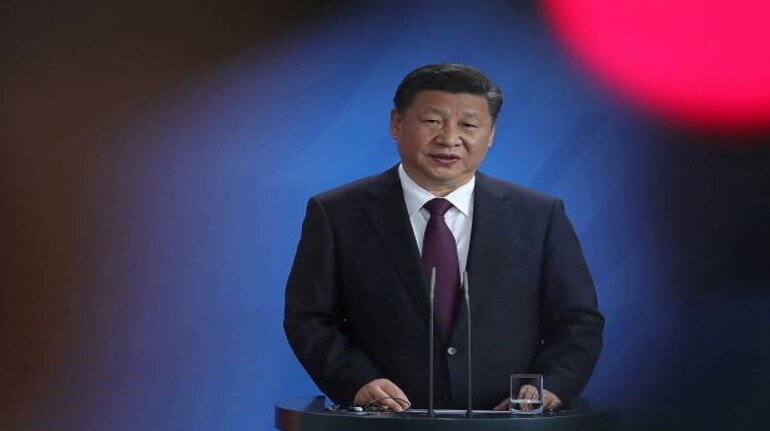
A record third term for Xi Jinping as general secretary of the Chinese Communist Party has sparked off speculation that the title of 'Chairman of the party', could be revived to make him a leader for life.
The title of Chairman of the Chinese Communist Party is closely associated with Mao Zedong, the founder of the People’s Republic of China, which he led from its establishment until his death in 1976.
The Chairman’s post gave Mao full authority over the party, the People’s Liberation Army, and the government. The position was without a set tenure. But for decades the title was not in use.
The 20th National Congress of the CCP that began deliberations in Beijing on Sunday, is expected to endorse Xi Jinping’ third-term.
Xi is the most powerful leader of the Communist party since Mao Zedong and has been making changes in the party to further consolidate his position.
He now holds the posts of General Secretary of the CCP, Chairman of the Central Military Commission and the President of China.
After Mao’s death, two of his successors, Hua Guofeng and Hu Yao Bang also used the title of Chairman.
But the title was disbanded in 1982 by Deng Xiaoping, the architect of China’s economic liberalisation to prevent autocratic tendencies among China’s leaders.
Deng was among the scores of leaders in the Chinese Communist party who suffered humiliation and harassment and was purged from the party on more than one occasion for questioning Mao’s absolute power.
If the party’s constitution is strictly followed the general secretary of the party is responsible for convening the meeting of the 25-member Politburo and its Standing Committee and preside over the work of the Secretariat.
All other key issues, including appointments are discussed and decided at the Politburo’s Standing Committee—the highest decision-making body of the party.
The Politburo’s Standing Committee currently has seven members and Xi Jinping is one of them.
The titles of the party Chairman and general secretary have different levels of power. As general secretary, Xi can act as the moderator for the Politburo Standing Committee. He is equal to all other members and has one vote only.
But if he followed Mao’s precedence and took the title of Chairman of the party, he would have veto power over all the other members and his decisions could not ever be scrutinised or questioned.
If he wanted to be leader beyond his third-term he could remain in power for life as Chairman since the post does not have any date for retirement. The term period typically of five-years would therefore not be applicable for him any longer.
Deng had introduced a two five-year term for the general secretary to prevent any individual from accumulating all the power and running the party according to his whims.
According to experts, the position of Chairman creates suitable conditions for authoritarian rule and lacks internal checks within the party, even limited ones.
If Xi manages to revive the title, it could bring back memories of the horrific Cultural Revolution and long periods of social and political tensions within China.
Mao’s Great Proletarian Cultural Revolution of May 1966 had unleashed a decade of political and social upheaval in his bid to reassert control of the Communist Party.
It had led to the death of nearly 3 million people, forcibly exiled several million more and seriously damaged the country’s historical and cultural heritage.
The Cultural Revolution was preceded by Mao’s Great Leap Forward-- an economic and social programme to rapidly transform the agrarian economy to a modern industrialised socialist society.
A countrywide famine caused by mandatory agricultural collectivization led to the death of nearly 30 million people.
While those who were engaged in private farming were branded as “counter-revolutionary” and hounded.
“All the biggest disasters that occurred during the Communist rule were due to Chairman Mao’s unchecked power,” says a Chinese expert.
But Xi Jinping sees himself on a par with Mao
He has already broken the two five-year term limit enforced by Deng.
He has also managed to get his philosophy—” Xi Jinping’s Thought on Socialism with Chinese Characteristics for a New Era” inserted into the constitution.
This has put him above the status enjoyed by his two immediate predecessors—Jiang Zemin and Hu Jintao, as their philosophies were inserted in the constitution without their names.
Even Deng’s name was inserted in the constitution after his death.
Xi has been conferred with titles like the helmsman of the country and the people’s leader that were associated with Mao.
He is also the first leader since Mao who has been named in the party as a ‘Guide to good Communist behaviour.’
But titles in China are not always a true measure of authority. As an old man in the early 1990s, Deng only had the honorary title of head of the Chinese Contract Bridge Association, though he continued to wield supreme power.
However, the most significant development in Xi Jinping’s favour has been adoption of a document at the Central Committee plenum of the CCP last year that broke with the party’s stand against personality cults and lifelong tenure.
This has led to speculation that Xi might now change party rules and submit a constitutional amendment to the National People’s Congress—the Chinese parliament, next year to revive the post of Chairman.
Though Xi Jinping is the most popular leader in China at present but there could still be strong resistance to his attempt to turn the clock back to an era in the Communist party’s history that is hardly remembered with pride.
Deng had abolished the post to avoid tragedies like the Cultural Revolution and the Great Leap Forward from recurring.
The resurrection of the Chairman’s post would be a departure from the collective leadership model that had been put in place by Deng.
Though many see Xi Jinping’s third-term as the first step towards bestowing him with the title of Chairman of the Communist Party of China to make him leader for life.
But it may prove to be not such an easy journey after all.

Discover the latest Business News, Sensex, and Nifty updates. Obtain Personal Finance insights, tax queries, and expert opinions on Moneycontrol or download the Moneycontrol App to stay updated!

Find the best of Al News in one place, specially curated for you every weekend.
Stay on top of the latest tech trends and biggest startup news.




