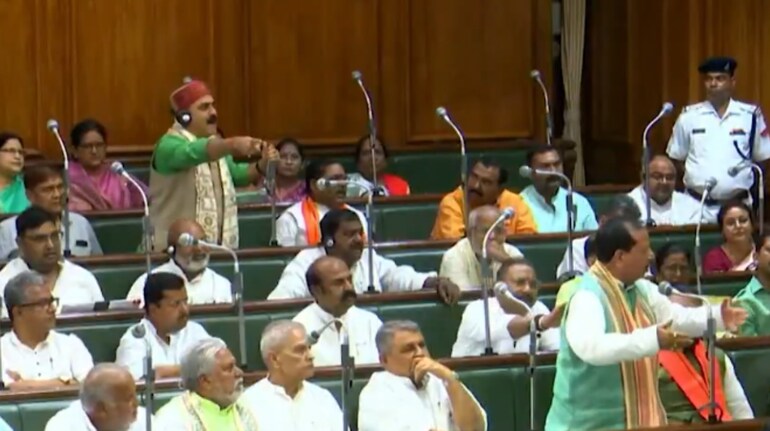

Even as voting for 37 seats in the Rajya Sabha across 10 states is underway, the political spotlight has turned to Bihar.
In the state, five Upper House seats are being contested amid intense manoeuvring between the ruling National Democratic Alliance (NDA) and the Opposition bloc.
With six candidates in the fray for five seats, the contest has become a test of legislative arithmetic, alliance discipline and the possibility of cross-voting. While the NDA is confident of securing four seats, its fifth candidate, Shivesh Kumar, would require at least three cross-votes from the Opposition for the alliance to achieve a clean sweep.
The Opposition, led by the Rashtriya Janata Dal (RJD), is meanwhile hoping to secure at least one seat with support from smaller parties, making Bihar the most closely watched battleground in Monday’s Rajya Sabha polls.
What is cross-voting?
Cross-voting occurs when a legislator votes for a candidate other than the one nominated by their own party or alliance. In Rajya Sabha election, this can happen when MLAs in a state assembly choose to back a rival candidate despite party directions.
Rajya Sabha members are elected by elected representatives of state legislatures through the Single Transferable Vote system of proportional representation. As voting in such elections can involve preferential ballots, cross-voting sometimes occurs when legislators defy party instructions and support another party’s nominee, potentially altering the expected outcome.
Numbers explained
The Bihar Legislative Assembly has a total strength of 243 MLAs. In elections to the Rajya Sabha, members are elected through proportional representation using the Single Transferable Vote system.
To determine how many votes a candidate needs to win, a quota is calculated using the formula:
Quota = [Total MLAs ÷ (Seats to be filled + 1)] + 1.
For the five Rajya Sabha seats from Bihar, the calculation works out to [243 ÷ 6] + 1, which equals roughly 41 votes. This means each candidate requires 41 first-preference votes to secure a seat.
Current strength
The ruling National Democratic Alliance (NDA)—comprising the BJP, JD(U) and allies—has around 202 MLAs in the assembly.
On the Opposition side, the Rashtriya Janata Dal has 25 MLAs, the Indian National Congress has six, and Left parties together have three, taking the core Opposition bloc to about 35 MLAs. Other parties include the All India Majlis-e-Ittehad-ul-Muslimeen with five MLAs and the Bahujan Samaj Party with one, according to NDTV.
With 202 MLAs, the NDA can comfortably secure four seats. Each seat requires 41 votes, so 41 × 4 = 164 votes.
After allocating these votes, the alliance would be left with 38 MLAs. To secure a fifth Rajya Sabha seat, the NDA would therefore need three additional votes from outside its bloc, which could come through cross-voting or support from smaller parties.
(With inputs from agency)Discover the latest Business News, Sensex, and Nifty updates. Obtain Personal Finance insights, tax queries, and expert opinions on Moneycontrol or download the Moneycontrol App to stay updated!
Find the best of Al News in one place, specially curated for you every weekend.
Stay on top of the latest tech trends and biggest startup news.