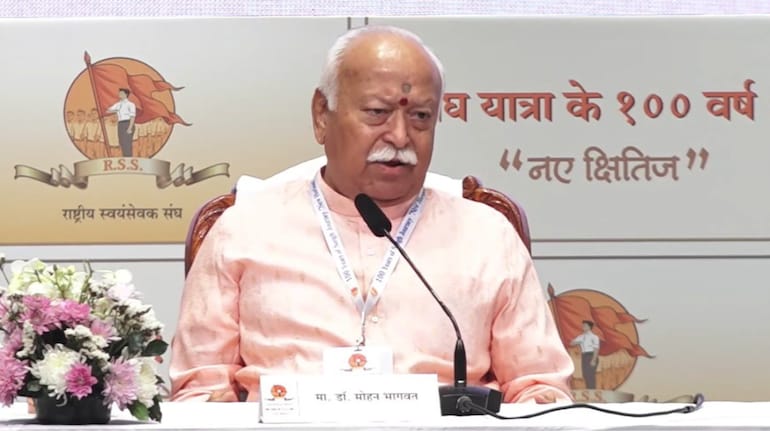
Knowing that the Rashtriya Swayamsevak Sangh (RSS) and the Communists follow diametrically opposed ideologies, it was quite an interesting moment when RSS Sarsanghchalak Mohan Bhagwat recently quoted Communist stalwart Rajani Palme Dutt’s 1940 treatise India Today to support the argument that India is an ancient nation and not a ‘nation in the making’, as advocated by sections of Left academia.
Dutt (1896–1974) was a prominent British journalist, theorist and a founding member of the Communist Party of Great Britain (CPGB) in 1921. He also exercised considerable influence over the Indian Marxist movement.
Bhagwat was speaking at a two-day RSS outreach programme in Mumbai, organised on 7–8 February this year as part of the organisation’s centenary celebrations. During the question-and-answer session on 8 February, Bhagwat pointed out that Dutt had argued that Indian nationalism is rooted in its own Bharatiya tradition and Sanskriti (culture).
It is important to examine Dutt’s arguments in detail, as his critique of fellow leftists and so-called liberals on the question of Indian nationalism equated them with agents of imperialism advancing the British imperial agenda. This has significant implications, as it challenges both Leftist historiography and Western paradigms.
Imperialist Thesis: India as a ‘Geographical Expression’
Dutt begins by outlining imperialist propaganda that denied the ancient roots of Indian nationalism: “At the outset we are faced with a ‘subtle’ question, which is still frequently raised by the apologists of imperialism, though it used to be more fashionable a generation ago than it is to-day, when the force of facts and events has largely destroyed its basis. Is there a people of India? Can the diversified assembly of races and religions, with the barriers and divisions of caste, of language and other differences, and with the widely varying range of social and cultural levels, inhabiting the vast sub-continental expanse of India, be considered a ‘nation’ or ever become a ‘nation’? Is not this a false transposition of Western conceptions to entirely different conditions? Is not the only unity in India the unity imposed by British rule?”
Several imperialist intellectuals had challenged India’s existence as a nation since the nineteenth century.
“There is not and never was an India, ‘no Indian nation, no “people of India”, of which we hear so much,” declared Sir John Strachey in 1888 (India: Its Administration and Progress).
Sir John Seeley was equally definite in his views. In The Expansion of England (1883), he wrote: “The notion that India is a nationality rests upon that vulgar error which political science principally aims at eradicating. India is not a political name, but only a geographical expression like Europe or Africa. It does not mark the territory of a nation and a language, but the territory of many nations and many languages.”
Dutt also cited the Socialist scholar H. W. Nevinson, who wrote in 1930 (in a review of the Simon Report, New Leader, 27 June 1930): “The almost insuperable difficulty of constructing (not criticising) a constitution or form of government to suit a minor continent including 560 native Indian States (nominally independent), races of 222 separate language peoples of two main and hostile religions—Hindus and Moslems in British India—and 10,000,000 outcasted or ‘depressed’ populations, also called ‘Untouchables’… Everyone who thinks of India ought to know these bare facts to start with.”
Dutt’s Critique of the Socialist and Liberal Position
Dutt dismantled this argument by observing: “The fact that a conclusion of such a character should have been reached by a sympathetic left-wing representative like H. W. Nevinson in a ‘socialist’ journal, and that this should have been typical of the reception, not merely in the official Press, but in almost the entire left Press at the time—liberal, labour or ‘socialist’—all accepting this official propaganda at face value, is indicative of the success of this method of (colonial) approach. For in truth this approach, despite all its air of impartial and statesmanlike recognition of unwelcome facts, is propaganda, and barefaced propaganda. It is by no means a presentation of the elementary ‘bare facts’ which everyone ‘ought to know’ about India, but a conscious and deliberate selection of facts with a purpose, and a distortion even of all that underlies those facts.”
Dutt went on to argue that if imperialists failed to deny India’s existence as a nation beyond a mere geographical expression, they would instead project the Indian nation “as a tribute to the achievement of British rule which has brought it into being”.
Imperialism and the Destruction of India’s Old Order
He further wrote: “With curious forgetfulness of the previous arguments which up to a generation ago so emphatically denied the Indian claim to national existence and dismissed India as ‘a geographical expression’, the alternative argument is now in general favour with the more sophisticated spokesmen of imperialism, to the effect that, if the Indian nation exists and has compelled recognition of its existence, then this must be regarded as the proud achievement of imperialism, which has brought Indian national consciousness into existence and planted the seeds of British democratic ideals in India.”
Dutt categorically stated: “The first and most important achievement of the British conquest and exploitation of India was the negative achievement, or destructive role—the ruthless destruction of the foundations of the old order of society in India.”
He concluded: “When Macaulay, on behalf of imperialism, imposed the system of Anglicised education, and defeated the Orientalists, his object was not to create Indian national consciousness, but to destroy it down to the very deepest roots of its being, in much the same spirit as the Tsarist methods of Russification of the conquered nationalities of the old Russian Empire.”
Earlier RSSFACTS columns can be read here.
(Arun Anand has authored two books on the RSS. His X handle is @ArunAnandLive.)
Views are personal, and do not represent the stand of this publication.
Discover the latest Business News, Sensex, and Nifty updates. Obtain Personal Finance insights, tax queries, and expert opinions on Moneycontrol or download the Moneycontrol App to stay updated!
Find the best of Al News in one place, specially curated for you every weekend.
Stay on top of the latest tech trends and biggest startup news.