
The Nifty 500 market breadth provides insight into the broader performance of stocks in the market and is currently near a 10-year low.
The Indian stock market has been correcting consistently since September 2024 due to the following key reasons:
1. Subdued corporate earnings
2. Depreciation of the rupee compared to the US dollar
3. Rampant FII selling
4. High market valuations
Additionally, a decrease in consumption and higher direct and indirect taxation have been adding fuel to the fire.
However, in the recent Union Budget, these issues were addressed to some extent by offering relief to the middle-class taxpayer. Also, the RBI's rate cut after five years is a step in the right direction to provide liquidity in the market while keeping inflation levels in check.
In this macroeconomic backdrop, where is the Indian stock market headed?
FinSharpe analysed the components of the Nifty 500 for a period of over 10 years to check how many stocks were trading above the 200 DMA at any given time. The 200 Day Moving Average (200 DMA) is a widely tracked indicator that is useful when analysing the trend of a particular asset. It is a long-term moving average.
The chart below shows the percentage of stocks in Nifty 500 that are trading above their 200 DMA.
Currently, only 25% of stocks are trading above their 200 DMA.
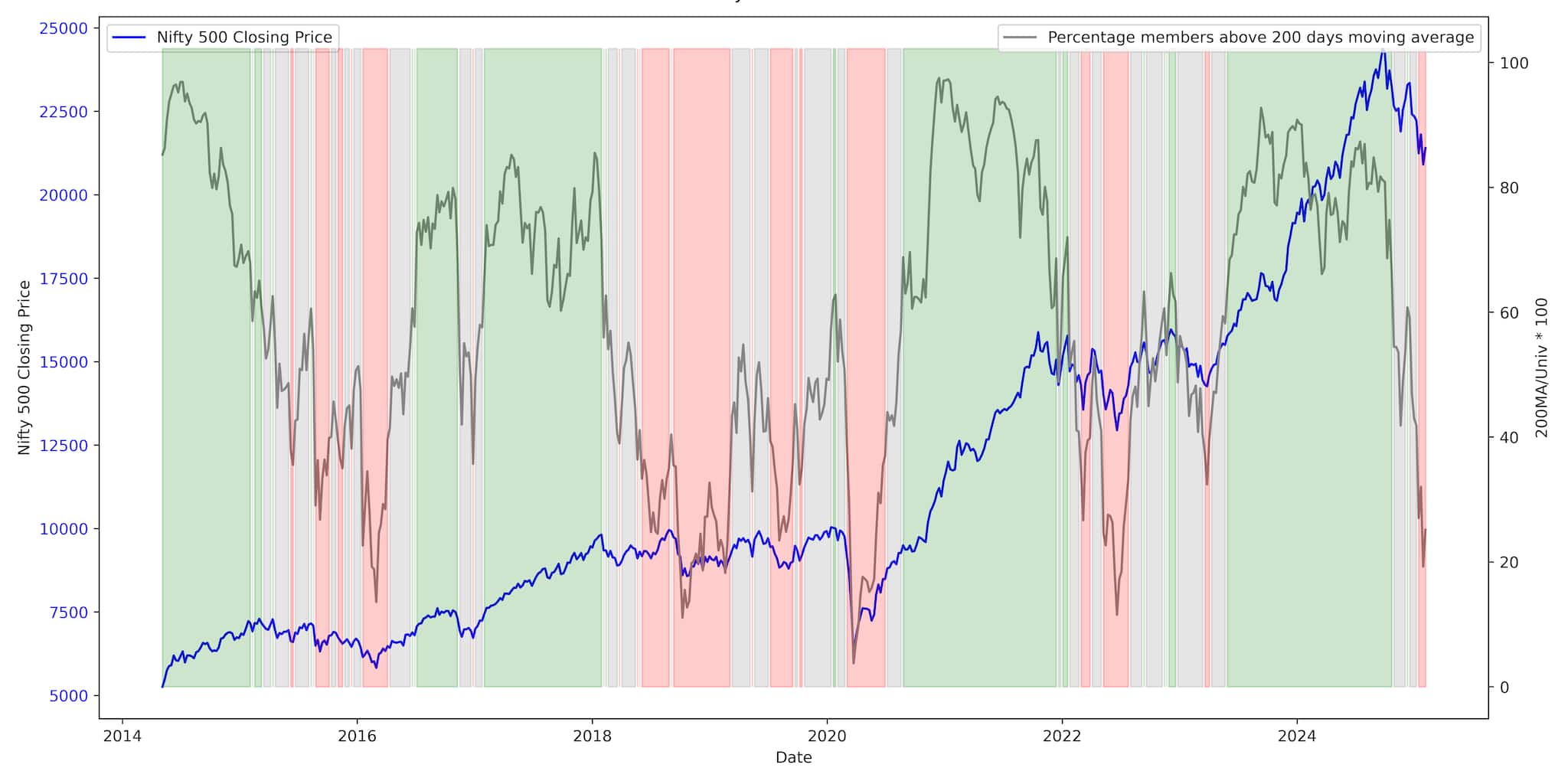
Observations based on the data above:
1) Whenever more than 80% of the Nifty 500 stocks were trading above their 200 DMA, the market corrected in the subsequent months.
2) Whenever less than 30% of the Nifty 500 stocks were trading above their 200 DMA, the market picked up in the subsequent months.
3) Generally, when the market breadth is picking up, it is an overall bullish sign. A declining market breadth shows a consolidation or bearish period.
The current market situation is similar to that in 2015, 2016, 2018, 2019, and 2022, where the market was largely bearish or sideways. Even in such years, the market gave a short-term bounce when it reached oversold levels.
Such markets could present an investment opportunity for the aggressive investor to pick good-quality stocks available at reasonable valuations. Based on the data, we can see that this situation has occurred only a few times in the last 10+ years.
However, for the conservative investor, it makes more sense to move to a multi-asset portfolio (equity, debt, and gold) and rebalance the allocation again when corporate earnings show a positive trend.
Discover the latest Business News, Sensex, and Nifty updates. Obtain Personal Finance insights, tax queries, and expert opinions on Moneycontrol or download the Moneycontrol App to stay updated!





Find the best of Al News in one place, specially curated for you every weekend.
Stay on top of the latest tech trends and biggest startup news.