






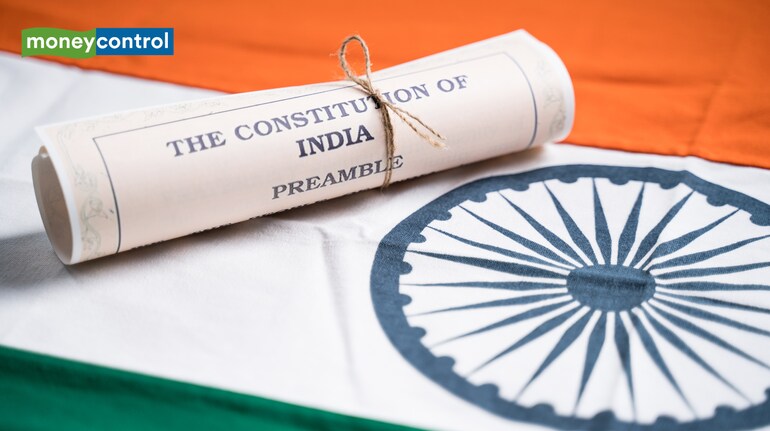
Dr Rajendra Prasad, President of the Constituent Assembly of India, addressed the Assembly one last time on November 26, 1949, before the Constitution was formally adopted. In that iconic speech, he expressed “two regrets” – one, that there were no qualifications laid down for legislators, and two, that the Assembly could not produce the draft Constitution in an Indian language. While acknowledging that the “difficulties in both cases were practical and proved insurmountable”, he said that it does not make the regret any less poignant.
In the decades that followed the commencement of the Constitution, a substantial body of scholarship emerged on the making of the Indian Constitution. Among the earliest and most authoritative contributions was B. Shiva Rao’s monumental six-volume work, ‘The Framing of India’s Constitution’, which remains an indispensable reference for constitutional historians. Granville Austin’s seminal study, ‘The Indian Constitution: Cornerstone of a Nation’, further illuminated the philosophical and political foundations of India’s constitutional experiment.
Recent scholarship on the Constitution
In more recent years, this field of inquiry has been enriched by a new generation of scholars. Arghya Sengupta’s ‘The Colonial Constitution’, Madhav Khosla’s ‘India’s Founding Moment: The Constitution of a Most Surprising Democracy’, Rohit De’s ‘A People’s Constitution’ and recently published ‘Assembling India’s Constitution: A New Democratic History’, jointly authored by Ornit Shani, collectively represent some of the most insightful and rigorous engagements with the framing and working of the Indian Constitution.
Each of these works stands out for its methodological rigour and interpretive depth, and together they have become indispensable reference points in discussions on the framing and early interpretation of the Constitution.
Yet, Dr Rajendra Prasad’s long-voiced concern about the linguistic exclusivity of constitutional discourse seems to persist even today. The most significant contributions to the study of India’s Constitution continue to appear predominantly in English, leaving a significant intellectual gap for Hindi and other regional language readers who seek to access and contribute to this vital strand of India’s democratic and constitutional thought.
An exception to the trend of writing in English
One notable exception to this predominance of English-language scholarship is the work of Ram Bahadur Rai, who has authored ‘Bharatiya Samvidhan: Anakahi Kahani’ (The Untold Story of India’s Constitution). Written in an engaging narrative form, the book is as insightful as it is accessible — combining perceptive analysis with a rich tapestry of anecdotes, thereby bringing the story of India’s Constitution closer to the Hindi-reading public. In doing so, Rai’s work represents an important intellectual intervention: it reclaims the narrative of constitution-making from the confines of English-speaking academia and places it within the broader linguistic context.
Now, two legal scholars of international repute, Tarunabh Khaitan and Surbhi Karwa, have made an earnest attempt to bridge the linguistic and intellectual divide. Their co-authored volume, ‘Hum Bharat Ke Log: Bhartiya Samvidhan Par Nau Nibandh’ (We, the People of India: Nine Essays on the Indian Constitution), represents a significant step towards making serious constitutional scholarship available in Hindi.
Professor Tarunabh Khaitan, who holds the Chair of Public Law at the London School of Economics and Political Science (LSE), and Surbhi Karwa, currently a PhD candidate at the University of New South Wales (UNSW), Sydney, bring both academic rigour and pedagogical clarity to this endeavour.
Importance of the Preamble in interpretation
The book comprises nine essays, each addressing a distinct and significant aspect of the Indian Constitution. The opening essay focuses on the Preamble — its meaning, significance, and the debates surrounding it. The authors engage thoughtfully with controversies such as the inclusion of the words “secular” and “socialist” through the 42nd Amendment, examining both their historical and interpretive implications.
In a particularly articulate manner, the essay underscores the centrality of the Preamble in constitutional interpretation. As the authors note at the outset, whenever a constitutional provision admits of more than one possible interpretation, the judiciary tends to prefer that interpretation which aligns most closely with the spirit and intent of the Preamble.
Citizenship
Then, chapter 9 addresses one of the most debated and controversial issues in recent times: citizenship. It examines the three major amendments to India’s citizenship law, enacted in 1986, 2004, and most recently in 2019. The authors argue that while the 2019 amendment claims the legitimate objective of protecting minority communities from persecution and violence in neighbouring countries, it explicitly excludes Muslims, rendering the law inconsistent with Article 14, which guarantees equality before the law and equal protection to all persons, regardless of citizenship.
Drawing on the Supreme Court’s ruling in the Anwar Ali Sarkar case, the authors invoke the two-pronged test under Article 14: classification must be based on an intelligible differentia and must have a rational nexus to the law’s objective. The authors contend that the 2019 amendment fails both criteria, as excluding a particular religious group lacks a rational connection to its stated humanitarian purpose. Through this analysis, the essay delves into broader tensions surrounding equality, secularism, and citizenship in contemporary India.
Rule of law, in theory and practice
The essays on federalism, democracy and the electoral system, and the separation of powers are equally insightful, offering nuanced perspectives on India’s constitutional architecture. However, it is Chapter 3, which delves into the rule of law, that stands out for its crisp and powerful critique. The essay delivers a strong indictment of arbitrariness in state action, demonstrating the authors’ deep legal understanding and their ability to connect doctrinal principles with practical governance challenges. Through precise analysis and well-chosen examples, the chapter underscores the centrality of the rule of law in preserving constitutional morality and protecting individual rights.
The book, which spans approximately 110 pages including the preface and epilogue, demonstrates that indeed “brevity is the soul of wit”. Despite its concise length, it addresses a wide array of important constitutional issues with remarkable clarity and precision. Only at a few points does the narrative slip into a more critical or argumentative mode, momentarily eclipsing the legal focus; yet, these instances are rare and do not diminish the overall rigour and coherence of the work.
It’s a milestone in reaching a larger audience
While the attempt to write a serious work on the Constitution in Hindi by scholars whose primary language of research and writing is not Hindi is undoubtedly laudable, a close reading of the book reveals certain limitations. The prose often appears strained and overly deliberate, giving the impression of a laboured translation rather than an organically conceived Hindi text. The language, though technically precise, lacks the natural rhythm and idiomatic ease characteristic of native expression; at times, the literal rendering of English academic terms and constructs makes the narrative sound awkward, and occasionally even unintentionally comic.
Yet, despite these linguistic and stylistic limitations, the very act of attempting to articulate constitutional ideas in Hindi deserves appreciation. It signifies a growing recognition within India’s academic and legal community of the need to democratise constitutional discourse and make it accessible to a wider linguistic audience. In many ways, such efforts, in spite of any shortcomings, resonate with Dr Rajendra Prasad’s long-standing aspiration that the Constitution and its underlying philosophy should not remain confined to the elite domain of English-speaking scholars, lawyers, and politicians. Rather, they should become part of the intellectual and moral consciousness of the ‘aam janta’ in their own languages. In this context, ‘Hum Bharat Ke Log: Bhartiya Samvidhan Par Nau Nibandh’ is an important step towards realising that vision.
Discover the latest Business News, Sensex, and Nifty updates. Obtain Personal Finance insights, tax queries, and expert opinions on Moneycontrol or download the Moneycontrol App to stay updated!
Find the best of Al News in one place, specially curated for you every weekend.
Stay on top of the latest tech trends and biggest startup news.









