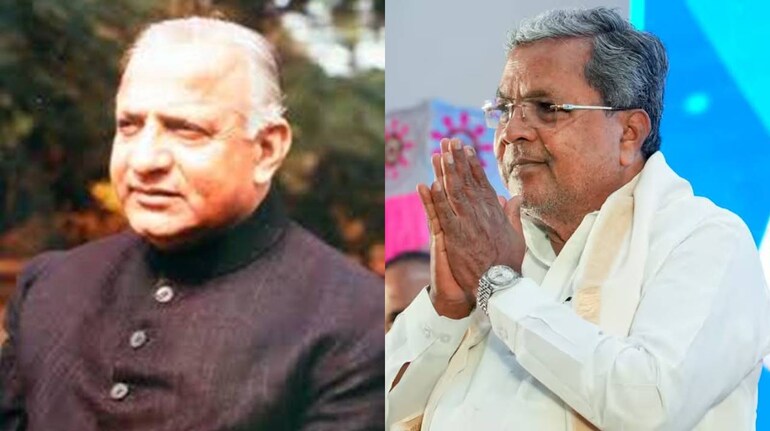
Even as Karnataka chief minister Siddaramaiah’s camp has got into a jubilant mood to celebrate his record of becoming “the longest serving Karnataka CM”, overtaking D Devaraj Urs’ record, a serious debate has begun on the respective “achievements” of the two leaders separated by four decades.
As politics of the country has changed rapidly over the years, it would be unfair and unrealistic to put them to test on comparative ethical or morality scales. Urs and Siddaramaiah took two entirely different routes to achieve the landmark in longevity of service as chief ministers.
But, when longevity is weighed in terms of legacy, Devaraj Urs clearly emerges as a towering personality, standing head and shoulders above Siddaramaiah.
Track record of Urs as CM
Urs served as CM for seven years and 239 days spread over two terms between 1972 and 1980, broken only by dismissal of his government for two months on political grounds and imposition of President’s rule before he bounced back.
On the other hand, Siddaramaiah’s record is also over two terms, separated by a defeat of his government in 2018 before he returned to power in 2023 with a thumping majority.
High ‘mortality’ rate in Karnataka politics
Interestingly, the volatility of Karnataka politics can be gauged by the fact that 21 out of 23 CMs who have held the post so far, could not complete their terms and were forced to leave midway. It is only Devaraj Urs and 33 years later, Siddaramaiah who enjoyed a full 5-year term.
Though Siddaramaiah has surpassed Urs in terms of the number of days spent in office – and he has not finished yet – his administration and his contribution to society pales in comparison to Urs’ transformational reforms effected in the face of tremendous odds.
Urs, the old school Congressman
Hailing from Hunasuru in Mysuru district, Urs belonged to the miniscule ‘Arasu’ community which had a close association with the Wodeyar dynasty that ruled parts of the state for over five centuries from 1399 to 1947. Urs, of course, was a Congressman of pre-independence vintage and owed his political rise to Mrs Indira Gandhi who liked his dynamism.
In the 1972 Assembly polls when the Congress party got a huge majority winning 165 seats, Mrs Gandhi handpicked Urs, then aged 56, to become the chief minister. A man with a clear vision and commitment to doing good to the society, Urs saw grinding poverty all around him and wanted to do something about it. He decided that one of his first tasks would be to identify the poorest among the poor and lift them up.
Havanur Commission
He set up the first Backward Classes Commission under the leadership of his lawyer-friend LG Havanur who organised a meticulous survey to identify thousan of castes and communities that needed help. With the data in hand, the Urs government introduced proportional reservation for OBCs in educational institutions and government jobs. It was done in less than three years after he came to power.
Revolutionary land reforms
Noticing that the poor did not have any land as most of it was concentrated in the hands of the upper castes, Urs introduced an audacious Land Reforms of Act. It was successfully pushed through despite stiff resistance from the Lingayats, the Vokkaligas and the Brahmins who owned most of the land.
Urs was able to quell any opposition from his own party leaders and cabinet colleagues as he had the complete backing of Indira Gandhi.
Later, Urs fell out of favour with Mrs Gandhi as he developed national political ambitions and had cold-shouldered her son Sanjay Gandhi, who had emerged as an extra-constitutional authority.
The sad end to a remarkable political career
When Mrs Gandhi stormed back to power in 1980, overcoming the post-Emergency setback, the mother and son duo ‘dethroned’ the Urs government in a silent coup. The defecting MLAs elected R Gundu Rao, an acolyte of Sanjay Gandhi, as the chief minister to form an alternative government.
After he lost power, Urs suffered one setback after another as a painful herpes and a financial crisis bothered him in his last days. His friends encouraged him to float a new political outfit, Karnataka Kranthi Ranga, to take on the Congress, but he died a sad man in 1982.
Prosaic political career that peaked when he moved to Congress
If Devaraj Urs’ political journey was a tale of a revolutionary-turned-rebel-turned-martyr, Siddaramaiah had a prosaic political career which peaked after he quit Deve Gowda’s JD(S) and joined the Congress in 2006.
He took a rudderless party – jolted by the rise of both the BJP and JD(S) – under his wings and galvanised the ‘Ahinda’ groups (backward classes, dalits and minorities) behind the Congress.
By the time 2013 Assembly polls arrived, the BJP had risen and fallen along with the Lingayat strongman BS Yediyurappa. Yediyurappa’s decision to form the KJP to take his ‘revenge’ against the BJP leadership which had removed him as chief minister split the core BJP votes and helped the Congress led by Siddaramaiah to come to power.
Childhood poverty leaves an imprint on his policy decisions
Having been a witness to poverty and hunger as a boy growing up in Siddaramanagundi in Mysuru district, one of the first schemes Siddaramaiah announced on becoming chief minister was to introduce ‘Anna bhagya’, free supply of 10 kg of rice to every poor family. He also introduced the concept of allocating budgetary funds to SC, ST and OBC communities based on the strength of their populations.
The stress on welfarism, which drained the state's exchequer substantially, left the state with little funds for the development of infrastructure, creation of jobs or even drought mitigation which hit the state for three consecutive years. The farmers, artisans and other poor families living in rural areas were the worst sufferers.
When the 2018 Assembly polls arrived, Siddaramaiah possibly knew that he was on a shaky wicket and pleaded with the party high command to let him contest from two seats. Chamundeshwari, his traditional seat, and Badami in north Karnataka. While he was defeated by a margin of 34,000 votes in Chamundeshwari, the people of Badami helped save his political career by handing him victory by a narrow margin of 1,600 votes. As far as the party was concerned, its tally of MLAs tumbled from 124 to 78.
Lost power, but not the clout
When the Congress high command decided to form a coalition government with the JD(S) by offering chief ministership to Deve Gowda’s son HD Kumaraswamy, the onus of clinching the deal with JD(S) before the BJP did so fell on Siddaramaiah’s shoulders. Having turned an ‘enemy’ of the Gowda family ever since he was ‘ill-treated’ in the JD(S), Siddaramaiah did not like the idea one bit but he had no choice. But in less than 14 months the coalition government fell – some people say at the behest of Siddaramaiah himself – leading to the return of Yediyurappa as BJP’s chief minister for a fourth term, helped by the defectors.
Dissent once again plagued the BJP as Yediyurappa was inexplicably removed after two years and Basavaraj Bommai, a ‘party-hopper’ who had come from Janata Dal, was made the chief minister. Lacking in administrative skills, Bommai had little control over his ministerial colleagues who indulged in unbridled corruption giving the BJP government an unsavoury title as “40% sarkar” as two ministers were forced to resign.
Working in tandem with DKS for 2023 election
Knowing that the people were again hankering for change, Siddaramaiah and DK Shivakumar, the KPCC chief, worked together as a team. The Congress party came up with “five guarantees” – basically, freebies aimed at attracting women voters – and it proved to be a game-changer. The Congress romped home with 136 seats, giving Siddaramaiah a second chance to become chief minister of Karnataka.
But the people have had no respite from political in-fighting – perhaps Karnataka’s unending curse – and the supporters of Siddaramaiah and Shivakumar are at each other’s throat publicly. Shivakumar’s claim that at the time of government formation in May 2023 he had been promised that he would take over from Siddaramaiah as chief minister after 30 months, has met with near-silence by the party high command.
Unending soap opera
Siddaramaiah has not only proclaimed publicly that he will continue for a full term of five years but will lead the party in the 2028 elections. Now, by adding the feather of becoming the longest serving chief minister, Siddaramaiah’s
supporters have planned a series of celebrations over the next two-three months.
As far as Shivakumar is concerned, his failure to mobilise the MLAs behind him has dampened his chances even further. His latest philosophical moaning that he was “happy to be a party worker” and would continue as DCM, reflects his state of helplessness as Siddaramaiah shows no signs of stepping down. But Shivakumar is unlikely to give up his claim and the tussle for power may continue as an unending television series for the people of Karnataka.
(Views are personal, and do not represent the stance of this publication.)
Discover the latest Business News, Sensex, and Nifty updates. Obtain Personal Finance insights, tax queries, and expert opinions on Moneycontrol or download the Moneycontrol App to stay updated!
Find the best of Al News in one place, specially curated for you every weekend.
Stay on top of the latest tech trends and biggest startup news.