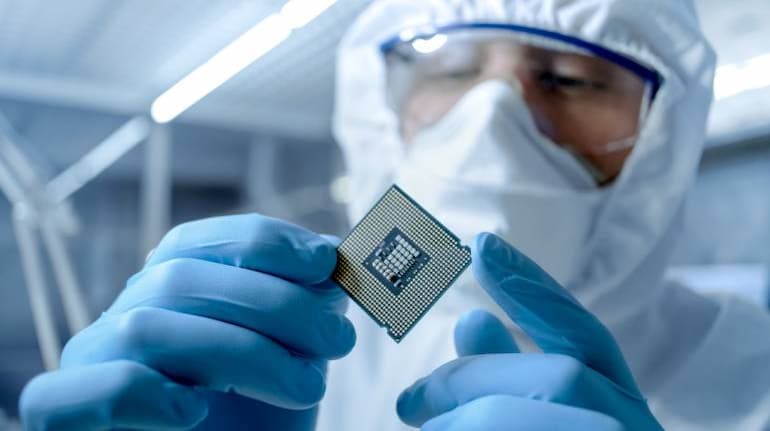
The world celebrated 50 years of the introduction of semiconductor-based integrated circuits (ICs), popularly known as silicon chips, on September 12, 2008.
Almost a year before that, Forbes reported that ‘India lost out on a multibillion-dollar chip plant because the government dragged its heels on introducing an investment policy on semiconductors’. That was neither the first nor the last of the multiple instances within the last two decades where there was much frenzy with media headlines like ‘India's first semiconductor chip manufacturing fab will come up soon’ — with eventually nothing happening on the ground.
Prime Minister Narendra Modi's first term (2014-19) also did not see any progress on this aspect; however, in his second term, the promise of launching an incentive scheme for semiconductor fabs was made in the Budget Speech on July 5, 2019.
On December 15, 2020, the Ministry of Electronics and Information Technology (MEITY) opened an ‘Expression of Interest’ arguably to study who may be interested in setting up chip fabs in India if incentives are offered, and what kind of incentives are they looking for. One year later, on December 15, 2021, the Union Cabinet cleared an incentive scheme with an initial overlay of Rs 76,000 crore meant for silicon fabs, other kind of semiconductor fabs, semiconductor design, and display fabs.
Silicon-based fabs, which are the most important ones, will take a minimum of three years to be built, equipped, and production ready, and hence the incentive scheme announcement was not meant to solve the short-term chip shortage that was at its peak then. However, what has been surprising one year after the scheme announcement is that the review and approval process has itself not been completed for the first set of applications, including three for silicon fabs received by February 15.
On February 24, Union Minister Ashwini Vaishnaw was quoted as saying, "The government will undertake a detailed evaluation of applications it has received in response to the mega semiconductor scheme and expects to complete the entire process and sign agreements with companies in the next 8-10 months".
Countries like Japan and the United States which started planning semiconductor incentive schemes around the same time, or even after India started planning, have already seen multiple cases of new fab construction taking off, and some of them are ready for equipment move-in.
More than three years after a budgetary promise, nearly two years after an Expression of Interest, and one year after a scheme announcement, India seems to be still struggling to make up its mind. On November 21, Vaishnaw was again quoted as saying, "The Centre will also approve at least two semiconductor fab proposals in the next two months", though he did not specify the exact date, nor did he clarify whether the two will be silicon fabs or other smaller ones like compound semiconductor fabs.
Such wavering statements from the minister in charge of India's semiconductor mission combined with the fact that global semiconductor industry has slowed down amidst recession fears as well as the US-China chip war has led to many wondering whether India is going to miss the boat yet again.
In theory, even if approved by early 2023, if the applicant fab is getting the technology from a global fab that has it already running in high volume production, India may be able to make silicon chips on its soil by around the middle of the decade. The initial orders that such a fab in India is going to get are likely to be cases of using it as a second source for the same chips that the parent fab makes. Unless both the packaging of the chip as well as the assembly of the final product that it goes into are also in India, these initial set of commercial chips produced in India are likely to be exported, though eventually they may come back as part of products.
Subsequently, or in parallel, there could be new orders that the India fab can get from the same global fabless customers as the fab from which the transfer of technology was done since the customers can use same the Process Design Kit (PDK) as the parent fab and design new chips, some of which could be for India-specific use. The third stage of orders flowing into the fab in India is likely to be from Indian fabless design companies and the chips could be for global or local use.
Practically, however, all this needs laser sharp execution focus and unwavering commitment in delivering promises. The first round of application for India's semiconductor fabs may not have the world's top-five foundries, but they will be watching how the current applications — including one from a foundry that is in the next five top foundries list — are dealt with, how fast the decisions are made, and how smooth the execution takes place before they show an interest when the scheme opens for a second round.
Even though 2022 is expected to have a near flat growth and 2023 possibly a negative growth for semiconductor industry, it is expected to have high growth again in the second half of this decade. Ground breaking for one or more silicon fabs by early 2023, even if not from the best in the world or using the most advanced technology node, can put India on the global semiconductor fab map by the time the next upswing is expected.
Vaishnaw has often said that India's Semiconductor Mission is a 20-year plan. While a long-term vision is welcome, it has to be supplemented with short-term action on the ground.
Discover the latest Business News, Sensex, and Nifty updates. Obtain Personal Finance insights, tax queries, and expert opinions on Moneycontrol or download the Moneycontrol App to stay updated!
Find the best of Al News in one place, specially curated for you every weekend.
Stay on top of the latest tech trends and biggest startup news.