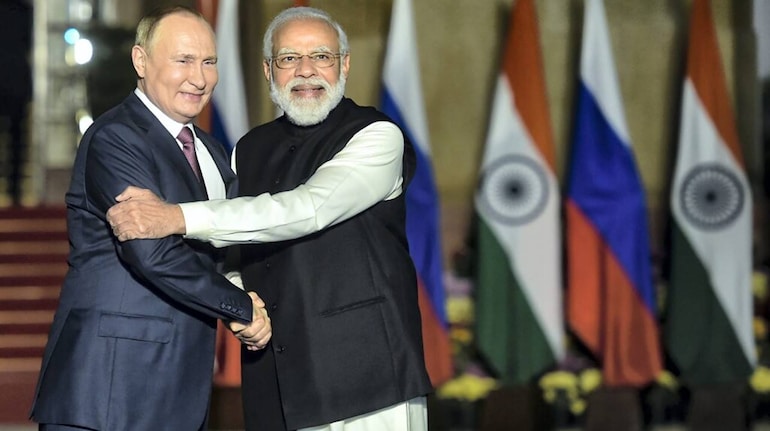
After a hiatus of four years, Russian President Vladimir Putin commenced his New Delhi visit yesterday. There is much anticipation in situating where the bilateral partnership stands, particularly against the backdrop of President Donald Trump’s attempts to constrain India’s relations with Russia by imposing secondary tariffs.
These developments have ostensibly signalled a continued relevance of the India-Russia partnership and its further insulation from geopolitical headwinds. That said, the nature of the partnership is undergoing an evolution, particularly amplified since the conflict in Ukraine. In this context, ascertaining the nature of this ‘time and tested’ partnership in light of the recent developments warrants close and continued scrutiny.
India-Russia since the Ukraine conflict
Since Putin’s last visit, the world order has been in a state of flux, marked by Russia’s invasion of Ukraine. The impacts of the war and the consequent sanctions resulted in the Russia-West contestation reaching its pinnacle.
Interestingly, for the partnership, it created a vacuum for enhanced cooperation. In this decade, the India-Russia partnership can be divided into five broad pillars: political, economic, energy, military, and sectors with future relevance.
Politically, India’s stance on the Ukraine conflict, and its interest in sustaining engagement with Moscow bilaterally and across regional and plurilateral mechanisms such as SCO, G20, and BRICS, reflected India’s commitment to sustaining cooperation.
Russia’s growing footprint in India’s energy matrix
Further, New Delhi’s decision not to join the sanctions regime resulted in India’s primacy in Russia’s calculus increasing. India became the second-largest economic partner for Russia, and trade increased from $12 billion in 2021 to $68 billion in 2022. This spurt in trade was attributed to discounted crude oil imports from Russia, paving the way for an enhanced energy partnership with Russia. Along with hydrocarbons, Moscow has expressed interest in strengthening bilateral partnership in the realm of nuclear energy, wherein Rosatom has offered to sell India small modular reactors, which subsequently aligns with India’s strategy to scale up the use of nuclear energy by 2030.
Additionally, in the economic segment, the volume of non-oil trade has increased, wherein there is a significant uptick in Indian exports to Russia, particularly in the sectors of consumer electronics, machinery, and mechanical appliances. Further, the agreement between United Aircraft Corporation and HAL to jointly co-produce the Sukhoi Superjet 100 planes and the interest from New Delhi to expedite India’s free trade agreement with the Russian-backed Eurasian Economic Union is a reflection of this development, giving a sense of the primacy of the economic driver in the time to come.
Military pillar is evolving
Meanwhile, the mainstay of the India-Russia partnership, the military pillar, has seen a progressive decline since the last decade. Despite the reduction due to the country’s priority of diversifying procurement and indigenising production, more than 2/3rds of the Indian military continues to rely on Russian weapons systems and platforms.
Russian military platforms such as the S-400 anti-missile defence system were pivotal in India’s Operation Sindoor, with talks underway to purchase more batteries and possibly the advanced S-500 system, with the prospect of domestic production. Moscow’s willingness to offer favourable terms in military exports is likely to keep the defence partnership relevant, even in light of its decline.
Lastly, since the last decade, bilateral cooperation in new areas has seen an uptick. India has increasingly articulated its contours of cooperation in areas such as the Russian Far East and the Arctic. The ratification of the RELOS (Reciprocal Exchange of Logistics Agreement) by the Russian lower house reduces the bureaucratic hurdles for Indian Navy vessels to access strategic Russian ports in the Arctic. Additionally, India has expressed interest in utilising the Northern Sea Route. Russia is in talks with Indian shipbuilders for the building of non-nuclear icebreakers. Further, Russia has offered to train Indian seafarers in polar navigation. In sum, these trends reflect an increasing interest in strengthening cooperation with Russia.
Why this visit is important
The significance of Putin’s visit to India, against the backdrop of secondary tariffs, has given an indication of the structural restraints in New Delhi’s relations with Washington. Experts argue that these incidents reflect a departure from the stance of previous American administrations. In response to the threats, India pushed back against the US secondary tariffs and sustained its bilateral cooperation with Russia. Even though the visit to India has remained on Putin’s agenda since last year, the visit, against the backdrop of India facing 50% US tariffs for maintaining its interests under the policy of strategic autonomy, has lent the visit a sense of historical weight. This visit, for Moscow, which has more than 30,000 sanctions imposed against it, signals the sustenance and the relevance of a longstanding partnership with a key non-Western power even in light of partial global isolation.
What to expect this time
Both sides have indicated that ‘trade’ is the flavour of the year, and the possible conclusion of an economic cooperation agreement until 2030 is on the cards. Officials have pointed towards
a large volume of intergovernmental MOUs that are to be concluded during the course of the summit. Both sides are to discuss about strengthening the military technical partnership (however, the likelihood of major defence deals being signed during the summit remains slim). It is likely that during the summit, regional security concerns, particularly in the context of Op Sindoor, may be discussed.
Further, both sides will deliberate on issues pertaining to trade facilitation, including issues such as the settlement of payments, addressing the trade imbalance, and strengthening business-to-business contacts. All in all, the 23rd India-Russia annual summit bring considerable promise in the strengthening of bilateral relations.
(Rajoli Siddharth Jayaprakesh is a Junior Fellow at the Observer Research Foundation.)
Views are personal, and do not represent the stance of this publication.
Discover the latest Business News, Sensex, and Nifty updates. Obtain Personal Finance insights, tax queries, and expert opinions on Moneycontrol or download the Moneycontrol App to stay updated!





Find the best of Al News in one place, specially curated for you every weekend.
Stay on top of the latest tech trends and biggest startup news.