India’s latest national accounts estimate project real GDP growth of 7.4 percent and nominal growth of around 8 percent in 2025–26. On the surface, these numbers reinforce India’s status as one of the fastest-growing major economies. Yet a closer look at the data reveals a more uneasy story about the quality, composition, and sustainability of this growth.
A narrowing nominal–real gap
One of the most striking features of the latest projections is the unusually narrow gap between real and nominal GDP growth. Historically, India’s nominal growth has exceeded real growth by a wider margin (4-6%), reflecting moderate inflation and pricing power across sectors. The current compression suggests weak price momentum and emerging deflationary pressures.
This is not a benign development. In a developing economy, persistently low inflation can erode producer margins, discourage capacity expansion, and dampen private investment. For a country still attempting to build scale in manufacturing and absorb a large labour force, deflationary tendencies risk becoming a constraint rather than a comfort.
Where incremental growth is coming from
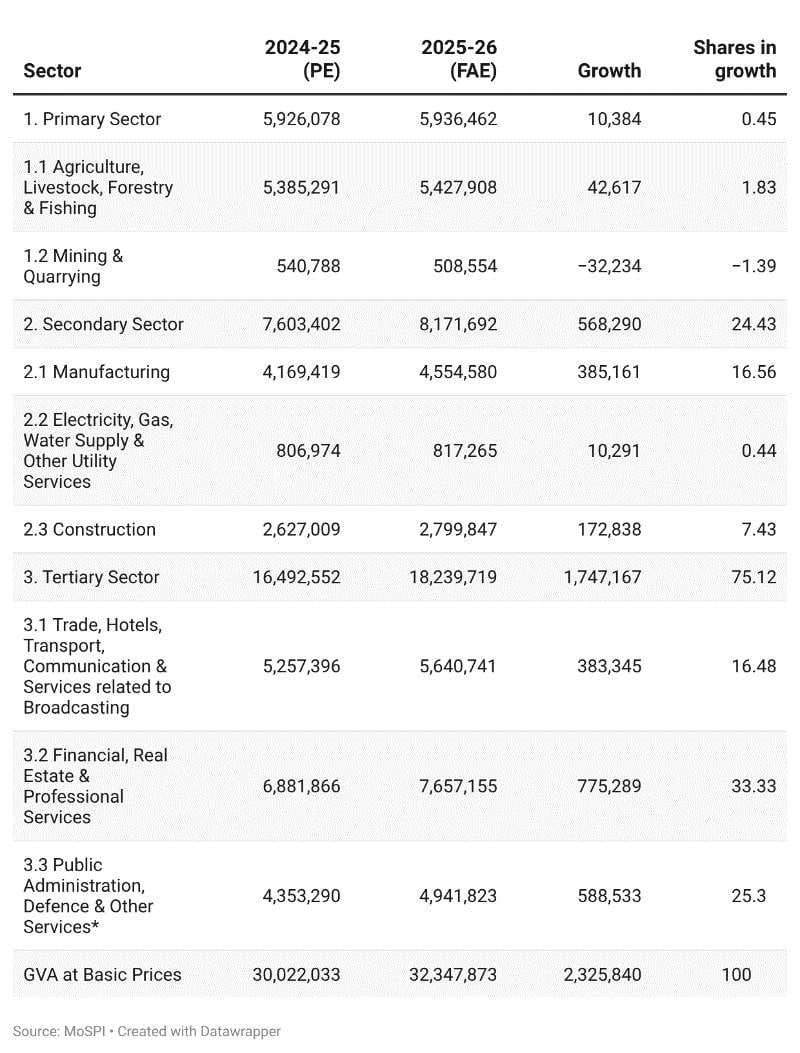
In nominal terms, gross value added (GVA) is expected to rise by ₹23.26 lakh crore between 2024–25 and 2025–26. What stands out is the sectoral concentration of this increase. Nearly three-fourths of incremental GVA, about ₹17.47 lakh crore, comes from the tertiary sector alone.
Within services, growth is powered by financial, real estate and professional services, which account for roughly one-third of the total increase, followed by public administration, defence and other services (25 percent) and trade, transport, hotels and communication services (16 percent). In contrast, the primary sector contributes less than one percent to incremental value addition, with agriculture contributing less than 2%. Manufacturing and construction account for about 16 percent and 7 percent respectively.
What matters is not just where growth occurs, but how strongly it is linked to the rest of the economy. Much of India’s recent services-led expansion is concentrated in activities with weak backward linkages, financial services, real estate, and professional services rely relatively little on domestically produced intermediate inputs. As a result, growth impulses generated in these sectors are not transmitted effectively throughout the economy. Input–output studies for India show that once import intensity is accounted for, many high-growth service activities exhibit lower domestic multiplier effects than manufacturing or construction (Sharma, Padhi, & Rath, 2022). This helps explain why rapid GDP growth has coincided with modest job creation and stagnant incomes in sectors that employ the bulk of the workforce.
What high-frequency indicators suggest
High-frequency indicators (HFIs) are not designed to replicate national accounts estimates. However, when averaged over April to November, they provide a useful sense of the economy’s underlying momentum, and that momentum appears more moderate than headline GDP numbers suggest.
On the consumption side, IIP consumer durables grew by around 4 percent, while IIP consumer non-durables contracted by roughly 2 percent, pointing to uneven household demand. Fuel consumption has been subdued, with petrol rising about 6.3 percent and diesel just 2.8 percent, indicating limited industrial and freight intensity.
Investment indicators show steadiness rather than exuberance. Gross fixed capital formation rose by 8.3 percent, while IIP capital goods increased by about 7 percent. External trade has held up better than expected despite global fragmentation, with merchandise exports and imports growing by around 9–10 percent.
At the same time, IIP electricity contracted marginally, often a warning sign for broad-based industrial activity. Overall, high-frequency indicators suggest resilience but not exuberance. Although manufacturing and services PMIs have stayed above the expansion threshold of 50 since April, readings in the mid-50s to low-60s range indicate steady but moderate expansion, rather than a sharp acceleration in activity.
A revealing divergence
Read together, the divergence between headline GDP growth and high-frequency indicators is telling. Is this divergence incompatible? Or is India’s growth is being driven less by physical production and more by services, public spending, and service-sector value addition?
This divergence offers a clear signal that primary & secondary sectors are not driving India’s current growth phase. Instead, income gains are increasingly decoupled from sectors that employ the bulk of the workforce. The result is a widening productivity and income gap between services and the rest of the economy weakening the link between growth, job creation, and broad-based demand.
Why this matters
India’s growth story remains credible, but its foundations are becoming narrower. As services take the lead and manufacturing struggles to assume a central role, growth risks becoming less inclusive and more spatially and socially uneven. Sustaining high growth while generating jobs and raising incomes across sectors will require more than strong headline numbers, it will require re-anchoring growth in sectors that combine productivity gains with large-scale employment.
Without that shift, India may continue to grow fast, but the disconnect between growth and livelihoods will only widen.
(Dr Rajiv Kumar, Chairperson, Pahlé India Foundation and former Vice Chairman NITI Aayog and Samriddhi Prakash, Research Associate, Pahlé India Foundation.)
Views are personal and do not represent the stand of this publication.
Discover the latest Business News, Sensex, and Nifty updates. Obtain Personal Finance insights, tax queries, and expert opinions on Moneycontrol or download the Moneycontrol App to stay updated!
Find the best of Al News in one place, specially curated for you every weekend.
Stay on top of the latest tech trends and biggest startup news.