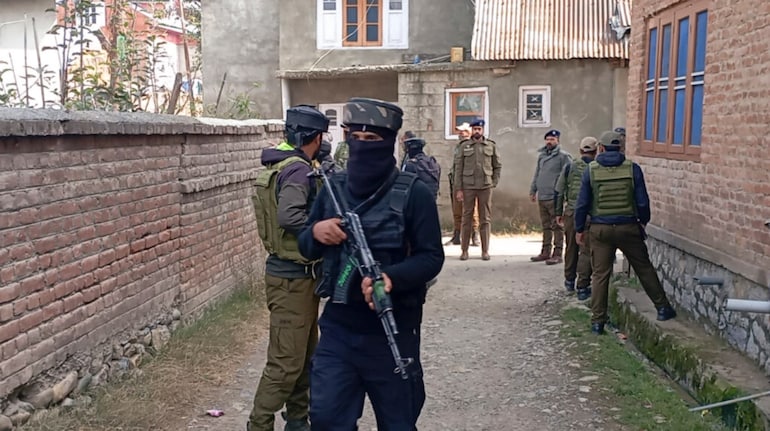
Jammu & Kashmir has become operationally very difficult, even for the highly-trained Pakistani terrorists. A comprehensive - if sometimes brutally ruthless - crackdown on the terror ecosystem in the troubled State has led to the menace being contained at feasible limits.
Simultaneously, deterrence by punishment as imposed on Pakistan by the 88-hour military confrontation in May 2025 (Op Sindoor) and the holding in abeyance of the Indus Waters Treaty, has the stayed the course in J&K post the April 22, 2025, Pahalgam massacre. Nearly eight months after the targeted killings of 25 Hindu males and a Christian, terrorists have not revived their proactive approach in the guise of Army vehicle / patrol ambushes, killings of Hindus in Jammu division and of non-locals, labourers and Kashmiri Pandits in the Valley.
Terrorists have been denied space in J&K
It is true that Army personnel have laid down their lives in J&K after Pahalgam, but the fatalities were incurred when the security forces were in hot pursuit or undertaking area domination patrols in the higher reaches and came upon the hiding, cornered terrorists.
The last ambush of the Army was in Gulmarg, Kashmir, on October 24, 2024. Terrorists were facing a challenge in repeating such hit-and-run tactics due to the Army's counter-insurgency forces (Rashtriya Rifles) and regular infantry formations reviewing the standard operating procedures, tactics and enhancing the critical counter-ambush drills. Apart from the induction of more central armed police forces (CAPF) like Assam Rifles battalions, more Para (SF) teams were deployed in the hot pursuit mode along with the augmentation of regular nfantry and RR units.
Vigilance is very tight in J&K - the mere putting up of Jaish-e-Mohammed posters in Srinagar's Nowgam, in October 2025, led to a nationwide trace and busting of an "invisible" white collar module embedded across different states.
Pahalgam killings were a symptom of desperation
In fact, one of the factors that led to the Pahalgam massacre was the sense of desperation in Pakistani handlers due to the declining opportunities available for attacks on the Army. Hence, the requirement to stay relevant in J&K through indulgence in a desperate, dastardly action as a cold-blooded massacre of defenceless civilians. The Pahalgam massacre was undertaken with a deliberate communal profiling and was designed to rupture social cohesion across India, though in vain.
Then came the suicide bombing in a crowded road opposite the Delhi Red Fort on November 10, 2025. The bombing, somewhat premature due to a pre-emptive crackdown on the doctors' terror module, was in a sense a natural release from the constrained operational environment of J&K. It could signal a move by varied terror outfits to once again move into the operational space of the Indian heartland that had seen years of quietude since the Patna blasts of 2013.
If complacency sets in, J&K will see a return of terror
Terrorism could return to J&K with renewed force in the years to come when complacency again sets in and vacuums are created, as was witnessed in the removal of counter-insurgency force (CIF) Uniform from the Udhampur-Reasi belt in 2020 or the 28 Infantry Division from Kargil in 1991.
Pakistan is wary
Terror strikes in J&K are more readily attributable to the Pakistani hand, and that acts to constrain cross-border terror handlers and planners in the contemporary phase.
Thus, the Pakistani terror establishment has had to double down on erasing linkages to terror in India as it faces the prospect of another hammering in the guise of Op Sindoor 2, international censure and FATF sanctions. Pakistan is itself in a military confrontation with Afghanistan over the Baluchis and TTP insurgents, apart from the political turmoil linked to former PM Imran Khan's detention. Whatever be the precise role of the Pakistan terror establishment in the Red Fort bombing, the fact is that the linkages are difficult to trace back to the Pakistan State.
Slipping through the net
The white-collar terrorists were domestic ones (local terrorists), the explosive materials were procured from within India and the handlers operating online were dispersed in Turkey, Afghanistan and Pakistan. What is of concern also, is that the doctors' terror module was operative since 2022 but it did not figure anywhere on the J&K Government's "dwindling" list of local recruits that laid the foundations of multiple narratives of JK's return to "normalcy" and "zero terrorism", a perception ruptured earlier by Pahalgam.
Constraints on India
The international community would require that the Indian establishment lay bare the terror trail to Pakistan with credible evidence before initiating another military confrontation with a neighbouring sovereign nation that is also a part of the United Nations. The Government of India, thus, displayed strategic wisdom in not going in for another round of military confrontations with Pakistan in the wake of the blast.
The resolution of the Union Cabinet of November 12, 2025, termed it a "heinous terror incident, perpetrated by anti-national forces". The resolution omitted any formulation directed against external forces (anti-national implies emanating from within India) and reiterated India's "unwavering commitment to a policy of zero tolerance towards terrorism in all its forms and manifestations".
This allowed the Government an escape hatch from its slightly-varied public statements that followed immediately after Op Sindoor and to public effect that "any act of terrorism would be treated as an act of war". In fact, most of the sabre rattling on both sides before the Red Fort blast was little more than deterrence posturing as evidenced by the lack of initiation of hostilities in the aftermath of the bombing, even though the blast's police case owes its origins to Pakistani Jaish posters in Nowgam.
Trump shadow on India’s response
Another military confrontation so soon after Op Sindoor would have contradicted the Government's prudent decision on a speedy conflict termination, i.e., to accept the Pakistan Army's Director Military Operations' (DMO) offer of a cessation of firing and military actions after just 88 hours of conventional stand-off hostilities in May 2025.
Another confrontation could have lent US President Donald Trump an opportunity to reinforce his gambit for a Nobel Peace Prize by loudly alleging a mediation effort. Given the geopolitical situation and the economic headwinds that India faces with Trump's trade tariffs and on the other side, a Pakistani Field Marshal all too acquiescing to the White House, neither of the two South Asian nations can afford to recklessly dismantle the so-called Trump-mediated ceasefire. It has held tenuously after May 10, 2025, and a breakdown could further irk the "tariff tyrant" who has staked personal prestige on it.
The China factor
With cogent signals of Trump seeking accommodation with China's Xi Jinping in a G2 formulation, New Delhi has its work cut out to avoid getting outflanked and burn the midnight oil to strengthen political relations with Beijing, bring the disputed frontier tensions of Eastern Ladakh to manageable stress levels and keep the PLA hawks at bay. With people-to-people contacts being restored between India and China after a few years of frosty, turbulent relations, a military confrontation with Beijing's ally, Pakistan, at this juncture would again introduce uncertainty and risk in New Delhi-Beijing ties. China's support to Pakistan in the guise of advanced military weapons and high-grade intelligence and satellite surveillance during Op Sindoor is a lesson not lost on India's politico-military establishment.
Pakistan has a lot less to lose
However, more than anything else the logic of economics and stability dictated India's choices in the wake of the suicide bombing. India has a vision of Viksit Bharat 2047 while Pakistan's basket case economy splutters on strategic rentier loans. During Op Sindoor, civil aviation was shut down in India and large parts of the border regions faced war-time black-outs, missiles, drones, artillery fire and civilian anxiety / panic.
To date, Air India faces mounting losses on flights to Europe after Pakistan closed its airspace. Such a situation repeated all too soon not only sends jitters down critical foreign investment but dilutes the decades of stability required to acquire the coveted status of a completely developed nation, i.e., an India firmly and proudly mounting its destined pedestal in the realm of the G10. The Indian strategic establishment has wisely heeded the import of the infamous analogy attributed to Field Marshal Asim Munir: “India is a shining Mercedes coming on a highway like a Ferrari, but we are a dump truck full of gravel. If the truck hits the car, who is going to be the loser?"
Threats to India are real
That said, the threat to India from multiple directions is all too real, apart from the "homegrown" one as manifest in the doctors' module. The rise to power of the Islamic parties in Bangladesh is impregnated with the threat of terrorists being pushed in from the east. In the years of the new millenium, the Harkat-ul-Jihad-al Islami Bangladesh had carried out actions in India till the time that Sheikh Hasina's government cracked down on them. With the threat of Islamic radicalisation all too real and powered through curated jehaadi online chat rooms, encrypted social media messaging platforms, self-help bomb-making videos etc, global jehaadi outfits will be looking at India with a jaundiced eye. In the Red Fort blast, though the initial posters put up in Nowgam, Srinagar, were purportedly of the Pakistani Jaish-e-Mohammed, Government intelligence and law-enforcement authorities subsequently have drawn linkages to Al Qaeda, and to the ISKP (ricin poisoning plot of Ahmedabad).
Don’t fall for the trap
It’s here that the postponement of Israel PM Benjamin Netanyahu's visit to India later this month must be seen in a prudent perspective. Though media reports cited security considerations in the wake of the Red Fort blast for the postponement (Netanyahu's last toured India in 2018), India could well do with a more discreet embrace of Israel lest it receives an unwarranted share of global jehaadi attention.
In the same breath, targeting Kashmiris residing outside JK indiscriminately would hand the jehaadis a victory on a platter by way of cannon fodder for radicalisation. This was what the late bomber doc, Umar Un Nabi, aimed for when he blew himself up along with several innocents, among them of his own faith. Nabi was the third Kashmiri since 2000, and the first outside the Valley, to indulge in a suicide bombing.
(Vikram Jit Singh has extensive experience as war correspondent and reported counter terrorism operations live while posted in Srinagar.)
Views are personal, and do not represent the stance of this publication.

Discover the latest Business News, Sensex, and Nifty updates. Obtain Personal Finance insights, tax queries, and expert opinions on Moneycontrol or download the Moneycontrol App to stay updated!
Find the best of Al News in one place, specially curated for you every weekend.
Stay on top of the latest tech trends and biggest startup news.