The US-Israel war against Iran entered the third week on Saturday (March 14) with the Hormuz strait being effectively closed and the global energy market in a state of heightened anxiety. Brent crude has crossed the $100 do mark and the entire hydrocarbon related supply chain has been severely impacted.
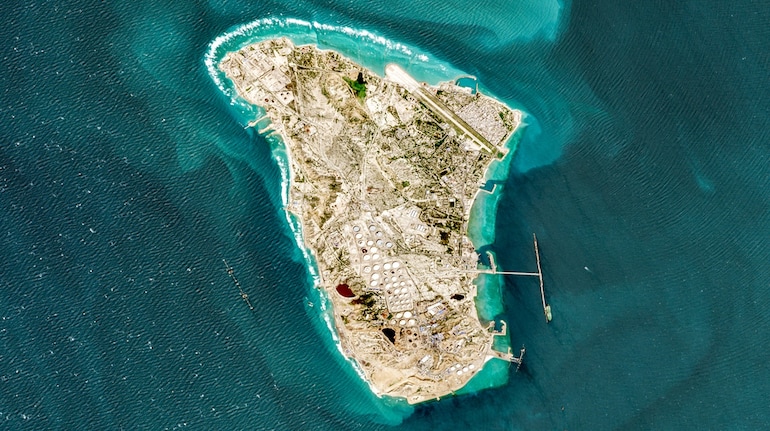
A potentially significant escalation in the war is on the cards with Kharg Island being targeted. The American attack on this crucial island occurred on Friday (March 13) as part of the broader US-led campaign, targeting military assets on the island - while deliberately sparing its oil infrastructure, as a strategic pressure tactic related to the Strait of Hormuz closure.
Kharg Island, located in the Persian Gulf about 25 km off Iran's coast, serves as the export hub for around 90% of Iran's crude oil, making it a critical economic and military site.
US President Donald Trump described the operation as "one of the most powerful bombing raids in the History of the Middle East" and added that over 90 military targets were struck but deliberately avoided oil facilities - to prevent any panic in global energy markets. Reports indicate explosions and fires were heard on Kharg but Tehran claims its oil export capabilities remain intact.
Iran condemned the American strike on Kharg and vowed retaliation, threatening to target US-linked oil facilities in neighbouring countries like the UAE.
Retaliation occurred on Saturday (March 14) and debris from an intercepted Iranian drone struck a UAE oil facility in Fujairah that caused a major fire and temporary suspension of some oil-loading operations.
This is a signal and Iran's armed forces declared that the Kharg attack crossed a "red line." They warned that any further strikes on Iranian oil, energy, or economic infrastructure would trigger immediate destruction of US-linked or allied energy facilities across the region.
However, at the time of writing this comment there has been no significant Iranian offensive but Tehran remains defiant about the Hormuz. Foreign Minister Abbas Araghchi stated (March 14) that the Strait of Hormuz "is open" but only to non-enemy vessels. He explicitly said it remains closed to ships and tankers belonging to the US, Israel "and their allies." Other countries like China and India or neutral parties are "free to pass" though insurance companies remain wary about the prevailing security environment in those waters and have hiked marine insurance premiums
The Hormuz normally has about 140 ships transiting this narrow strait on a daily basis and accounts for about 20 percent of global oil trade, which is about 20 mbpd (million barrels per day). At last count (March 14) just two ships transited the Hormuz and these were Indian flagged LPG carriers bound for ports in Gujarat.
It has been reported that Delhi is trying to negotiate with Tehran for the safe passage of 22 other India-bound vessels in the Persian Gulf west of the Hormuz with the Indian navy deploying ships to escort them.
The geography of the Hormuz gives Iran a distinctive strategic advantage that it can use as ‘leverage’ in the current war. All the major oil exporters in the region (Saudi Arabia, UAE, Kuwait, Iraq, Qatar and Bahrain) are totally dependent on the Hormuz strait to exit the Persian Gulf and enter the Arabian sea for onward passage.
The narrow strait that separates Iran in the north from Oman in the south lies at the mouth of the Persian Gulf and extends for 167 kms in length and is about 34 kms (21 miles) wide at its narrowest point. The biggest oil export terminals use this waterbody that has two lanes for inbound and outbound traffic that is closely monitored by the Iranian navy and military.
US President Trump has ordered a marine expeditionary unit (MEU) to the region and whether this is more a show of force to compel Iran to comply with the US demands, or part of an actual ‘boots on the ground’ operation to take control of the Hormuz is moot at this point.
In a seemingly odd pattern, Trump urged China, France, Japan, South Korea, Britain and others to send warships to the Strait of Hormuz. However, none of those countries gave any immediate indication that they would do so.
A US-led military operation to seize control of the Hormuz would be imprudent and could be tactically challenging. Iran controls the Hormuz strait in a very unassailable manner with its innovative sea-denial strategy and this is a catch-22 situation for President Trump. Regime change remains elusive and military options costly.
Pounding Kharg and its oil infrastructure from the air and threatening a land offensive could lead to a desperate Iran attacking US assets in the region in an indiscriminate manner.
The possibility that water desalination plants in the region could also be struck cannot be ruled out. This would be catastrophic for the whole region and further retaliation by the US will push the regime in Iran to even more extreme responses.
Tehran has repeatedly cautioned its adversaries that this will be the last war that will be forced upon it and the sub-text is ominous. The martyrdom (‘shahadat’) of Ayatollah Khamenei is being distilled by the Iranian regime into high-octane national theological resolve and sacrifice becomes sacred. What is being termed ‘fun’ by Trump could turn apocalyptic if this war lurches into week four in this manner.
Major powers must encourage a lowering of angry rhetoric and a return to the negotiating table. The last phase of Ramadan should not be tainted with more bloodshed.
(C Uday Bhaskar (Retd.) is Director, Society for Policy Studies, New Delhi.)
Views are personal and do not represent the stand of this publication.
Discover the latest Business News, Sensex, and Nifty updates. Obtain Personal Finance insights, tax queries, and expert opinions on Moneycontrol or download the Moneycontrol App to stay updated!
Find the best of Al News in one place, specially curated for you every weekend.
Stay on top of the latest tech trends and biggest startup news.