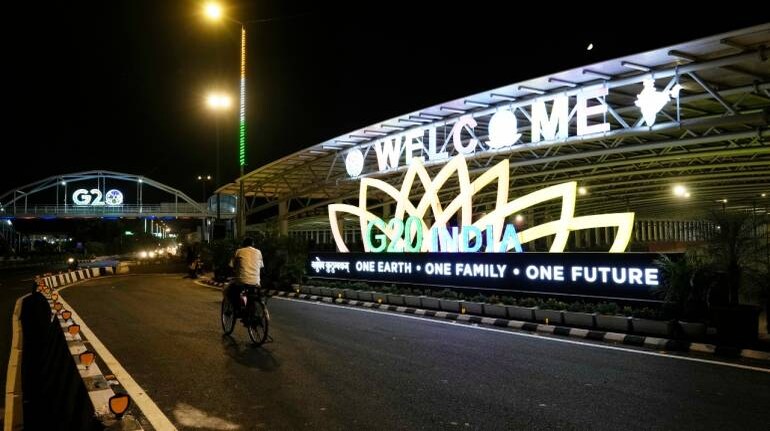
When India listed “women-led development” as one of six main priorities of its G20 presidency, along with inclusive growth, progress on Sustainable Development Goals, green development, technological transformation and reforming multilateral institutions, it was considered a tacit acknowledgement of the fact that gender equality remains one of the most pressing policy challenges in India.
India’s gender gap – it was ranked 127 out of 146 countries in this year’sGlobal Gender Gap Report and faces the perennial issue of “missing women” from the workforce – is a wicked problem, a term that policymakers ascribe to problems that are impossible to solve in a way that is simple or final, like climate change which is a wicked problem.
Under its presidency, India took an approach to mainstream gender into G20 discussions. India has promoted women-led development as a distinct concept. Under women-led development, women are not just beneficiaries of development, instead, they set the agenda for development and are key to achieving the 2030 Goals, as leaders and equal participants.
The concept, as such, taps into a long-established approach in development theory, which calls for the inclusion of women in development planning and decision-making.
Gender And G20
Gender, which was a neglected subject, has slowly gained traction in the G20. There is enough evidence to support that women are force multipliers – when women have access to resources, they invest in the education and health of families and communities, more than men. There is a multiplier effect on economies too: India, for instance, can boost its GDP by 27 percent by raising women’s workforce participation.
At the 2014 summit in Australia, G20 leaders made the “25x25” pledge to reduce the gender gap in labour market participation by 25 percent by 2025. In 2015 in Turkey, the W20 was launched as an official engagement group, a network designed to strengthen women's economic empowerment in the G20 process.
G20 EMPOWER (Alliance for the Empowerment and Progression of Women's Economic Representation) was launched in Japan in 2019, as an alliance between businesses and governments to promote women’s leadership and empowerment in the private sector.
Gender commitments in the G20 have mainly emphasised increasing female labour force participation and improving workplace conditions and earnings for women. From 2015 onwards the forum has promoted women’s entrepreneurship, enhancing digital skills and education in STEM to increase female participation in these sectors.
More recently, the G20 has recognised that the COVID-19 pandemic and the climate crisis have impacted women and girls disproportionately in every part of the world and committed to work on narrowing the resultant inequalities.
Indian Vision Of Women-Led Development
The themes under India’s vision for women-led development are wide-ranging, but they can be summarised through the statement that came out of the G20 Ministerial Conference on Women Empowerment, which took place in August and encapsulates discussions that took place during this year.
These include increasing investment in and access to education and skilling, including in STEM for women; promoting women entrepreneurs and women-owned and led MSMEs; promoting leadership and decision-making roles for women at the grassroots, including in political systems and governance; recognising and promoting women’s roles in climate change, food security and nutrition.
India’s emphasis on women’s role in building climate resilience is cognisant of how the climate crisis is not gender-neutral and women and girls experience the greatest impacts of climate change.
Outcomes Of India’s Presidency
It is a little early to sum up the outcomes, though there have been a few. G20 Empower under the Indian presidency launched a Digital Inclusion Platform for women, TechEquity, an aggregator for learning and skilling that brings together technical training and core skill development along with content on digital and financial education.
India has also committed to launching an online platform for mentoring and capacity-building of women in G20 countries with a focus on women in MSMEs and grassroots leaders. The portal will be hosted by NITI Aayog's platform for women's empowerment.
W20 India has pushed for developing National Gender Strategies that are funded and tracked through gender-disaggregated data for G20 countries. That the G20 should create mechanisms to collect and analyse gender-disaggregated data to bridge the gender divide has been demanded under previous presidencies. W20 India has also recommended creating an annual review mechanism to track the implementation and impact of the commitments made to women and girls.
G20 processes are extensive and are dependent on continuity from one presidency to another, just like India promoted women-owned and led MSMEs, an agenda that was taken up last year under the Indonesian presidency. It will be up to Brazil to carry forward some of India’s work on these themes.
Sunaina Kumar is a Senior Fellow at the Observer Research Foundation and Executive Director at Think20 India Secretariat. She works on gender and development. Views are personal, and do not represent the stand of this publication.
Discover the latest Business News, Sensex, and Nifty updates. Obtain Personal Finance insights, tax queries, and expert opinions on Moneycontrol or download the Moneycontrol App to stay updated!

Find the best of Al News in one place, specially curated for you every weekend.
Stay on top of the latest tech trends and biggest startup news.