




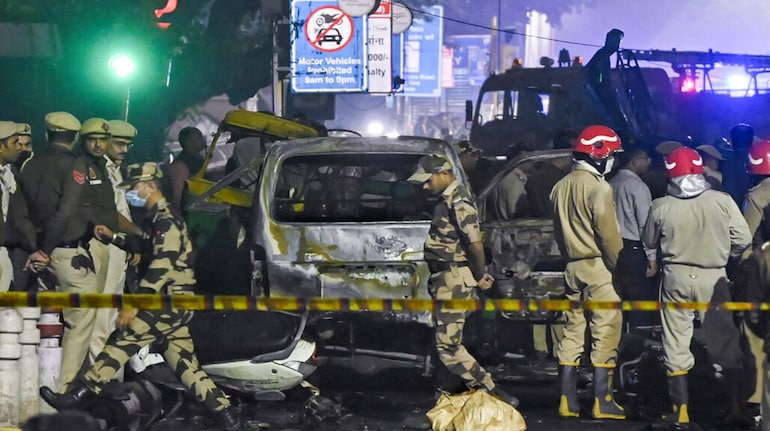
After covering the serial train blasts in Mumbai in 2006, the coordinated Pakistani terrorist attack in the same city in 2008 that lasted three days and the more recent Pulwama strike, the terror blast in Delhi is the first I am witnessing from afar, just like another citizen. It gave me perspective.
Every terror attack, every act of violence, chips away at the idea of India. Mind you not the India of GDP, which posts impressive growth year after year, but the India of shared spaces and inclusion.
Watching from a distance, I realised that the true test of a nation is not how it bleeds in the face of violence, but how it holds itself together afterwards.Speculation at this stage is not helpfulThe official investigations into the Chandni Chowk terror attack are ongoing. Looking at the speed and scale of the inquiry, the agencies will soon hold the real perpetrators to account. In a tragic coincidence, some of the explosives seized from Faridabad -- the same cache linked to the Delhi car blast -- later detonated accidentally in the Nowgam police station in Srinagar, killing nine police and forensic personnel.
To be honest, at this early stage, speculation helps no one. Carrying unverified reports or quoting unnamed “sources” only deepens society’s angst and anxieties and its fear and fracture that follow such tragedies.
Sense of restraint this time stood outYet in the aftermath of the Delhi blast, something remarkable has stood out: the sound of restraint. Appealing for restraint, prominent Muslim organisations across India swiftly condemned the attack, calling it an assault not just on innocent lives but on the nation’s moral fabric.
The All India Muslim Personal Law Board, Jamaat-e-Islami Hind, Jamiat Ulama-i-Hind and spiritual voices such as Syed Salman Chishty of the Ajmer Sharif Dargah spoke in one moral chorus. Their message was clear and even courageous that terrorism, whatever its claimed justification, is treachery against both faith and nation. Dr. Illias Ali, the Padma Shri-winning surgeon from Assam, said it most bluntly: “Those choosing violence and terrorism are not followers of Islam and should be boycotted by the community.”
Political parties have exercised restraint. Even the government has displayed restraint. It has not pointed fingers or named enemies before the evidence is clear. The police and intelligence agencies are questioning suspects, but there has been no indiscriminate rounding up of young Muslim men, which was a troubling routine that once followed every blast, especially during the UPA years. This restraint has helped keep Delhi calm and the nation balanced. It shows that maturity and patience can also be forms of strength. Because the first line of defence against extremism is not the state. It is society itself.
The quality that holds India in good steadI have long believed that restraint, moral or emotional, is India’s quiet superpower. I saw its strength three decades ago, in another time of turmoil. Gen Z may only have read about the aftermath of the Babri Masjid demolition in 1992 -- the anger, the hatred, the unrestrained yearning for revenge. But I witnessed it firsthand as a young reporter. Distrust seeped into everyday life. Colleagues, friends, neighbours suddenly looked at each other with suspicion. Every morning I left home not knowing if I would return safely.
Yet amid the fear, small acts of courage surfaced. A group of prominent Indian Muslims (that included Javed Akhtar, Shabana Azmi, Farooque Sheikh, academics and clerics) came together to calm tempers and restore reason. Some met youth groups, visited mosques, urged restraint, pleaded that violence must not beget violence. Their words worked in Delhi and much of northern India. Sadly, in Mumbai, rage found its outlet. Twelve coordinated bomb blasts in March 1993 killed hundreds and shattered what little hope remained. As they say restraint saves societies, rage destroys them.
Chandni Chowk terror strike has reopened old fault linesThe blast in Delhi’s crowded Chandni Chowk has done more than claim innocent lives. It has reopened old fault lines of fear, mistrust and prejudice. The accused, reportedly young professionals with clean records, come from a community long living under scrutiny. Whatever their motives, their actions were indefensible. It was a betrayal of their nation and their own people, who will now bear the burden of doubt once more.
In recent years, several prominent Muslim celebrities (Emraan Hashmi jumps to mind) have spoken of being denied rentals (or buying a property) because of their faith. I have faced this myself in Mumbai, especially after terror attacks. But the issue is layered.
Some housing societies run by strict vegetarians refuse non-vegetarian tenants, regardless of one's faith; Catholic societies often limit occupancy to their own. Let’s face it: a Hindu tenant might not be welcome in Bhindi Bazaar either. The problem is not confined to one faith. What begins as caution becomes separation. We build our own ghettos and stop talking across walls. Much of Ahmedabad stands as a reminder of that.
The aftermath of every terror attack deepens these divides. It shows up in a neighbour’s hesitation, a landlord’s refusal, a sudden silence between old acquaintances. A community already struggling to rent homes, find jobs and outgrow stereotypes now faces renewed isolation. The Chandni Chowk blast is more than a security crisis. It is a moral test. It asks whether we can remain alert without becoming suspicious
The voices we heard after the Delhi blast matter. Maulana Khalid Saifullah Rahmani of the AIMPLB called the incident “deeply alarming,” but sought reform, not revenge. Syed Saadatullah Hussaini of Jamaat-e-Islami Hind called it “a crime against humanity” and demanded justice through due process. Syed Salman Chishty urged communities to “extend a hand of love, peace and support instead of hatred, fear and suspicion.” Religion, at its best, is an antidote to hate, not a justification for it.
India needs a focused deradicialisation strategyBut I would still ask these leaders to go further. It is commendable that they condemned the attack. But why not also lead community vigilance? Why not create systems to identify radical elements early? How could a medical university become ground zero for plotting terror without notice? Yes, policing is the state’s job. But when extremists rise from educated, middle-class families, society too must act as a circuit-breaker.
The state, for its part, must think long-term. We need a robust deradicalisation strategy that draws on those who have walked away from violence. I know one such man in downtown Srinagar, Saifullah. He was once a Pakistan-trained militant and a terror in his city. Now he is an eloquent voice for peace. “When I had a gun in my hand, they paid attention,” he told me, “now that I speak of peace, they find me of no use.”
Terrorism does not weaken our resolve when terrorists kill. It weakens us when we begin to doubt one another. The police can guard the streets. But only society can guard the soul.
(Syed Zubair Ahmed is a London-based journalist of Indian origin with over 30 years of experience in the Western media.)
Views are personal and do not represent the stand of this publication.Discover the latest Business News, Sensex, and Nifty updates. Obtain Personal Finance insights, tax queries, and expert opinions on Moneycontrol or download the Moneycontrol App to stay updated!
Find the best of Al News in one place, specially curated for you every weekend.
Stay on top of the latest tech trends and biggest startup news.




