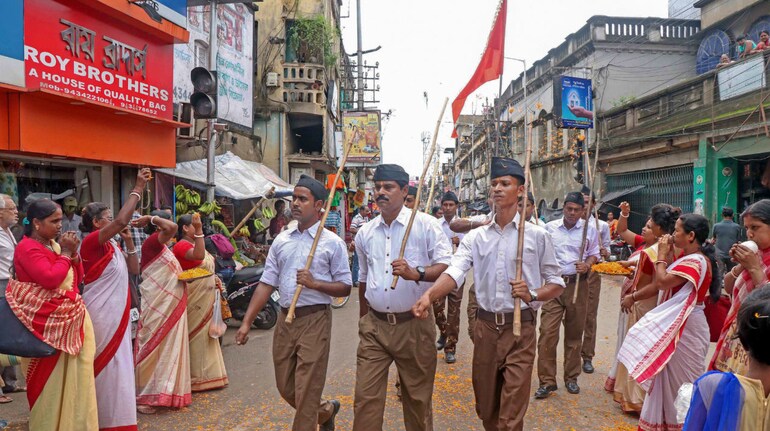
The Central government has lifted the ban on the government employees joining the Rashtriya Swayamsevak Sangh (RSS). This ban was imposed by the Indira Gandhi-led Congress government in 1966. Several Opposition parties led by Congress have objected to the Central government orders.
This despite the fact that there have been several judgements since then which allowed the government employees not to be penalised for being part of the RSS as the Courts considered it to be a lawful socio-cultural organisation.
To give an example, the Madhya Pradesh High Court had delivered a decision regarding this and when the then Congress government objected to it, the Supreme Court rejected the objection of the state government (Petition for Special Leave to Appeal Civil No. 4679/1980).
According to an article written by noted lawyer Alok Kumar and republished in digital edition of the weekly Organiser on July 22, 2024, the Supreme Court while rejecting the petition had observed, “Neither the RSS nor the Jan Sangh is alleged to be engaged in any subversive or other illegal activity; nor are the organisations banned. Most people, including intellectuals, may not agree with the programme and philosophy of the Jan Sangh and the RSS or, for that matter, many other political parties and organisations of an altogether different hue.
But that is irrelevant. Everyone is entitled to his thoughts and views. There are no barriers. Our Constitution guarantees that. In fact, members of these organisations continue to be members of Parliament and. and State Legislatures. They are heard often with respect inside and outside the Parliament. What was wrong in his being a member of an organisation which is not even alleged to be devoted to subversive or illegal activities?”
First ban on the RSS post-independence
The Congress government order to stop the government employees from joining the RSS in 1966 wasn’t a standalone order. The Congress, worried, over the growing influence of the RSS especially in the post-independence era had been looking to crush the organisation. The first attempt to that effect was made in 1948 after the assassination of Mahatma Gandhi.
The RSS was falsely implicated and was banned. Mahatma was assassinated on January 30, 1948. Without even holding an enquiry the RSS Sarsanghchalak MS Golwalkar was arrested on February 2, 1948. The RSS was banned through a central government notification on February 4.
Congress stalwart Dwarika Prasad Mishra, who was the Home Minister of Central Provinces at that time, writes in his autobiography, Living in An Era (Pp59), “That Mahatma Gandhi’s assassination gave a handle to unscrupulous politicians to defame and, if possible, to pull down their rivals is difficult to deny.”
Nehru government failed in its attempt to crush the RSS by falsely implicating it and it had to finally lift the ban on the RSS on the midnight of July 11, 1949. Golwalkar was released on July 13, 1949 from Baitul prison. He went straight to Nagpur from there where the RSS had its headquarters.
1966 ban order and JL Kapur Commission
The 1966 order to ban government employees from joining the RSS was part of a larger plan as in 1966, the Congress government headed by then prime minister Indira Gandhi had also set up a new judicial commission to thoroughly probe the assassination of Gandhi. The commission was headed by Justice JL Kapur, a retired judge of the Supreme Court. The commission published its report in 1969 and before that it had examined 101 witnesses and 407 documents. Its key findings were:
‘They (the accused) have not been proved to have been members of the RSS, nor has that organization been shown to have had a hand in the murder.’ (vol. I, p. 186).
‘There is no evidence that the RSS as such was indulging in violent activities against Mahatma Gandhi or the top Congress leaders.’ (vol. I. p. 66).
An Indian civil services officer RN Banerjee, who was the union home secretary at the time of Gandhi’s assassination also deposed before the Kapur Commission. Banerjee categorically said in his deposition that even if the RSS had been banned earlier, it would not have affected the conspirators or the course of events “because they have not been proved to have been members of the RSS nor has that organisation been shown to have a hand in the murder”.
Two more bans
When the Congress couldn’t fix the RSS in 1948, 1966 and 1969, it again hit back in 1975 and banned the RSS during emergency. However, the RSS not only survived that ban but turned the tables on the Congress and led from the front a movement that led to defeat of both the Emergency and the Congress. Another attempt was made by the Congress government at the Centre to ban the RSS in 1992 in wake of the Babri Masjid demolition. But the RSS bounced back again and soon its ideological mentee Bharatiya Janata Party formed the first National Democratic Alliance (NDA) at the Centre.
Earlier RSSFACTS columns can be read here.
Discover the latest Business News, Sensex, and Nifty updates. Obtain Personal Finance insights, tax queries, and expert opinions on Moneycontrol or download the Moneycontrol App to stay updated!
Find the best of Al News in one place, specially curated for you every weekend.
Stay on top of the latest tech trends and biggest startup news.