




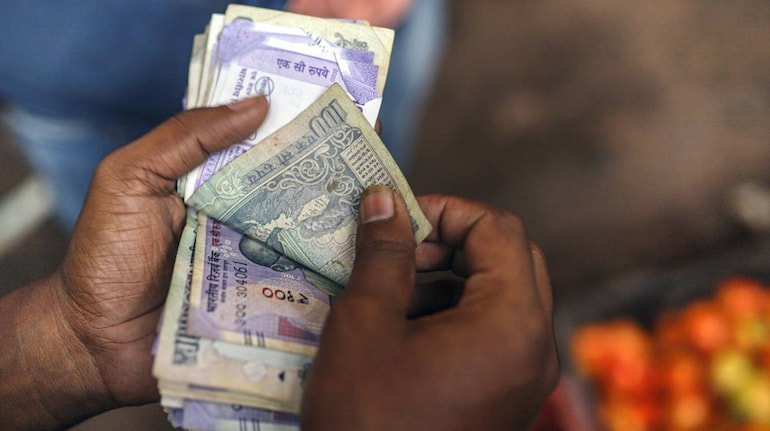
As Finance Minister Nirmala Sitharaman prepares to present the full budget for FY 2024-25 later this month, a critical macroeconomic challenge looms large - the alarming decline in household financial savings rate in India. The latest Financial Stability Report from the Reserve Bank of India (RBI) paints a concerning picture that demands urgent attention in the upcoming budget.
As per the RBI report, net financial savings of Indian households dropped significantly to Rs 14.16 lakh crore in 2022-23, representing a mere 5.3% of GDP, significantly below the 8% average of the preceding decade. The share of net financial savings in total household savings has plummeted to 28.5% in 2022-23, a stark contrast to the 10-year average of 39.8% during 2013-2022. India’s gross savings rate, at 29.7% of gross net disposable income (GNDI) in 2022-23, relies heavily on household savings, contributing 60.9% to aggregate savings.

Source: Crisil (2024), Quickonomics, May 21.
Inadequate interest rates pulled down savingsThe declining trend in savings rates can be better understood by closely examining the interest rate dynamics. The real interest rates for deposits and the small-savings have decreased since 2010. The average deposit rate (proxied by SBI 3-5 year fixed deposit rate) above the repo rate, historically at 0.81% since 2010, has dropped to zero since the last year.
Similarly, the average Public Provident Fund (PPF) rate above the repo rate has fallen from 2% to 0.6% in the previous five quarters (see figure below). This inadequate rate transmission to deposits and small savings since May 2022, when monetary tightening began, has contributed significantly to the decline in financial savings rates.

Source: Data from RBI & SBI website and old deposit rates are partially collected from newspaper reports
In contrast, the transmission of rates for loans has been highly efficient. The base lending rate of the State Bank of India (SBI), which historically hovered 2.97% above the repo rate, is currently 3.75% higher. This disparity between deposit and lending rates has created a disincentive for savings since the higher cost of acquiring physical assets has created a pinch on the money available for savings.
Savings drive investmentThe budget must consider the broader economic implications of the declining trend in the savings rate. Lower savings translate to decreased money available for investment by the private sector. The slower growth in bank deposits results in relatively less money available for private sector loans, which remain the primary source of capital expenditure for Indian companies. Moreover, as small savings collections directly contribute to the government treasury, a decrease in their growth impacts government expenditure.
The shift towards physical assets and away from financial instruments threatens to create a savings-investment gap that not only poses a formidable challenge to the government’s ambitious plans for investment-led growth but could severely hamper the economy’s long-term growth potential.
The upcoming budget must, therefore, introduce measures to reverse this trend and incentivize household financial savings. The following measures need consideration.
Five measures to boost savingsFirst, the budget must announce measures to increase the attractiveness of traditional savings instruments. The Finance Minister should consider raising the tax exemption limits on instruments like the Public Provident Fund (PPF) and National Savings Certificates (NSC). For instance, increasing the annual PPF investment limit, through direct tax changes, from the current Rs1.5 lakh to Rs 3 lakh could significantly boost long-term savings.
Second, the budget should seriously consider introducing well-designed inflation-indexed bonds (IIBs) to address a key concern driving savers towards physical assets (bullions and real assets). These instruments can provide a crucial solution for both investors and policymakers in the current high-inflation environment. IIBs, linked to the Consumer Price Index (CPI), can offer real positive returns, providing savers with a hedge against inflation risk. Learning from past attempts in 1997 and 2013, new IIBs should feature a range of tenures, ensure liquidity, provide regular inflation-adjusted cash flows, and, most importantly, be accessible to a wide range of investors through multiple distribution channels. By introducing well-designed IIBs, the government can create a win-win situation: address concerns over inflation, potentially attract more savings into financial instruments, and signal a strong commitment to economic stability.
Third, acknowledging the growing preference for equity investments, the budget should focus on creating a more balanced investment ecosystem. The shift towards equity markets is partly due to the guaranteed returns on small savings and bank deposits falling below the certainty equivalent rate of risky stock market investments.
While this has increased liquidity in the stock market, it has also potentially created a liquidity-driven bubble and resulted in lower growth rates in bank deposits and small savings. Notably, small savings collections (excluding Public Provident Fund or PPF) have declined to Rs 2.0 lakh crore in 2022-23 from Rs 2.6 lakh crore in 2019-20. On the one hand, fresh investments in the stock market have increased through higher SIP investments; on the other hand, net collections in small savings have declined since 2021-22 (see the graph below). Money flowing into stock markets does not play as crucial a role in private investment as does bank deposits.

Source: Data from AMFI and National Savings Institute. NSI data is available only till 2021-22, and AMFI data is available from 2016-17.
To address this, the budget should leverage fiscal tools to encourage diversification in household savings. This could include creating a uniform and all-encompassing capital gain tax regime that creates a balance between stock and traditional instruments (bank deposits and small savings). Using fiscal levers to shape market incentives could foster a more dynamic, market-driven solution to the savings imbalance while aligning with the government’s broader economic objectives. Concomitantly, the government must allocate funds for enhancing financial literacy, emphasizing the importance of diversification in long-term financial planning.
Fourth, the budget should focus on strengthening the pension system to boost long-term savings. Expanding the coverage of the National Pension System (NPS) and increasing the tax benefits associated with it could encourage more individuals, especially in the unorganized sector, to save for retirement. The government could consider raising the additional tax deduction under Section 80CCD(1B) from the current Rs 50,000 to Rs 1 lakh for NPS contributions.
Fifth, the budget must address the structural issues driving households towards physical savings and equity markets. This must include measures to increase the efficiency and transparency of real estate markets, which could reduce the speculative demand for property as a savings instrument. Notably, the BSE Realty Index tracking real estate stocks has dropped over 80% during bubble bursts in the past. Similarly, rationalizing import duties on gold could help, too. The recent surge in gold imports, reaching $3.11 billion in April this year, a staggering 209% increase from the $1 billion recorded in April last year, underscores the urgency of this measure.
ConclusionThe success of these measures will be crucial in determining India’s economic trajectory in the coming years. As we navigate through global uncertainties and domestic challenges, a robust domestic savings base will be our strongest asset in achieving sustainable and inclusive growth. The upcoming budget must seize this opportunity to realign household savings with the nation’s long-term economic objectives, ensuring that the engine of India’s growth is fueled by the financial prudence of its citizens and supported by a balanced and efficient financial system.
Amarendu Nandy is assistant professor, Indian Institute of Management (IIM) Ranchi. Sayantan Kundu is assistant professor, International Management Institute (IMI) Kolkata.Views are personal and do not represent the stand of this publication.Discover the latest Business News, Sensex, and Nifty updates. Obtain Personal Finance insights, tax queries, and expert opinions on Moneycontrol or download the Moneycontrol App to stay updated!
Find the best of Al News in one place, specially curated for you every weekend.
Stay on top of the latest tech trends and biggest startup news.




