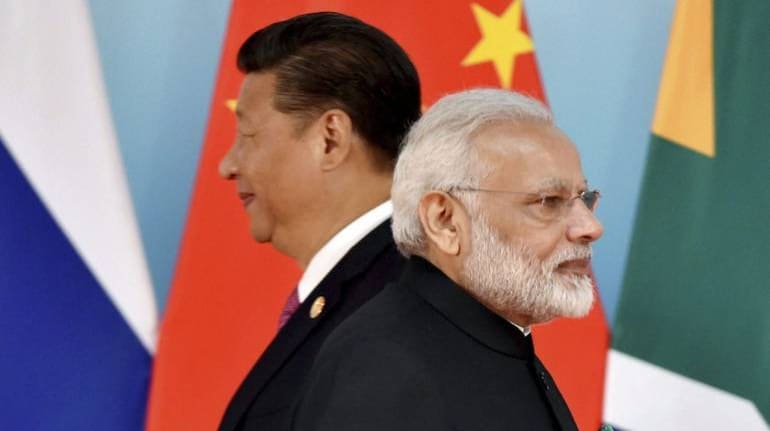
There’s little doubt that the Chinese land grab in Ladakh is a pre-meditated act of aggression. There’s been speculation whether it’s due to the building of roads and the beefing up of military infrastructure on India’s side of the line of control. That may well have been the immediate trigger.
An assertive China
But Chinese aggression isn’t directed only towards India. Chinese warplanes entered Taiwan’s air defence zones at least thrice last week, Vietnam says one of its fishing boats was attacked by the Chinese navy recently, the Chinese regime has vowed to take action against democracy supporters in Hong Kong, Chinese ships have been seen near the disputed Senkaku islands near Japan in the East China Sea and Chinese and Malaysian vessels faced off in the South China Sea.
These are all signals of an assertive China, which will not think twice about flexing its muscles, whether military or economic. China has retaliated against Australia’s asking for an investigation into the origins of the coronavirus by banning beef imports from that country and slapping high tariffs on Australian barley.
The battle for hegemony
The broad background of these conflicts is well-understood. US economic might has steadily declined, while that of China has increased. The International Monetary Fund database shows the share of world GDP for China and the US, based on purchasing power parity (PPP), which adjusts for the varying prices of goods and services in different economies. At the beginning of this century, the IMF data say China was 7.4 percent of the world economy while the US was 20.4 percent.
By 2019, China accounted for an estimated 19.3 percent of global GDP, higher than the US share of 15.1 percent. To be sure, this is in PPP terms and the US economy is still numero uno when measured in dollars. But it does bring out starkly the rise of China and the relative decline of the US.
The Chinese have also moved up the value chain in cutting-edge technologies such as artificial intelligence and 5G telecom, so much so that the US is now worried that its lead in technology is under threat. The Made in China 2025 policy aims to make 70 percent of high-tech products indigenously by 2025.
Chinese president Xi Jinping has made no secret of his project to achieve China’s ‘national rejuvenation’ after a ‘century of humiliation’. At a speech last year, Xi said, ‘….for those that deter China’s realisation of a great national rejuvenation, we will wage a determined struggle against them as long as they are there. And we must win the struggle.’ The time seems to have come for China to drop Deng Xiaoping’s policy of ‘hiding your strength, biding your time’ and instead flaunt China’s strength. It believes its hour has come at last.
To be sure, the US is far from being a spent force. It still has by far the most powerful military in the world. The trouble is the US under Trump has opted out of its role as global leader. It has torn up trade deals with allies, it has said they don’t contribute enough money for NATO and other defence arrangements and it has withdrawn from multilateral agreements. The upshot: US global leadership has been replaced by a clutch of regional leaders, all vying for power.
A recent Bloomberg article said the Chinese are rooting for four more years
of a Trump presidency, on the premise that what China will lose by way of trade will be more than made up by the erosion of US alliances under Trump.
A crisis of Western capitalism?
But it’s far from being all about Trump. As long as global growth was chugging along fine, everything was hunky-dory. US businesses outsourced production to China, China invested its surpluses in the US. Historian Niall Ferguson coined the term ‘Chimerica’ to refer to the symbiotic relationship between China and the US.
The global financial crisis changed all that. After the crisis, as global growth fell, the cracks that had been papered over during the boom years were exposed. Increasingly, it was each country for itself. China came out of the crisis thanks to massive spending on infrastructure. But the stimulus only worsened China’s problems of overproduction and debt. Xi’s way out was the Belt and Road Initiative, which served as an outlet for its excess capacity and also, in the process, promoted an economic system under China’s leadership.
The US has reacted with security arrangements such as the Quad—an informal alliance between the US, India, Japan and the US. Trump has shifted focus from the so-called ‘War on Terror’ to Great Power Rivalry, calling China and Russia ‘revisionist powers’ and a threat to US pre-eminence.
Also Read: Amid border tension with China, what does India's UNSC non-permanent member seat mean?
The pandemic has made things worse. Debt is going up in all countries. Developed economy central banks have reduced interest rates to zero, while in some cases interest rates have become negative. Quantitative easing till infinity seems to be their policy. Nobody knows what will happen when central banks roll back the stimulus. In China, already very high debt levels will rise even further. The loans given for the Belt and Road Initiative may well come home to roost. Supply chains are being recast. Chinese growth has slowed sharply.
The Chinese ruling class believes that Western capitalism has reached an impasse. He Yafei, a former Vice Minister of Foreign Affairs, in an article titled ‘The crisis of capitalism and the evolution of US-China relations’ wrote, ‘the systemic crisis of capitalism has made its way from North America to Europe and other parts of the world. No one knows how long the crisis is going to last and how extensive or profound its impact will be to the political and economic order of the world.’
And further: ‘The capitalist model of development is in trouble. Many countries introduced structural reforms after the 2008 financial tsunami to address their mounting institutional and cyclical difficulties, resulting in widespread slowdown, rising protectionism and sometimes trade wars caused by sentiments like “America First”.
China and the US now face an unpredictable future on trade, which casts a dark shadow over the world economy. Capital’s profit-seeking instinct also stokes financial risks and asset bubbles.’ Of course, the assumption here is that China is not part of the capitalist world. That is hogwash---China is a plutocratic capitalist dictatorship, fascist rather than communist and its economy too is in trouble.
A time of monsters
The central geopolitical rivalry of our time is between a rising China and a US past its prime. Of course, this won't be the first time that global leadership passes from one country to another. Britain, the leading power in the nineteenth century, had to cede its position to the US. The last time the leadership was up for grabs, we had a Depression and two world wars. This time, the wars are unlikely to happen, not only because it will mean nuclear obliteration but also because the economies of the US and China are inextricably intertwined.
But as in the nineteen thirties, the world is increasingly multi-polar, with many powers competing with each other, some for global, some for regional, hegemony. The Chinese aggression in Ladakh is part and parcel of that process, now that India is firmly in the US camp. It’s going to be a period of extraordinary uncertainty.
As Antonio Gramsci wrote in his ‘Prison Notebooks’ between 1929 and 1935, “The crisis consists precisely in the fact that the old is dying and the new cannot be born; in this interregnum a great variety of morbid symptoms appear”. Slavoj Zizek puts that quote much more dramatically: ‘ The old world is dying, and the new world struggles to be born: now is the time of monsters.’
Do write in with your views on Sino-US rivalry to Manas.Chakravarty@nw18.com

Discover the latest Business News, Sensex, and Nifty updates. Obtain Personal Finance insights, tax queries, and expert opinions on Moneycontrol or download the Moneycontrol App to stay updated!
Find the best of Al News in one place, specially curated for you every weekend.
Stay on top of the latest tech trends and biggest startup news.