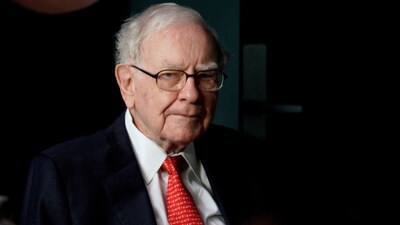
Warren Buffett reminds us of Charlie Munger's greatest investment advice
After Buffett got control of Berkshire, Munger advised him to "add to it wonderful businesses purchased at fair prices and give up buying fair businesses at wonderful prices". This approach that embraced paying up for the right high-quality companies (including, today, a massive stake in Apple Inc.) has worked well for many investors

Byju’s governance failures should force a regulatory overhaul of the startup ecosystem
Till such time as the notional value of the company kept going up, the alarm bells were muted. Between 2019 and 2022, Byju’s valuation climbed from $5.5 billion to $22 billion even though there was clear evidence that all wasn’t well within
Despite Trump win, Nikki Haley still has an important role to play
She should stay in the race as long as she can to accumulate delegates, then use them as leverage to become leader of the anti-Trump faction and exert some influence over the party and Trump’s sycophants. She should never endorse Trump, but give homeless Republicans some hope
India’s ‘No’ at WTO may just mean ‘Not Yet’
From the outside, it’s easy to think of India as an undifferentiated mass of individuals with leaders who turn up in places such as Abu Dhabi to reject everything the rest of the world suggests. But this is the world’s most complex democracy, and sometimes we just have to wait while it fights its internal battles over policy that affects the rest of the world
WTO Ministerial Conference: India’s food security demands a strong stand on the ‘peace clause’
The so-called peace clause, allowing member countries to breach the subsidy limits specified in the WTO Agreement on Agriculture for food security programmes, has not, however, been made a permanent provision. Instead, it gets extended on a temporary basis. The challenge for India is to make this a permanent facility so that disputes aren’t raised at the trade body over breach of subsidy limits
How badly will Sandeshkhali hurt Mamata Banerjee in the upcoming elections?
The Sandeshkhali incidents are a big blow to the Trinamool Congress, which is already on the back foot because of allegations of widespread corruption
Household Consumption Expenditure Survey 2022-23: Decoding who consumes how much
In urban India, the top 10 percent account for a quarter of all consumption
WTO: Time to end monopoly of tech giants, rework food agriculture subsidies framework
Sanghnomics: Swadeshi Jagran Manch (SJM) has been actively involved in discussions at WTO and in various other trade bodies. It watches out and alerts the Indian government to protect national interests in such negotiations and meetings amid conflicting interests and lobbying by multinational companies and governments of developed countries
Has Berkshire Hathaway become too big to grow?
'Size did us in', writes Buffett, meaning that Berkshire Hathaway, finding wonderful businesses that can add meaningful value to the firms is a problem
Stockology: Markets to remain range-bound volatile, big dip cannot be ruled out
Selective buying on dips can be continued, and stocks in extended momentum can be periodically trimmed. On the other hand, volatility will increase during the week, and the possibility of breaking the level of 21,800 is very high.
Japan's stock-market mojo rubs off on me
Former Premier Shinzo Abe's famous three arrows of reform are belatedly hitting their targets. Cultural change is happening with more consistent wage rises, less resistance to mergers and acquisitions and a return to steady inflation. The prospects are not just in equities, but in residential as well as commercial real estate. If ever the US domestic picture falters, Japan is the obvious alternative for fund managers looking for growth, combined with a cheap currency
Smartphones for kids were a Faustian bargain
Children who spend a large part of their formative years in a virtual world are missing out on face-to-face interactions that help to build strong social bonds and resilience. This applies even more to social media, which replicates real-world interactions though removes the filters that modulate behavior in real-world interactions
Putin’s war is decimating the Russian economy
The war’s consumption of able-bodied workers has driven is forcing civilian industries to pay more for scarce labour. To keep inflation in check, the central bank has had to hike its benchmark interest rate to 16%, further squeezing the private sector. The annual budget deficit is about $17 billion, but government's borrowing capacity is of limited use if domestic banks are the only available lenders. Those same banks are increasingly exposed to losses as sky-high interest rates weigh on corporate borrowers
Punjab Budget: Will 2024-25 see a course correction of the last Budget’s failures?
Despite a vision document spelling out the precarious situation of the present and enlisting the steps needed to become a Developed Punjab by 2047, Budget 2023-24 failed to stick to the path of fiscal consolidation, and instead cut back on much needed expenditure needed to sustain human capital, industry and infrastructure
Moneycontrol Pro Panorama | Welcome to the rate cut bingo!
In this edition of Moneycontrol Pro Panorama: RBI faces stiff challenge from stubborn food inflation, India faces a retirement dilemma, investors advised caution as private capex action heats up, airport wheelchair policy needs a revisit, and more
Indian startups’ US IPO listing presents both opportunities and challenges
Despite a more cost-efficient option of listing at GIFT IFSC, challenges such as smaller investor base and evolving regulations make US listings more attractive for Indian companies. However, complying with Sarbanes-Oxley Act, US GAAP and the Foreign Corrupt Practices Act poses complexities and costs, especially for smaller companies
In the age of AI, make sure your brain has a diverse portfolio too
Students find shelter from the AI storm by taking joint degrees that help make them adaptable to a shifting jobs market
Octogenarian Air Passenger’s Death: Why the policy on wheelchairs needs a review
It isn’t uncommon to have as many as 75-80 passengers on one flight seeking wheelchairs – quite a challenging task for airlines to address without delays. Imagine when a number of long-haul flights are bunched within a short span of time. It has been observed that many senior citizens purportedly not requiring a wheelchair also make requests, clogging the pipeline for those who really need it
As India ages, its working population faces a retirement dilemma
As the world embraces larger tech-enabled businesses and embraces diverse social and cultural engagement, the traditional notion of retirement must adapt
Ola Electric’s IPO plans prove that EVs trump ride-hailing as an investment
Over the past five years, Ola has exited several markets and shuttered down many different lines of business such as Ola Money and Ola Foods. Aggarwal is now left with two main lines, the ride-hailing and the EVs
India needs a state supported capital strategy for minerals security
India’s critical mineral strategy seeks to bridge the gap between supply and demand based on multifaceted strategies. It now needs to drive partnerships to secure offshore minerals sources amid an aggressive China and intense competition
Reddit IPO: Company's biggest risk is its reliance on unpredictable users
Where Reddit differs among its tech peers is in its striking dependence on its user base to keep things operational. Reddit must keep its users satisfied and its efforts to expand its limited (and already unpopular) advertising formats could send users packing. 98% of Reddit’s revenue is made up of advertising income. And of that, 26% came from just 10 ad clients in 2023. Investors will be watching this closely and expect more diversity sooner rather than later
China has a quant quake because there’s no Citadel
China's crackdown on quantitative trading shows how inexperienced the Chinese quants are. The country has largely blocked out the world’s best hedge funds. In other words, they were not baptized by the likes of Citadel, which relentlessly sifts out untalented traders and portfolio managers and speeds up industry consolidation in whichever markets they operate. By allowing in the best, Beijing can ensure the bad ones can’t thrive and create havoc
Karnataka’s Misguided MNC Mandate: Putting politics over progress
In today's era of globalisation, states must enhance their competitiveness and refrain from coercing businesses into prioritising local hires for mere statistical representation. If Karnataka is attempting to ensure more Kannada speakers get MNC jobs, the state has to prioritise equipping its residents with high-quality education, skills relevant to current and future job markets, and opportunities for grassroots entrepreneurship
Why India’s attempt to regulate coaching schools is doomed to fail
What is needed is a holistic approach aimed at improving the quality of school education across the board