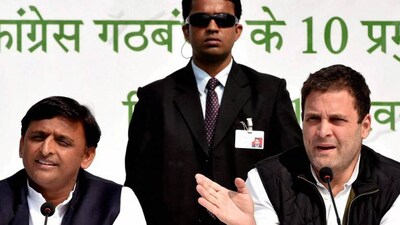
SP-INC weaker than 2019 SP-BSP-RLD alliance, but BJP’s 2024 target of 80/80 in UP gets tougher
The Congress-SP alliance is a reprieve for the INDIA bloc after a series of debilitating jolts. The narrow social base of the alliance, absence of a caste-neutral governance programme, and the low credibility of the Akhilesh-Rahul duo are challenges to be overcome

Japan Stock Market High: Congratulations Nikkei, now don’t screw it up
Those sceptical of the current boom argue that this is nothing more than another instance of a once-a-decade cycle in which interest in Japan is resurgent, but fleeting. But there are good reasons to believe that this time, things are different: Investors are souring on China; problems like the low fertility rate that once seemed unique are now experienced worldwide
The US needs to push Israel, starting at the UN
To get Netanyahu's attention, the US can sponsor a resolution that would formally enshrine the two-state solution in international law as the goal to be pursued by all sides, including Israel. An even more drastic move, if Netanyahu stays intransigent, would be for Washington to recognise a Palestinian state at the UN. That gesture would create facts not on the ground but in international law
Moneycontrol Pro Panorama | A tale of two markets
In this edition of Moneycontrol Pro Panorama: Cocoa price graph turns vertical, February flash PMI shows India in a good position, current earnings trends hint at sustainablity, wait for a robust gig economy before taxing it, and more
Nuclear Energy: India’s private sector plans must get roles-responsibilities and the comms right
Private entry into nuclear energy holds promise. But poorly conceptualised and unclear roles-responsibilities, skewed risk-return frameworks, lack of contractual clarity and effective dispute resolution frameworks have harmed public-private partnerships. Effective communications and informing positive public opinion, a key nuclear energy obstacle, needs addressing. India cannot miss the bus again
The MSP Conundrum: Striking a balance between farmer welfare and economic realities
Despite widespread support for fixing floor prices for all major crops, the current MSP system's effectiveness is limited. MSP for many crops are indicative in nature due to a lack of an effective procurement mechanism. A nuanced strategy, informed by global experiences and focused on efficiency and innovation, is essential for sustainable agricultural growth in India
Flash PMI for February shows best of both worlds for India
The Flash Composite PMI came in at a 7-month high while inflation in input costs as well as selling prices is very low
Good luck catching up to Nvidia
The world’s most valuable chip company is working on its next next-generation AI chip
Japan's 'Magnificent Seven' stock basket that have stood the test of time
Here's a list of seven Japanese companies that say something about modern Japan and the state of Japanese enterprise; enterprises that have stood the test of time or aged better than their US counterparts. Of course, it’s worth remembering that not everyone survives to the end of the 'Seven Samurai'
Does SEBI’s action against TV experts have a basis in law?
In cases such as insider trading or front-running, specific and general regulations exist to prosecute offenders. But in this case, is there a legal or even a commercial basis?
What’s the future of advertising? Ask Sora
Perhaps the most significant short-run use of Sora's one-minute videos will be for advertising — especially internet advertising. The costs of creating new ads are likely to fall. More advertising may sound like a mixed blessing. But ads will almost certainly be more fun and creative than they are now. These ads also might be targeted, rather than serving a mass audience, with your internet history deciding what ads you will see
The Green Pivot | Wall Street gets cold feet on ESG as politics plays spoilsport
The principal argument employed by those against ESG investing is that it diverges from the fiduciary duty of asset managers to ensure the best possible returns for investors
Indian fintech is fast, furious — and problematic
Three fundamental sources of infirmity need fixing. First, the KYC process using Aadhaar must be made credible and secure. Second, since most UPI transactions are free, traditional lenders have little incentive to shorten their technology-upgrade cycle. Third, the monopoly of the National Payments Corporation of India, which runs the UPI, must end. As long as the country’s preferred system for moving money online is devoid of fair charges — and free from competition, there are great risks
Greek Prime Minister’s Visit: Connectivity prospects reboot an ancient dialogue with India
Today, the main pillars of bilateral ties are defence, trade and connectivity. Greece can become an integral part of the India-Middle East-Europe Economic Corridor (IMEEC) and to be India’s gateway to the European Union
Chart of the Day | Cocoa price graph turns vertical as bad weather, hedge funds join forces
While poor weather has led to supply issues, the likelihood of a third successive year of deficit supplies has seen financial bets increase, driving up prices sharply
How sustainable are current trends in earnings?
From a time when earnings disappointed but markets looked past them, now the earnings outlook has brightened but the question is if it’s already priced in
Equity AUM of mutual funds grows 45% in Jan, Tatas lead overall growth matrix
Heightened investor awareness and the growing SIP culture are acting as big pulls for participation in the equity market through MF investing
Don’t tax the gig economy before it becomes robust
Governments must strive to enable new businesses to grow so that there is economic growth resulting in a growing tax base. The cardinal rule is to not start taxing an emerging sector before it has found its feet
Startup Street | From FOMO to IPO: How markets make venture funds dance
The unicorn minting rush of 2021 was on the back of easy-money-fuelled foreign funds like Tiger Global and Softbank. But 2024 is seeing investors, old and new, embrace the siren song of IPOs
Fali Sam Nariman: Till memory fades you will remain in our hearts
It is impossible for words to measure the man who was a constitutionalist, a humanist, an Indian to the core, and the patriot forever ready to protect the fundamental values which made this nation
Byju’s-Paytm Aftermath: Time for National Startup Advisory Council to prove its worth
As controversy grips two of the biggest poster boys of India’s startup arena, there can be no better moment than now for the body constituted by the Department for Promotion of Industry and Internal Trade to demonstrate its usefulness in ensuring that the country’s startup space does not lose its lustre
Moneycontrol Pro Panorama | The premiumisation of the Indian stock market
In today's edition of Moneycontrol Pro Panorama: NBFC regulation needs more work, decoding India’s core inflation fall, RBI pauses rate cuts till inflation stabilises, time to reimagine social security contributions, and more
What will happen to the Madhya Pradesh Congress if Kamal Nath defects?
Many in the MP Congress blame Kamal Nath for the party’s spectacular failure in the 2023 assembly polls. Though his exit would mean the loss of the Chhindwara Lok Sabha seat and a handful of MLAs, the general mood among party workers suggest they are not likely to lament the veteran’s defection
Navalny Death: The poisoner’s recipe for making history
Throughout history, key actors from Augustus Caesar to Napoleon Bonaparte to Alexey Navalny have abruptly vanished from the scene. Many poisoners do get found out but, in its many variations, poison can provide ample room for alibi and denial for those wily enough to use it to manage politics and power
Are energy efficient appliances worth it?
The biggest gains will be made by adding insulation and switching to low-carbon heating, as these investments will have the largest impact on fossil-fuel demand (74% of UK homes are heated with gas). But energy efficiency is a no-brainer climate solution. Improving it not only reduces greenhouse gas emissions but also energy bills. Residential electricity consumption fell by 12% between 2008 and 2018, even as the UK population grew, thanks to improvements in lighting and appliances