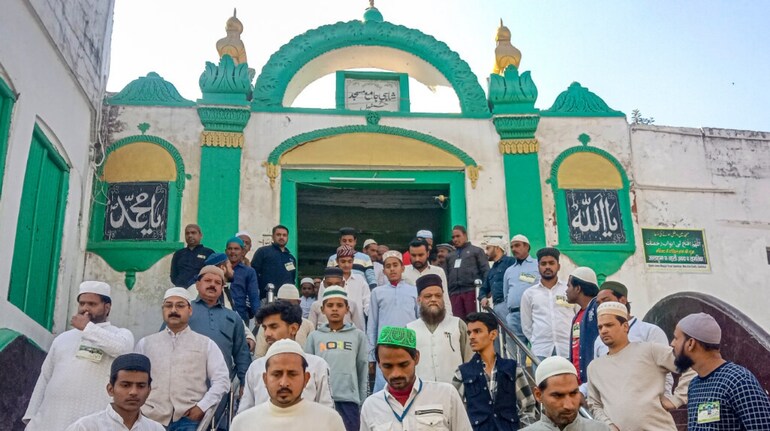
The Uttar Pradesh administration covered 10 mosques, including the historic Jama Masjid in Sambhal, with plastic and tarpaulin sheets ahead of Holi falling on Friday during the Islamic holy month of Ramzan.
The move came amid remarks by a section of ruling BJP leaders and administrative officials instructing Muslims to stay indoors if they have an issue with getting colours.
President of Sambhal Shahi Jama Masjid, Zafar Ali, said that prayers on March 14 will be held at 2.30 pm due to Holi celebrations. Ali also urged members of both communities to celebrate Holi and offer Friday prayers in a harmonious atmosphere.
'Laat Saheb' Holi
Mosques on the route of the traditional 'Laat Saheb' Holi procession in Shahjahanpur have also been covered with tarpaulins and strict security measures put in place.
Following an 18th-century tradition, Holi in Shahjahanpur begins with revellers hurling footwear at a man impersonating 'Laat Saheb' -- a British Lord -- seated on a bullock cart.
The local administration has raised barricades along the procession route and installed several CCTV cameras.
"There are 18 Holi processions in the city, including the two major 'Laat Saheb' processions. To ensure security, the larger procession has been divided into three zones and eight sectors, with around 100 magistrates deployed," Superintendent of Police Rajesh S told PTI.
Police have taken preventive action against 2,423 people to deter potential troublemakers, he said. “The security deployment includes 10 police circle officers, 250 sub-inspectors, around 1,500 police personnel and two companies of the Provincial Armed Constabulary (PAC),” the SP added.
Similarly, in districts such as Mathura, Ayodhya, Varanasi, Meerut, Muzaffarnagar, Saharanpur, Moradabad, Rampur, Aligarh, Agra, Kanpur, Gonda, Bahraich and Siddharthnagar, additional paramilitary forces have been deployed.
"Two tractor trolleys will accompany the procession to collect the discarded shoes, torn clothes and other debris. A sky lift will also be part of the procession and cameras will be positioned at 16 police picket points for video recording and it will be monitored live,” Vikas Khurana, a historian from Swami Sukhdevanand College, told PTI. He traced the origins of the tradition to 1728, when Nawab Abdullah Khan, who had left Shahjahanpur for Farrukhabad, returned to the city on Holi.
"Upon his return, he played Holi with the locals, which became an annual tradition. In 1930, the procession began using camel carts. Over time, its format has evolved," he told PTI.
Khurana further noted that in the 1990s, a petition was filed in the High Court seeking to stop the procession, but the court refused to intervene, ruling it was an old tradition.
(With PTI inputs)
Discover the latest Business News, Sensex, and Nifty updates. Obtain Personal Finance insights, tax queries, and expert opinions on Moneycontrol or download the Moneycontrol App to stay updated!
Find the best of Al News in one place, specially curated for you every weekend.
Stay on top of the latest tech trends and biggest startup news.