






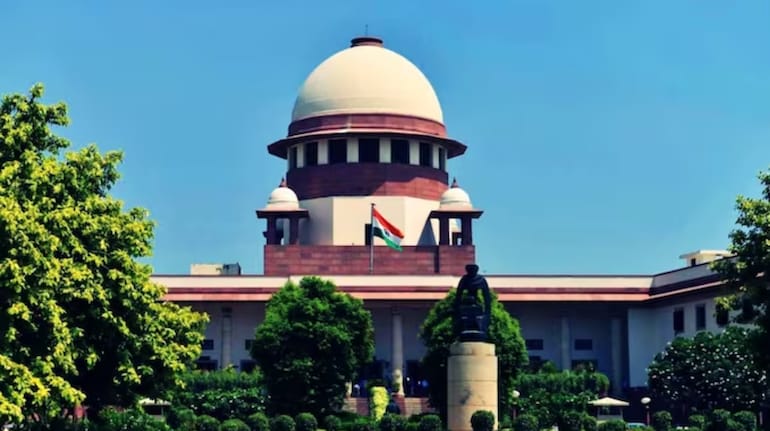

In 2025, the Supreme Court of India often did something unusual even by its own expansive standards -- it acted before anyone knocked on its door. Across the year, the Court invoked its suo motu jurisdiction seventeen times, triggered not by petitions but by discomfort: a news report, a troubling order, a governance vacuum, or conduct that threatened institutional balance.
Read together, these interventions offer a revealing snapshot of where systems failed -- and where the Court felt compelled to fill the gap. From judicial independence to urban safety, environmental collapse to cyber fraud, the story of 2025 is one of a court repeatedly stepping in as a last-resort custodian.
What follows is a thematic retelling of the most consequential of those moments.
Fear, dogs and governance paralysis
One of the year’s most contentious suo motu cases began not with a filing, but with a newspaper story detailing a spike in stray dog attacks, many involving children.
Justice JB Pardiwala took cognisance of the report, describing a collapse of basic urban administration. Animal birth control programmes existed largely on paper, shelters were overcrowded, and authorities appeared unsure of their legal mandate.
From the outset, Justice Pardiwala made his concern explicit. He warned that while animal welfare laws were endlessly invoked, human safety had been sidelined. At one point, he asked whether authorities had become “more afraid of contempt than of dead children.”
The initial directions were sweeping. The Delhi government and civic bodies were ordered to remove stray dogs from all localities, particularly vulnerable zones. The Court warned that obstruction would invite strict consequences, including contempt.
The backlash was immediate and intense. Animal rights groups protested what they saw as judicial sanction for mass displacement. The debate soon shifted from dogs to judicial overreach, empathy, and constitutional tone.
At that point, the case was reassigned to a Bench led by Justice Vikram Nath. What followed was recalibration, not reversal. The Court clarified that it did not endorse indiscriminate removal or killing. The Animal Birth Control Rules, it said, remained the governing framework.
Dogs removed earlier were directed to be released after vaccination and sterilisation. The Bench said that public safety and animal welfare were not opposing goals.
Over time, the scope widened. Stray cattle, unauthorised feeding, unfenced highways and the absence of coordinated urban animal policies came under scrutiny.
When judicial language itself caused harm
Another intervention was triggered not by executive failure, but by judicial reasoning.
An Allahabad High Court judgment diluted charges in a case involving an 11-year-old girl, holding that acts alleged did not show a “determined intent” to commit rape. The reasoning dissected the incident in a manner many found deeply insensitive.
After initial hesitation, the Supreme Court took suo motu cognisance following concerns raised by a civil society organisation. A Bench of Justices BR Gavai and AG Masih stayed the High Court’s order, describing parts of its reasoning as reflecting a “total lack of sensitivity.”
The diluted charges were restored for trial. The case remains pending, with the possibility of broader guidance on judicial language in sexual violence cases.
Guarding the guardians: Lokpal and judicial independence
The year began with the Supreme Court confronting a question that cut to the core of constitutional design: who can hold judges to account, and how?
In February 2025, the Court took suo motu notice of an order by the Lokpal directing a preliminary inquiry against a sitting High Court judge.
A Bench led by then Chief Justice of India BR Gavai said that judges of constitutional courts are subject to carefully designed accountability mechanisms, including impeachment under Articles 124 and 217. Allowing a statutory body to exercise oversight over judges, even at an initial stage, risked unsettling that architecture.
The Court stayed the Lokpal’s directions, observing that permitting such inquiries could have a chilling effect on judicial independence. The issue, it said, raised serious constitutional questions that required authoritative resolution.
The matter remains pending. But the intervention had an immediate effect: it halted a precedent that could have altered the balance between statutory oversight and constitutional autonomy before it took root.
Too late for the forest: When the Court arrived after the damage
Environmental cases often confront the judiciary with a bitter reality -- by the time the alarm is raised, the harm is already irreversible. The Kancha Gachibowli episode near Hyderabad was one such instance.
Media reports revealed extensive tree felling in a forested tract under pressure from rapid urban expansion near the city’s IT corridor. Development, on paper, translated into near-total erasure on the ground.
The Supreme Court took suo motu cognisance after noticing public disclosures that suggested environmental safeguards had been reduced to formalities. It sought explanations from the Telangana government on how permissions were granted, whether statutory processes were followed, and why precaution appeared absent.
Following the Court’s intervention, the State halted further activity.
The case exposed a familiar pattern: fragmented environmental governance where responsibility dissolves across departments. By stepping in, the Court attempted to re-anchor accountability, even if the forest itself could not be restored.
A river reduced to a drain
The Jojari river case was another reminder of environmental neglect normalised over time. Flowing through western Rajasthan before joining the Luni, the river had for years carried untreated effluents and sewage.
By 2025, the pollution was no longer sporadic. The river had effectively become a drain, contaminating groundwater, farmland, and public health.
A Bench led by Justice Vikram Nath took suo motu notice after reports and materials showed the scale of degradation. The Court recorded that Rajasthan’s intensified inspections began only after judicial intervention, observing that such efforts came “years too late.”
Rejecting paper compliance, the Court constituted a High-Level Ecosystem Oversight Committee headed by former Rajasthan High Court judge Justice Sangeet Lodha to supervise restoration.
When lawyers were summoned for lawyering
In July 2025, outrage from the legal community itself prompted one of the year’s most institutionally significant suo motu cases.
The Enforcement Directorate had summoned Senior Advocates Arvind Datar and Pratap Venugopal in a money laundering probe. Their role was professional -- legal opinion and representation. They were not accused of wrongdoing.
Bar associations across the country called it an existential threat to the profession. The Supreme Court responded without waiting for a petition.
A Bench led by ex-CJI BR Gavai framed the issue starkly: can an investigating agency summon a lawyer simply for doing their job?
Although the ED withdrew the summons before detailed hearings, the Court pressed on. In its judgment, it held that summoning lawyers for legal advice or court representation violates attorney-client privilege, now codified under Section 132 of the Bharatiya Sakshya Adhiniyam, 2023.
Privilege, the Court said, is not a benefit for lawyers but a structural requirement of justice. Exceptions exist, but they are narrow and cannot be invoked casually. Even then, procedural safeguards are mandatory.
Fake courts, real fear: Digital arrest scams
One of the most unsettling suo motu cases of 2025 involved fraudsters impersonating the justice system itself.
A senior citizen couple wrote to the Supreme Court describing how they were virtually “arrested” through video calls by people posing as officials of the CBI, the ED, and even the judiciary. Fake Supreme Court orders with forged signatures were displayed. The couple transferred around Rs 1.5 crore under threat.
Recognising a wider pattern targeting elderly citizens across States, a Bench of CJI Surya Kant and Justice Joymalya Bagchi took suo motu cognisance. Describing it as organised cybercrime, the Court handed the probe to the CBI, noting that fragmented State investigations were inadequate.
Defending judges from scandal
The Supreme Court also acted when it felt the line between criticism and scandalisation had been crossed.
In one case, it issued suo motu criminal contempt notices over allegations made against Justice Moushumi Bhattacharya of the Telangana High Court in a transfer petition. The Court called the claims “scurrilous and scandalous” and directed apologies to be tendered before the judge concerned.
In another, it initiated contempt against journalist Ajay Shukla over a YouTube video referring to Justice Bela M Trivedi as a “Godi judge.” The Court said that while criticism is permissible, defamatory allegations amplified on digital platforms damage institutional credibility.
Notably, this was the only suo motu criminal contempt initiated in 2025 -- a signal of restraint alongside resolve.
The Court pauses itself
Perhaps the most telling moment came when the Supreme Court paused its own recent judgment.
During the winter break, it stayed a November ruling that had accepted an elevation-based definition of the Aravalli Hills for mining regulation. A new expert committee was ordered after acknowledging ambiguity and environmental concerns.
Simultaneously, the Court took suo motu notice of forest encroachments in Uttarakhand, halting construction and barring third-party rights.
Discover the latest Business News, Sensex, and Nifty updates. Obtain Personal Finance insights, tax queries, and expert opinions on Moneycontrol or download the Moneycontrol App to stay updated!
Find the best of Al News in one place, specially curated for you every weekend.
Stay on top of the latest tech trends and biggest startup news.










