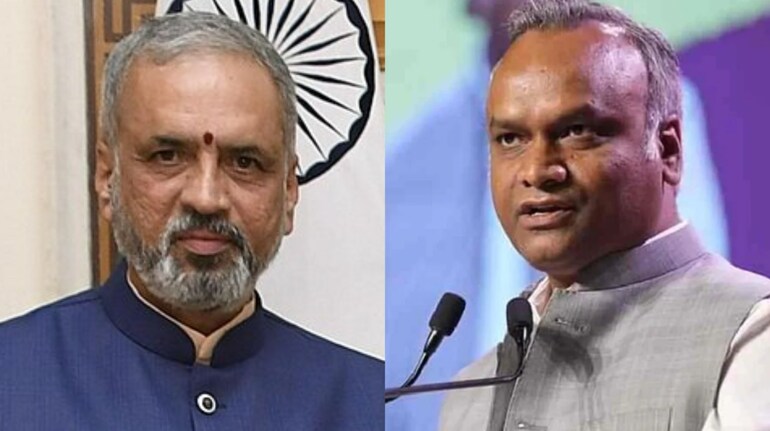
BJP MP and former Karnataka Assembly Speaker Vishweshwar Hegde Kageri stirred controversy after claiming that the national anthem, Jana Gana Mana, was written to welcome the British. Speaking at an event in Honnavara, Karwar, Kageri said he did not wish to “revisit history” but asserted, “There was a strong chorus to make Vande Mataram the national anthem. However, our ancestors decided that along with Vande Mataram, Jana Gana Mana, which was composed to welcome the British, should also be included.”
He went on to stress upon the significance of Vande Mataram in the freedom struggle, saying, “Its contribution remains a great source of inspiration. As we mark its 150th year, we must ensure that Vande Mataram is sung by everyone, especially the youth in schools and colleges across the country.”
The statement prompted a sharp response from Congress leader and minister Priyank Kharge, who labeled the remark a “WhatsApp history lesson” and dismissed it as “utter nonsense.” In a post on X, Kharge wrote, “Another day, another RSS ‘WhatsApp history’ lesson. @BJP4Karnataka MP Sri Kageri now claims our National Anthem is ‘British’. Utter nonsense.”
Kharge further clarified, “Sri Tagore wrote the hymn Bharoto Bhagyo Bidhata in 1911; its first stanza became Jana Gana Mana. It was first sung on 27 Dec 1911 at the Indian National Congress in Calcutta – not as a royal tribute.” He added that Tagore himself had stated in 1937 and 1939 that the song celebrated “the Dispenser of India’s destiny” and “could never be George V, George VI, or any other George.”
The Congress leader took another swipe, urging BJP and RSS members to “revisit history” by studying the editorials of the RSS’s own publication. “The MP says he doesn’t want to revisit history. But I strongly urge every BJP, RSS leader, worker and ‘swayamsevak’ should revisit history by reading the editorials of @RSSorg mouthpiece Organizer and know that RSS has a great tradition of disrespecting the Constitution, the Tricolour and the National Anthem. This viRSS needs to be cured,” Kharge wrote.
The controversy over Jana Gana Mana is not new. Several public figures in the past have made similar claims linking it to British colonial events. Historians, however, have repeatedly clarified that the belief is misplaced.
Rabindranath Tagore composed Bharoto Bhagyo Bidhata on December 11, 1911. The following day, a Delhi Durbar at Coronation Park was held to proclaim King George V as Emperor of India, which led to the mistaken belief that the song was dedicated to the monarch.
In truth, the hymn was first performed on December 28, 1911, during the Indian National Congress session in Calcutta and later at the Adi Brahma Samaj foundation day event in February 1912.
The misunderstanding arose primarily from the word “adhinayaka,” meaning leader. To dispel the confusion, Tagore wrote in 1937 that “neither the Fifth nor the Sixth nor any George could be the maker of human destiny through the ages.” He clarified, “I had hailed in the song Jana Gana Mana that Dispenser of India’s destiny who guides, through all rise and fall, the wayfarers, He who shows the people the way.”
Discover the latest Business News, Sensex, and Nifty updates. Obtain Personal Finance insights, tax queries, and expert opinions on Moneycontrol or download the Moneycontrol App to stay updated!
Find the best of Al News in one place, specially curated for you every weekend.
Stay on top of the latest tech trends and biggest startup news.