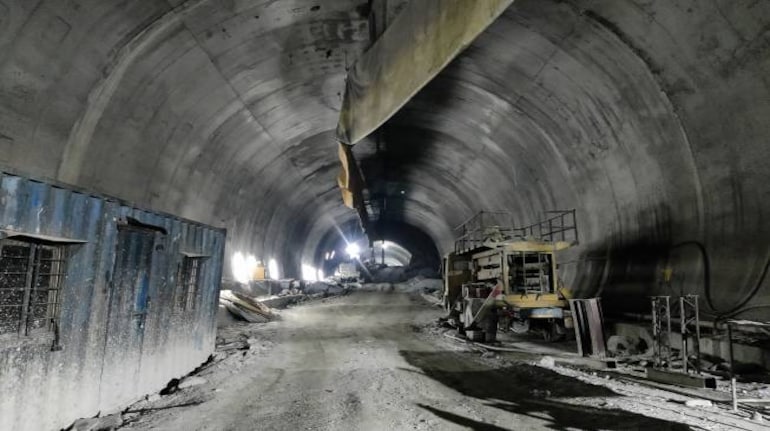
Rescue authorities in Uttarakhand's Uttarkashi expect the 41 workers trapped in an under-construction tunnel on the Char Dham route to be rescued in three days, multiple officials aware of the situation told Moneycontrol.
“As part of the 5-point evacuation plan, we expect workers to start being rescued from the Silkyara tunnel in the next 3 days,” Anshu Manish Khalkho, director, National Highway Infrastructure Development Corp (NHIDCL), told Moneycontrol.
He added that Rail Vikas Nigam (RVNL) has started work on micro-drilling at a distance of 280m to the left of the Silkyara tunnel entrance, also known as evacuation pipe 2, while Satluj Jal Vidyut Nigam (SJVN) has started digging a 1.2 meter from above the tunnel, also known as evacuation pipe 3, which will cover a distance of 320 meters from the entrance to reach the workers.
“Work on evacuation pipes 2 and 3 has started and unless they experience any new obstacle or hurdle, the work is expected to be completed by the 24th of November,” Khalkho said.
ALSO READ: Be sensitive in reportage, avoid sensationalising tunnel rescue operations: Govt to TV channels
Part of the Rs 12,000 crore infrastructure plan to improve connectivity between Char Dham sites, the tunnel collapsed 160 metres from the entrance at Silkyara early in the morning on Diwali (November 12).
Another official from the Ministry of Road Transport and Highways of India (MoRTH) said that Oil and Natural Gas Corporation (ONGC) has also started work on constructing a backup route from the Barkot end to rescue the 41 workers, who have been trapped for the past 11 days.
“At the moment RVNL and SJVN have been given priority in completing the evacuation pipes assigned to them. If work on these pipes moves ahead smoothly, we expect the first worker to be rescued by November 25,” the official said.
He added that the agencies have been advised to not rush the drilling process and work hand in hand with Arnold Dix, president of Geneva-based International Tunnelling and Underground Space Association, in case they encounter any snags in drilling.
Dix, who hails from Australia, is widely recognised as the world’s leading expert on underground tunnelling and issues associated with it from an operational safety perspective.
The Union government has considered five options to rescue the workers, with Tehri Hydro Development Corp, ONGC, RVNL, SJVN, and NHIDCL, each working on an alternative.
Mahmood Ahmed, managing director of NHIDCL, has been stationed in Silkyara and tasked with ensuring coordination with all central agencies.
The State Disaster Response Force, the Defence Research and Development Organisation, the Border Roads Organisation, and the public works department of Uttrakhand are also part of the rescue mission.
Rescue operation so far
The 4,531 metre-long Silkyara tunnel is part of the Chardham project of the Ministry of Road Transport and Highways. Navayuga Engineering Co is constructing it on behalf of the NHIDCL for Rs 853.79 crore.
A portion of the under-construction tunnel, between Silkyara and Dandalgaon on the Brahmakhal-Yamunotri national highway, collapsed at 5:30 am on November 12, trapping 40 workers.
According to the State Disaster Response Force (SDRF), rescue teams were immediately rushed to the spot. They drilled a pipe through the debris and they sent a walkie-talkie to the trapped workers.
The tunnel was being constructed for the benefit of Char Dham pilgrims, as it would cut their travel time by around an hour, avoiding steep, mountainous, and narrow roads prone to accidents and landslides.
The existing road, if widened, would have completely destroyed the rich flora and fauna of the Radi Top mountains, with a thick cover of Rhododendron vegetation.
However, rescue efforts were halted on November 17 at about 2:45 pm after a large cracking sound was detected in the tunnel during the installation of a fifth pipe, according to a statement released that day by NHIDCL.
The sound created panic in the rescue team. An expert involved with the project warned about the possibility of further collapse. Subsequently, the pipe-pushing activity was stopped.
Rescue work was on hold on November 18 as the agencies involved in the effort set up for the next stage and resumed on November 19.
On November 19, a 6-inch pipe was successfully pushed through the collapsed portion of the tunnel, paving the way for larger quantities of food to be supplied to the workers trapped inside, who until then were subsisting on dry rations pushed through a 4-inch pipe.
The Char Dham Highway project, spanning almost 1,000 kilometres, has had substantial environmental repercussions, particularly through the extensive disruption of mountainous ecosystems. Environmentalists have expressed concerns about the project’s extensive construction activity, which they say has potentially exacerbated ecological vulnerabilities in the Himalayan region.
This area is already grappling with the fallout of climate change, which has affected millions. Specialists warn that the intensive drilling involved in the project could further destabilise the already delicate terrain, potentially leading to increased incidents of landslides and flash floods.
How did the tunnel collapse?
While initial media reports suggested that a landslide triggered the collapse, NHIDCL officials say that an investigation is on.
The Uttarakhand government has constituted a six-member expert committee to investigate the Uttarkashi tunnel collapse.
Environmentalists such as Ravi Chopra have pointed out that the use of dynamite and large drills causes landslides and tunnel collapses.
In the development of the Himalayan region, ecological concerns should be addressed first, Chopra said. Sustainable development demands approaches that are both geologically and ecologically sound, he added.
Chopra had resigned last year as chairman of a Supreme Court-appointed high-powered committee on the Char Dham all-weather road, expressing disappointment over an apex court order limiting the panel's jurisdiction to only two ‘non-defence’ stretches of the project.
Harshapati Uniyal, former advisor to the state planning commission, also said that the construction methods for the Char Dham all-weather highway, especially for widening roads, are unacceptable.
“These all-weather roads are a tragedy for Uttarakhand, especially because of the wrong techniques being used for their widening. The river valley alignment cannot be considered safe. If you disturb the slopes, disasters like landslides are inevitable,” said Uniyal.
He added that due to the underground tunnel of the project passing near the hill town, cracks had appeared in nearby buildings and roads.
Social activist Shivanand Chamoli, who has been vocal on these issues, also said that considering the sensitivity of the Himalayas, development projects should be examined from every aspect before permission is given. “If development work is carried out in a haphazard manner, disasters will definitely occur,” he added.
Discover the latest Business News, Sensex, and Nifty updates. Obtain Personal Finance insights, tax queries, and expert opinions on Moneycontrol or download the Moneycontrol App to stay updated!

Find the best of Al News in one place, specially curated for you every weekend.
Stay on top of the latest tech trends and biggest startup news.