




When Captain Pritam Singh rode into Poonch in November 1947, the district was already fraying at the edges. Villages around the town were burning, tens of thousands of civilians were fleeing in panic, and the last road link to Jammu was collapsing under tribal lashkar attacks. By the time snowfall sealed the Pir Panjal passes, Poonch was encircled. What should have been a brief holding action became a 12-month siege, one of the most punishing in the 1947-48 war.
The odds were clear from the start. As the Poonch account records, the garrison was little more than a mix of 1/2 Punjab troops, local levies and hurriedly raised volunteer militias, with scarce weapons, limited ammunition and a population whose numbers swelled overnight into a humanitarian crisis. Into this chaos stepped Pritam Singh, a determined field leader who understood that Poonch could not be abandoned — because if it fell, the western flank of Jammu & Kashmir could unravel with it.
A frontier spiralling into warBy late 1947, tribal forces supported by Pakistani irregulars had overrun large parts of western Jammu & Kashmir. Poonch lay directly in their path. The geography left little room for manoeuvre: a small valley ringed by hills, threaded by a fragile road to Jammu and surrounded by communities now caught between loyalty and fear.
When the lashkars swept across the countryside, the town became a refuge of last resort. The document notes that “tens of thousands” poured into Poonch, overwhelming its stores and clinics even before the real fighting began. What awaited the new garrison commander was not merely a tactical problem. It was the collapse of an entire district in real time.
Pritam Singh reorganises a town under siegeWith outlying posts falling and enemy forces tightening a noose around the valley, Pritam Singh moved quickly. As the file describes, he consolidated the perimeter around the town and its small airstrip, fortified key ridges and turned the battered foothills into a defensive ring built to absorb repeated blows.
Throughout late 1947 and early 1948, the defenders endured wave after wave of attacks. Massed lashkar assaults tried to storm the town. Mortars and captured artillery shells rained on civilian areas. Snipers targeted the approaches. Every land route was cut. Each attack, the record notes, “was repulsed — often narrowly, always at high cost”.
The siege was no longer a temporary emergency. It had become a way of life.
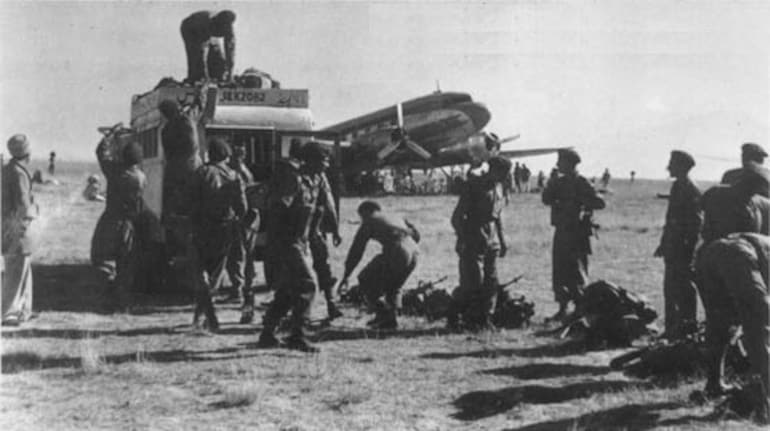
The sky becomes Poonch’s only roadOnce the last land corridor was severed, the only way to keep Poonch alive was through the narrow strip of ground inside the defensive ring. The airstrip was little more than a rough patch of land, exposed to enemy-held heights. Yet it became, as the file puts it, “the town’s only lifeline” — one of the earliest and most daring air-supply missions attempted by independent India.
Dakotas of the Royal Indian Air Force flew in ammunition, rations, medical supplies and reinforcements, and flew out civilians who would otherwise have perished in the winter. Pilots came in low under fire, landed fast, and took off even faster. Some aircraft returned with bullet holes. Others did not return.
Without these flights, Poonch would have fallen in weeks. Instead, the airbridge kept the garrison alive for eleven months — a feat of endurance that matched the resilience of the defenders on the ground.
Civilians become part of the defenceUnlike the dramatic counterattacks that saved Srinagar, Poonch’s story is rooted in slow perseverance. The file makes clear that the defence was impossible without civilians, who dug trenches, carried loads, formed militias, tended to the wounded and survived ceaseless shelling while sharing the same ration shortages as the troops.
There were no safe zones in Poonch. Families lived in makeshift shelters, bracing for the next mortar burst. Food was scarce; disease widespread. Yet the town held together, because surrender meant irreversible collapse. In this sense, Poonch was not a military garrison resisting a siege — it was a whole society doing so.
1948: Enemy pressure tightens, hope thinsBy early 1948, Pakistan’s approach had shifted. The irregular lashkars were now supported by more organised units, including experienced ex-soldiers. Fire grew heavier. Heights around the airstrip were fortified. Night infiltration attempts became frequent. The garrison’s ammunition often ran critically low between airdrops.
Relief attempts from the Jammu-Rajouri axis repeatedly stalled. The Poonch document recounts how narrow passes, destroyed bridges and well-entrenched enemy units thwarted multiple pushes toward the valley throughout the year.
Commanders realised Poonch could not survive another winter on air supply alone. A breakout had to be engineered — not as an expedition but as a rescue.
Operation Easy: Planning the impossibleThe link-up operation that would finally relieve Poonch — Operation Easy — required an audacity equal to the town’s year-long survival. The plan, as laid out in the file, demanded simultaneous thrusts from Rajouri and from Poonch’s defenders, coordinated infantry-armour movement through some of the war’s most treacherous terrain, and diversionary attacks to confuse enemy forces guarding the heights and passes.
For the first time in the western theatre, the Indian Army attempted a large, synchronised manoeuvre involving multiple brigades, engineers and armour in high hill country. It was a measure of how important Poonch had become — not symbolically, but strategically.
Breaking the siegeIn late October 1948, the breakout began. Forces advancing from Rajouri fought through fortified chokepoints, mined roads and deep valleys where armour barely had room to manoeuvre. Engineers worked around the clock to repair destroyed stretches and build bypasses.
Simultaneously, Pritam Singh’s garrison struck outward, capturing ridges that had dominated the town for months. These assaults expanded the defensive perimeter, freed the airfield from enemy observation and aligned the garrison’s advance with the Rajouri column.
On 20 November 1948, after nearly a year of encirclement, the two forces met. Land access to Poonch was restored. The siege was over.
A frontier saved — and remadeThe lifting of the siege reshaped the war. As the Poonch narrative emphasises, holding the town prevented a collapse of India’s western flank; kept Rajouri and Jammu from being threatened; tied down large enemy forces for months; and allowed India to reallocate resources to other sectors before winter offensives began in Naushera, Jhangar, Kargil and Zoji La.
Had Poonch fallen, the war in western Jammu & Kashmir might have unfolded very differently. Its survival transformed a vulnerable district into a strategic bastion — one that still anchors the Line of Control today.
Pritam Singh’s legacy: Endurance as strategyWhat stands out in Poonch’s story is not a single decisive battle but a year of unbroken resolve. Pritam Singh did not have the luxury of manoeuvre, mobility or abundant supplies. His leadership was defined by something more elemental: the refusal to give up a town that seemed indefensible.
He reorganised a scattered garrison, forged unity with civilians, kept morale alive during starvation months, and coordinated his defenders with the first large-scale airbridge of independent India. When the moment came to strike outward, he did so with the same clarity he had shown on the first day of the siege.
Poonch endured because he willed it to — and because thousands of soldiers and civilians stood with him.
Today, the story of Poonch remains one of the finest chapters of the 1947-48 war: a story of leadership under isolation, of a town that refused to break, and of a commander whose reputation as the “Defender of Poonch” was earned ridge by ridge, shell by shell, month by month.
Discover the latest Business News, Sensex, and Nifty updates. Obtain Personal Finance insights, tax queries, and expert opinions on Moneycontrol or download the Moneycontrol App to stay updated!
Find the best of Al News in one place, specially curated for you every weekend.
Stay on top of the latest tech trends and biggest startup news.




