






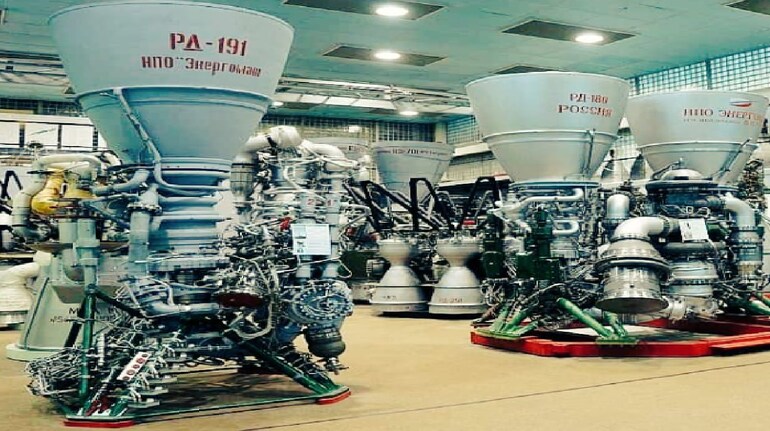
Amid President Vladimir Putin’s visit to India, Russia has agreed to 100% transfer of technology for RD-191M semi-cryogenic rocket engines to the Indian Space Research Organisation, according to Economic Times.
The ET report stated that future space cooperation between the two countries would cover several joint areas, including engine development, crewed missions, orbital stations, personnel training, and rocket fuel.
India’s rockets have traditionally relied on cryogenic engines. These are high-tech machines that burn ultra-cold liquid hydrogen and oxygen. In a quiet revolution, Indian space labs are trying to build semi-cryogenic engines.
What is the RD-191M semi-cryogenic rocket engine?
It is an advanced semi-cryogenic engine from Russia. Semi-cryogenic engines do not use liquid hydrogen and liquid oxygen but operate using Liquid Oxygen (LOX) as the oxidizer, with refined Kerosene, RP-1, as fuel.
Developed by NPO Energomash, the ‘RD-191’ is a workhorse engine used in Russia’s Angara series of rockets.
‘RD-191’ is also a throttleable engine. As a result, it can significantly reduce or increase its thrust mid-flight. This capability enables precise flight control, recovery, and reuse of rocket stages.
The RD-191 is approximately two-and-a-half times more powerful than ISRO’s workhorse Indo-French Vikas engine. The Vikas engine delivers about 60-80 tonnes of thrust while the ‘RD-191’ can deliver between 200 and 220 tonnes of thrust. The Vikas engine is used in India’s PSLV, GSLV, and LVM3 rockets.
Variants of RD-191 (or related engines derived from its design lineage) have been used beyond Russia. The RD-181 is used in the American Antares launch vehicle while the slightly lower-thrust RD-151 are for the South Korean KSLV-1.
How will RD-191 help India?
India’s primary heavy-lift launcher, LVM3 currently uses a combination of solid and cryogenic stages. Acquisition of RD-191 (or a variant) could significantly boost lift capacity, enabling heavier payloads to GTO or allowing greater flexibility in mission design.
The increased capacity is a must for deploying next-generation heavy communication satellites and for undertaking ambitious interplanetary missions such as future Chandrayaan expeditions and the human spaceflight program, Gaganyaan.
As ISRO develops powerful rockets for the future, it can use the Russian ‘RD-191’ engine and associated systems to replace the existing L110 or second stage of the three-stage LVM3 rocket. This will be one step towards significantly enhancing the lifting power of the LVM3 rocket.
With 100% technology transfer, India may gain the potential to export these sophisticated engines to other countries in the future. This will place India in the league of nations, alongside Russia, the United States, and China, which have the capability to develop semi-cryogenic engines.
Discover the latest Business News, Sensex, and Nifty updates. Obtain Personal Finance insights, tax queries, and expert opinions on Moneycontrol or download the Moneycontrol App to stay updated!
Find the best of Al News in one place, specially curated for you every weekend.
Stay on top of the latest tech trends and biggest startup news.









